

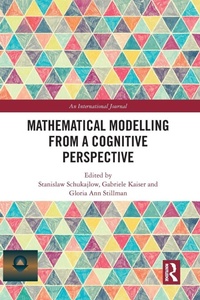
Mathematical Modelling from a Cognitive Perspective
1st Edition
Published on 16. May 2025
Book
Hardback
106 pages
978-1-041-04434-5 (ISBN)
Description
This edited volume provides readers with a snapshot of some of the current thinking on mathematical modelling education. It focuses on the relationship between cognitive and metacognitive activities and student approaches to attempting to solve real-world modelling problems.
This book presents a focused review of some current thinking and research on mathematical modelling education focusing on the relationship between cognitive and metacognitive activities and secondary student approaches to attempting to solve real-world modelling problems. The results of the review highlight areas where theoretical constructs are well advanced and point to areas where development and empirical confirmation are required. Four empirical studies showcase both qualitative and quantitative studies, providing recent findings resulting from a cognitive analysis of student modelling activity in classroom settings or under test conditions. Solving of data-rich modelling tasks, using strategic knowledge about drawing during modelling activities, connecting metacognitive individual strategies, metacognitive group strategies and modelling competencies, and the activation and nurturing of students' mathematical thinking during the solution of a design problem are considered.
The book will be of interest to researchers, teachers and teacher educators and curriculum and educational policy writers. It was originally published as a special issue of Mathematical Thinking and Learning.
This book presents a focused review of some current thinking and research on mathematical modelling education focusing on the relationship between cognitive and metacognitive activities and secondary student approaches to attempting to solve real-world modelling problems. The results of the review highlight areas where theoretical constructs are well advanced and point to areas where development and empirical confirmation are required. Four empirical studies showcase both qualitative and quantitative studies, providing recent findings resulting from a cognitive analysis of student modelling activity in classroom settings or under test conditions. Solving of data-rich modelling tasks, using strategic knowledge about drawing during modelling activities, connecting metacognitive individual strategies, metacognitive group strategies and modelling competencies, and the activation and nurturing of students' mathematical thinking during the solution of a design problem are considered.
The book will be of interest to researchers, teachers and teacher educators and curriculum and educational policy writers. It was originally published as a special issue of Mathematical Thinking and Learning.
More details
Language
English
Place of publication
London
United Kingdom
Publishing group
Taylor & Francis Ltd
Target group
Professional and scholarly
Postgraduate, Undergraduate Advanced, and Undergraduate Core
Dimensions
Height: 260 mm
Width: 183 mm
Thickness: 11 mm
Weight
429 gr
ISBN-13
978-1-041-04434-5 (9781041044345)
Copyright in bibliographic data and cover images is held by Nielsen Book Services Limited or by the publishers or by their respective licensors: all rights reserved.
Schweitzer Classification
Other editions
Additional editions
Stanislaw Schukajlow | Gabriele Kaiser | Gloria Stillman
Mathematical Modelling from a Cognitive Perspective
E-Book
05/2025
Routledge
€73.99
Available for download
Stanislaw Schukajlow | Gabriele Kaiser | Gloria Stillman
Mathematical Modelling from a Cognitive Perspective
E-Book
05/2025
Routledge
€73.99
Available for download
Persons
Stanislaw Schukajlow, Gabriele Kaiser, and Gloria Ann Stillman are active members of the international research community which focuses on researching mathematical modelling education viewing modelling as real-world problem solving. They have extensively edited and contributed to international journals and books on the topic. The latter two editors are past presidents of the International Community of Teachers of Mathematical Modelling and Applications (ICTMA).
Content
Introduction - Modelling from a Cognitive Perspective: Theoretical Considerations and Empirical Contributions 1. Modelling the Phenomenon versus Modelling the Data Set 2. Does Strategic Knowledge Matter? Effects of Strategic Knowledge about Drawing on Students' Modelling Competencies in the Domain of Geometry 3. Metacognition in Mathematical Modelling: the Connection between Metacognitive Individual Strategies, Metacognitive Group Strategies and Modelling Competencies 4. Mathematical Thinking about Systems - Students Modelling a Biometrics Identity Verification System