

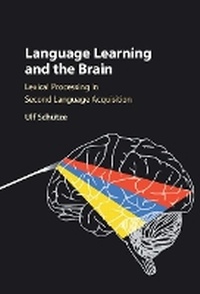
Language Learning and the Brain
Lexical Processing in Second Language Acquisition
Will be published approx. on 31. October 2016
Book
Paperback/Softback
978-1-316-61095-4 (ISBN)
Unfortunately, price unknown
Not yet published
Not available
Description
Every person who encounters or learns another language is faced with the challenge of processing many new words in a short period of time. What are the conditions under which a learner can acquire those words successfully and process them to long-term memory? How do language and memory faculties interact? What role do the senses play in this process? Are factors such as age or individual backgrounds of learners to be considered? Taking the reader on a fascinating journey through the brain to demonstrate how language is processed, Ulf Schuetze explains the dynamic environment involved in recording and producing words. The book also discusses how to use information technology, such as Apps, to make the learning of words entertaining and efficient.
More details
Language
English
Place of publication
Cambridge
United Kingdom
Target group
Professional and scholarly
Illustrations
10 Halftones, black and white
ISBN-13
978-1-316-61095-4 (9781316610954)
Copyright in bibliographic data and cover images is held by Nielsen Book Services Limited or by the publishers or by their respective licensors: all rights reserved.
Schweitzer Classification
Other editions
Additional editions
Book
10/2016
Cambridge University Press
€140.20
Shipment within 15-20 days
Person
Ulf Schuetze is an Associate Professor of Second Language Acquisition in the Department of Germanic and Slavic Studies at the University of Victoria, Canada. His research in computer-assisted language learning, lexical processing, and the sustainability of technology in second language acquisition has been published in journals worldwide.
Content
Introduction; 1. A new word; 2. Memory, language and the brain; 3. Synaptic connections; 4. Cognitive load; 5. First and second language acquisition; 6. The bilingual lexicon and speaker; 7. Spacing; 8. Word analysis; 9. Learning and teaching.