

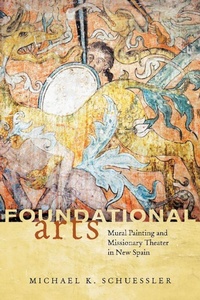
Foundational Arts
Mural Painting and Missionary Theater in New Spain
2nd Edition
Will be published approx. on 30. January 2014
Book
Hardback
224 pages
978-0-8165-2988-9 (ISBN)
Description
The languages of two hemispheres collided when Spain conquered Mexico, and as a result, a dynamic expression of visual and dramatic arts emerged. Mural painting and missionary theater quickly became the media to explain and comprehend the encounter of indigenous peoples with Christ and the crucifixion, as well as with heaven and hell.
In Michael K. Schuessler asserts that the literature of New Spain begins with missionary theater and its intimate relationship to mural painting. In particular, he examines the relationships between texts and visual images that emerged in Mexico at two Augustinian monasteries in Hidalgo, Mexico, during the century following the Spanish Conquest. The forced combination of the ideographical tradition of Nahuatl with Latin-based language alphabets led to a fascinating array of new cultural expressions.
Missionary theater was organized by ingenious friars with the intent to convert and catechize indigenous populations. Often performed in Nahuatl or other local languages, the actors combined Latin-based language texts with visual contexts that corresponded to indigenous ways of knowing: murals, architectural ornamentation, statuary, altars, and other modes of visual representation. By concentrating on the interrelationship between mural painting and missionary theater, Foundational Arts explores the artistic and ideological origins of Mexican plastic arts and literature.
In Michael K. Schuessler asserts that the literature of New Spain begins with missionary theater and its intimate relationship to mural painting. In particular, he examines the relationships between texts and visual images that emerged in Mexico at two Augustinian monasteries in Hidalgo, Mexico, during the century following the Spanish Conquest. The forced combination of the ideographical tradition of Nahuatl with Latin-based language alphabets led to a fascinating array of new cultural expressions.
Missionary theater was organized by ingenious friars with the intent to convert and catechize indigenous populations. Often performed in Nahuatl or other local languages, the actors combined Latin-based language texts with visual contexts that corresponded to indigenous ways of knowing: murals, architectural ornamentation, statuary, altars, and other modes of visual representation. By concentrating on the interrelationship between mural painting and missionary theater, Foundational Arts explores the artistic and ideological origins of Mexican plastic arts and literature.
More details
Edition
2nd edition
Language
English
Place of publication
Tucson
United States
Product notice
Unsewn / adhesive bound
Cloth over boards
With dust jacket
Illustrations
35 photographs
Dimensions
Height: 236 mm
Width: 156 mm
Thickness: 25 mm
Weight
478 gr
ISBN-13
978-0-8165-2988-9 (9780816529889)
Copyright in bibliographic data and cover images is held by Nielsen Book Services Limited or by the publishers or by their respective licensors: all rights reserved.
Schweitzer Classification
Person
Michael K. Schuessler is a professor of humanities at the Universidad Autonoma Metropolitana, Cuajimalpa, in Mexico City. He is the author of Elena Poniatowska: An Intimate Portrait and the editor of Peregrina: Love and Death in Mexico, among other works dedicated to the history and culture of Mexico.