

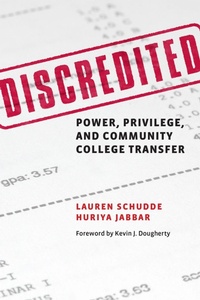
Discredited
Power, Privilege, and Community College Transfer
Published on 3. September 2024
Book
Paperback/Softback
180 pages
978-1-68253-904-0 (ISBN)
Description
An incisive investigation of the often fraught student-transfer pathways from community colleges to four-year institutions-and a blueprint for process reform
In Discredited, education scholars Lauren Schudde and Huriya Jabbar illuminate the successes and failures of the systems that support student transfer among postsecondary institutions. Summarizing the key challenges of various transfer pathways, Schudde and Jabbar show how the current decentralized, bureaucracy-ridden, and often confusing process undermines equity and access in higher education. They illustrate how transfer success is closely tied to how educational institutions disseminate information about credit portability, especially for vertical transfer between community colleges and destination universities, in which prospective transfer students often confront hidden curricula and unfounded biases about their academic preparedness.
This deeply considered work is grounded in hundreds of interviews of students and personnel, data from a six-year longitudinal study in Texas, and a synthesis of five decades of research on college transfer. Presenting a field perspective, Schudde and Jabbar use strategic action fields, a framework that considers how rules and norms are maintained in an existing power structure, to examine the political-ecological contexts in which transfer-intending students and transfer-related college personnel interact within and across organizations. They frame transfer policy as a complex public higher education issue rather than an isolated community college problem.
Schudde and Jabbar call for transfer reform and offer insight into how transfer outcomes could be improved through better transparency, centralized policy, and even government intervention.
In Discredited, education scholars Lauren Schudde and Huriya Jabbar illuminate the successes and failures of the systems that support student transfer among postsecondary institutions. Summarizing the key challenges of various transfer pathways, Schudde and Jabbar show how the current decentralized, bureaucracy-ridden, and often confusing process undermines equity and access in higher education. They illustrate how transfer success is closely tied to how educational institutions disseminate information about credit portability, especially for vertical transfer between community colleges and destination universities, in which prospective transfer students often confront hidden curricula and unfounded biases about their academic preparedness.
This deeply considered work is grounded in hundreds of interviews of students and personnel, data from a six-year longitudinal study in Texas, and a synthesis of five decades of research on college transfer. Presenting a field perspective, Schudde and Jabbar use strategic action fields, a framework that considers how rules and norms are maintained in an existing power structure, to examine the political-ecological contexts in which transfer-intending students and transfer-related college personnel interact within and across organizations. They frame transfer policy as a complex public higher education issue rather than an isolated community college problem.
Schudde and Jabbar call for transfer reform and offer insight into how transfer outcomes could be improved through better transparency, centralized policy, and even government intervention.
More details
Language
English
Place of publication
Cambridge
United States
Target group
Professional and scholarly
Product notice
Paperback (trade)
Unsewn / adhesive bound
Dimensions
Height: 208 mm
Width: 137 mm
Thickness: 13 mm
Weight
200 gr
ISBN-13
978-1-68253-904-0 (9781682539040)
Copyright in bibliographic data and cover images is held by Nielsen Book Services Limited or by the publishers or by their respective licensors: all rights reserved.
Schweitzer Classification
Other editions
Additional editions
E-Book
06/2024
Harvard Education Press
€26.49
Available for download
Persons
Lauren Schudde is an associate professor of educational leadership and policy at The University of Texas at Austin. She studies how to ameliorate social inequities in the United States through higher education policy.
Huriya Jabbar is an associate professor of education policy in the Rossier School of Education at the University of Southern California. Her research uses sociological and critical theories to examine how market-based ideas in PK- 12 and higher education shape inequality, opportunity, and democracy in the US.
Huriya Jabbar is an associate professor of education policy in the Rossier School of Education at the University of Southern California. Her research uses sociological and critical theories to examine how market-based ideas in PK- 12 and higher education shape inequality, opportunity, and democracy in the US.