

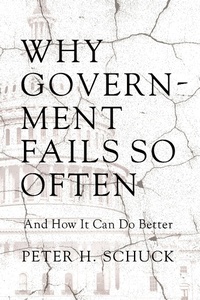
Why Government Fails So Often
And How It Can Do Better
Published on 25. August 2015
Book
Paperback/Softback
488 pages
978-0-691-16853-1 (ISBN)
Description
From healthcare to workplace and campus conduct, the federal government is taking on ever more responsibility for managing our lives. At the same time, Americans have never been more disaffected with Washington, seeing it as an intrusive, incompetent, wasteful giant. Ineffective policies are caused by deep structural factors regardless of which party is in charge, bringing our government into ever-worsening disrepute. Understanding why government fails so often--and how it might become more effective--is a vital responsibility of citizenship. In this book, lawyer and political scientist Peter Schuck provides a wide range of examples and an enormous body of evidence to explain why so many domestic policies go awry--and how to right the foundering ship of state. An urgent call for reform, Why Government Fails So Often is essential reading for anyone curious about why government is in such a disgraceful state and how it can do better.
Reviews / Votes
Honorable Mention for the 2015 PROSE Award in Government & Politics, Association of American Publishers Selected for the Claremont Review of Books CRB Christmas Reading List 2015 "[A] sweeping history of policy disappointments."--David Leonhardt, New York Times "In Why Government Fails So Often, Peter H. Schuck takes up this vital question in what amounts to a systematic survey of the limits of American public administration. It is a profound book, and a sobering one... Peter H. Schuck has written an essential manual for 21st-century policy makers."--Yuval Levin, Wall Street Journal "Schuck does a beautiful job of laying out all the problems with government intervention... [T]here are many gems in this book."--David Henderson, Econlog "Schuck makes a compelling case that many domestic programs, including those that have considerable public support among Republicans as well as Democrats, deliver benefits at costs that are much higher than necessary and contain damaging unintended consequences."--Glenn Altschuler, Boston Globe "Anyone who wants clear insight into government's modern wayward momentum, and its toll on society, should hear Peter Schuck... His recommendations for change are refreshing."--Colorado Springs Gazette "This lively and authoritative account of government failure deserves to be read by advocates of all political persuasions... This admirable work offers compelling evidence that government might do far better by doing far less."--Gene Epstein, Barron's "Peter Schuck's new book Why Government Fails So Often provides a thoughtful if pessimistic analysis."--Laura Tyson, Project Syndicate "Peter Schuck's Why Government Fails So Often is one of the most important books of the year and may be one of the most important books of the decade. Although I have seen this prolific author's name over the years, I had never read any of his work. My loss. Fortunately, I have read every page--including endnotes--of his latest book, and it is a tour de force."--David R. Henderson, Regulation "[Why Government Fails So Often] is a timely book in light of the steep declines in the public's regards for government, a Congress that is increasingly hostile to federal programs, and a civil service whose morale keeps sinking lower with every survey. Schuck's analysis helps explain why the government is so reviled and thus helps us think about remedial steps and the kinds of policies that should be avoided in the future."--Timothy B. Clark, Government Executive "Very highly recommended for academic and community library Political Science collections, Why Government Fails So Often: And How It Can Do Better is an impressive work of meticulous scholarship that is so well written and presented that it is equally accessible for political science students and non-specialist general readers with an interest in understanding the mechanics, development, and implementation issues concerning governmental policies on the federal level."--Jack Mason, Midwest Book Review "[S]ubstantive, and important... [R]ealizing exactly where we are is the first step towards moving to a better state of affairs. This volume sets us squarely down that path."--Matt E. Ryan, Public Choice "Schuck's important book reminds us about the allure of expert judgments and the need for public discourse at each step along the traverse of policy formulation and implementation."--David M. Levy and Sandra J. Peart, Journal of Economic LiteratureMore details
Language
English
Place of publication
New Jersey
United States
Product notice
Paperback (trade)
Dimensions
Height: 216 mm
Width: 141 mm
Thickness: 35 mm
Weight
450 gr
ISBN-13
978-0-691-16853-1 (9780691168531)
Copyright in bibliographic data and cover images is held by Nielsen Book Services Limited or by the publishers or by their respective licensors: all rights reserved.
Schweitzer Classification
Other editions
Additional editions
E-Book
07/2015
1st Edition
Princeton University Press
€93.95
Available for download
Person
Peter H. Schuck is the Simeon E. Baldwin Professor of Law Emeritus at Yale University. He is the author or editor of many books, including Agent Orange on Trial, Meditations of a Militant Moderate, Diversity in America, and Understanding America.
Content
Acknowledgments ix CHAPTER 1: Introduction 1 PART 1: The Context of Policy Making 37 CHAPTER 2: Success, Failure, and In Between 39 CHAPTER 3: Policy-Making Functions, Processes, Missions, Instruments, and Institutions 64 CHAPTER 4: The Political Culture of Policy Making 91 PART 2: The Structural Sources of Policy Failure 125 CHAPTER 5: Incentives and Collective Irrationality 127 CHAPTER 6: Information, Inflexibility, Incredibility, and Mismanagement 161 CHAPTER 7: Markets 198 CHAPTER 8: Implementation 229 CHAPTER 9: The Limits of Law 277 CHAPTER 10: The Bureaucracy 307 CHAPTER 11: Policy Successes 327 PART 3: Remedies and Reprise 369 CHAPTER 12: Remedies: Lowering Government's Failure Rate 371 CHAPTER 13: Conclusion 408 Notes 413 Index 463