

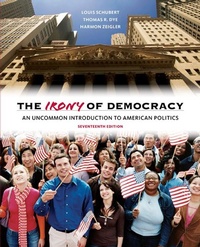
The Irony of Democracy
An Uncommon Introduction to American Politics
17th Edition
Will be published approx. on 1. January 2015
Book
Paperback/Softback
432 pages
978-1-285-87028-1 (ISBN)
Description
The question at the center of the seventeenth edition of THE IRONY OF DEMOCRACY is "How democratic is American society?" While most American government books address politics from a pluralist perspective (the theory that many groups of people share power in the United States), this book approaches the subject using an elitist perspective (the theory that only a tiny number of people make the decisions that shape our lives). By exposing the irony between elitism and democratic theory and modern pluralism, this eye-opening book helps readers understand why the U.S. government works as it does.
More details
Edition
17th edition
Language
English
Place of publication
Belmont, CA
United States
Publishing group
Cengage Learning, Inc
Target group
College/higher education
Product notice
Paperback (trade)
Unsewn / adhesive bound
Dimensions
Height: 229 mm
Width: 183 mm
Thickness: 18 mm
Weight
658 gr
ISBN-13
978-1-285-87028-1 (9781285870281)
Copyright in bibliographic data and cover images is held by Nielsen Book Services Limited or by the publishers or by their respective licensors: all rights reserved.
Schweitzer Classification
Persons
Louis E. Schubert has been Professor of Political Science at City College of San Francisco since 2000. He received his B.A. from the University of Connecticut and his M.A. and Ph.D. from the University of Southern California. He regularly teaches courses on American government, ethnic politics, terrorism and counterterrorism, political theory, and American studies. He has also taught Environmental Politics and Policy, The Presidency, Interest Groups and Elite Behavior, Elections and Political Participation, Political Economy, Parties, PACs and Campaigns, and American Political Thought. He has taught at the University of Southern California, the University of California Riverside, Santa Monica College, and the University of Redlands. Thomas R. Dye is Emeritus Professor of Political Science at Florida State University. He received his B.S. and M.A. from Pennsylvania State University and his Ph.D. from the University of Pennsylvania. He is the author of numerous books and articles on American government and public policy. Dye has served as president of the Southern Political Science Association, president of the Policy Studies Organization, and secretary of the American Political Science Association. He is the recipient of the Harold Laswell Award for career contributions to the study of public policy and the Donald C. Stone Award for career contributions to the study of federalism. He received the Outstanding Alumni Award in 2001 from Penn State's College of Liberal Arts. Dye has taught at the University of Pennsylvania, the University of Wisconsin, and the University of Georgia. He served as visiting scholar at Bar-Elan University, Israel, and the Brookings Institution, Washington, D.C. Harmon Zeigler taught at numerous universities, including Florida State University, Emory University, the University of Georgia, the University of Oregon, State University of New York (Stony Brook), New York University, and the University of Washington. Abroad, he taught at the University of Oslo, Sydney University, and Passau University. In addition to THE IRONY OF DEMOCRACY: AN UNCOMMON INTRODUCTION TO AMERICAN POLITICS, he and Thomas R. Dye wrote AMERICAN POLITICS IN THE MEDIA AGE. His other books include INTEREST GROUPS IN AMERICAN SOCIETY; GOVERNING AMERICAN SCHOOLS (with Kent Jennings); THE QUEST FOR RESPONSIVE GOVERNMENT (with Harvey Tucker); THE POLITICAL COMMUNITY, PLURALISM, CORPORATISM AND CONFUCIANISM; and POLITICAL PARTIES IN INDUSTRIAL DEMOCRACIES. He received two Fulbright awards and was named a Guggenheim Fellow in 1970.
Content
1. The Irony of Democracy.
2. The Elite Consensus of the Founding Fathers: U.S. Political Principles.
3. Elites in America.
4. Masses in the United States.
5. The Media: Elite-Mass Communication.
6. Elections, Parties, and Democracy.
7. Elites and Organized Interests.
8. Congress: The Legislative Elite.
9. The Presidency.
10. Courts: Elites in Black Robes.
11. The Federal Bureaucracy.
12. Federalism: State and Community Elites.
13. Civil Rights: Diversifying the Elite.
14. The United States as Global Elite.
Epilogue: What Can Students Do?
Appendix: The Constitution of the United States of America.
Glossary.
2. The Elite Consensus of the Founding Fathers: U.S. Political Principles.
3. Elites in America.
4. Masses in the United States.
5. The Media: Elite-Mass Communication.
6. Elections, Parties, and Democracy.
7. Elites and Organized Interests.
8. Congress: The Legislative Elite.
9. The Presidency.
10. Courts: Elites in Black Robes.
11. The Federal Bureaucracy.
12. Federalism: State and Community Elites.
13. Civil Rights: Diversifying the Elite.
14. The United States as Global Elite.
Epilogue: What Can Students Do?
Appendix: The Constitution of the United States of America.
Glossary.