

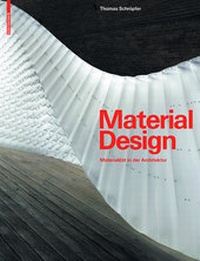
Material Design
Materialität in der Architektur
Published on 1. January 2011
Book
Mixed media product
192 pages
978-3-03821-237-9 (ISBN)
Description
An innovative approach at the world of material performances, operations, and strategies in architectural design
The approach of "Informing Architecture by Materiality" opens the way to an innovative use of materials in the design professions. Taking material qualities and properties such as texture, elasticity, transparency and fluidity as a point of departure, the concept described and employed here transcends the conventional definitions of building materials. Instead, the focus is on a multitude of material operations, like folding and bending, carving and cutting, weaving and knitting, mirroring and screening. The featured design strategies and methods address established and "new" materials alike. They are applied both to the scale of the detail and the entire building. The examples comprise prototype structures as well as large building projects. Eightchapters deal with surfaces and layers, joints and juctions, weaving and texturing, nanoscale transformations, responsiveness, the integration of ephemeral factors like wind and light as well as material collections providing professional resources. Written by reknowned experts in this field, the book features many examples from international contemporary architecture. The introductory part provides the conceptual background, while a final chapter describes consequences for pressing issues of today, like sustainability or life cycle assessment.
Entwurfsstrategien für den architekturbezogenen Einsatz von neuen Materialien
Wenn das professionelle Interesse an neuen Materialien über eine intuitive Faszination hinausgeht, stellt sich die Frage, wie Innovationen aus der Materialerforschung in die Architekturanwendung importiert werden können. Hier setzt dieses grundlegende Buch an. Ausgehend von Materialeigenschaften wie Textur, Elastizität oder Transparenz überwindet es die traditionellen Einteilungen von Werkstoffen zugunsten der Darstellung übergreifender Verarbeitungs- und Verwendungsarten wie Falten und Biegen, Schneiden und Weben, Spiegeln und Projizieren. Die entwurfsorientierten Strategien und Techniken umfassen sowohl die etablierten als als "neue" Materialien. Sie übergreifen alle Maßstäbe vom Detail bis zum Gesamtgebäude. Die Beispiele reichen von Prototypen bis hin zu großen ausführten Projekten der letzten Jahre. In neun Kapiteln werden aus dieser neuen Sicht Oberflächen und Schichtungen, Fügungen und Verbindungen, Gewebe und Texturen, Transformationen mittels reaktiver Materialien und Nanomaterialien, die Integration ephemerer Faktoren wie Wind und Licht sowie die systematische Erschließung von Ressourcen durch Materialsammlungen dargestellt. Einleitend wird die Herausbildung der aktuellen Materialkultur beschrieben. Ein abschließender Teil behandelt den Beitrag der Materialinnovation zu aktuellen Anforderungen von Fragen der Nachhaltigkeit, des Lebenszyklus usw.
The approach of "Informing Architecture by Materiality" opens the way to an innovative use of materials in the design professions. Taking material qualities and properties such as texture, elasticity, transparency and fluidity as a point of departure, the concept described and employed here transcends the conventional definitions of building materials. Instead, the focus is on a multitude of material operations, like folding and bending, carving and cutting, weaving and knitting, mirroring and screening. The featured design strategies and methods address established and "new" materials alike. They are applied both to the scale of the detail and the entire building. The examples comprise prototype structures as well as large building projects. Eightchapters deal with surfaces and layers, joints and juctions, weaving and texturing, nanoscale transformations, responsiveness, the integration of ephemeral factors like wind and light as well as material collections providing professional resources. Written by reknowned experts in this field, the book features many examples from international contemporary architecture. The introductory part provides the conceptual background, while a final chapter describes consequences for pressing issues of today, like sustainability or life cycle assessment.
Entwurfsstrategien für den architekturbezogenen Einsatz von neuen Materialien
Wenn das professionelle Interesse an neuen Materialien über eine intuitive Faszination hinausgeht, stellt sich die Frage, wie Innovationen aus der Materialerforschung in die Architekturanwendung importiert werden können. Hier setzt dieses grundlegende Buch an. Ausgehend von Materialeigenschaften wie Textur, Elastizität oder Transparenz überwindet es die traditionellen Einteilungen von Werkstoffen zugunsten der Darstellung übergreifender Verarbeitungs- und Verwendungsarten wie Falten und Biegen, Schneiden und Weben, Spiegeln und Projizieren. Die entwurfsorientierten Strategien und Techniken umfassen sowohl die etablierten als als "neue" Materialien. Sie übergreifen alle Maßstäbe vom Detail bis zum Gesamtgebäude. Die Beispiele reichen von Prototypen bis hin zu großen ausführten Projekten der letzten Jahre. In neun Kapiteln werden aus dieser neuen Sicht Oberflächen und Schichtungen, Fügungen und Verbindungen, Gewebe und Texturen, Transformationen mittels reaktiver Materialien und Nanomaterialien, die Integration ephemerer Faktoren wie Wind und Licht sowie die systematische Erschließung von Ressourcen durch Materialsammlungen dargestellt. Einleitend wird die Herausbildung der aktuellen Materialkultur beschrieben. Ein abschließender Teil behandelt den Beitrag der Materialinnovation zu aktuellen Anforderungen von Fragen der Nachhaltigkeit, des Lebenszyklus usw.
More details
Persons
Thomas Schröpfer, Singapore University of Technology and Design SUTD.
Thomas Schröpfer ist Associate Professor und Programmdirektor der Architekturabteilung an der Singapore University of Technology and Design SUTD. James Carpenter leitet das Büro James Carpenter Design Associates in New York. Sheila Kennedy leitet das Büro Kennedy & Violich Architecture in Boston und lehrt am Massachusetts Institute of Technology. Toshiko Mori leitet das Büro Toshiko Mori Architects in New York and lehrt an der Graduate School of Design der Harvard University. Liat Margolis ist Landschaftsarchitektin und lehrt an der John Daniels Architecture School der Universität von Toronto. Nader Tehrani leitet das Büro Office dA in Boston und leitet die Architekturabteilung des Massachusetts Institute of Technology. Peter Yeadon leitet das Büro Decker Yeadon in New York und lehrt an der Rhode Island School of Design. Erwin Viray ist Architekt und lehrt an der National University von Singapur.
Thomas Schröpfer ist Associate Professor und Programmdirektor der Architekturabteilung an der Singapore University of Technology and Design SUTD. James Carpenter leitet das Büro James Carpenter Design Associates in New York. Sheila Kennedy leitet das Büro Kennedy & Violich Architecture in Boston und lehrt am Massachusetts Institute of Technology. Toshiko Mori leitet das Büro Toshiko Mori Architects in New York and lehrt an der Graduate School of Design der Harvard University. Liat Margolis ist Landschaftsarchitektin und lehrt an der John Daniels Architecture School der Universität von Toronto. Nader Tehrani leitet das Büro Office dA in Boston und leitet die Architekturabteilung des Massachusetts Institute of Technology. Peter Yeadon leitet das Büro Decker Yeadon in New York und lehrt an der Rhode Island School of Design. Erwin Viray ist Architekt und lehrt an der National University von Singapur.