

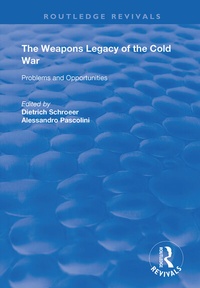
The Weapons Legacy of the Cold War
Problems and Opportunities
1st Edition
Published on 26. February 2020
Book
Paperback/Softback
230 pages
978-1-138-36612-1 (ISBN)
Description
First published in 1997, this volume builds its discussion on a technological base along with policy implications, and constitutes a review of the current situation in international security created by the Cold War, and how the end of the Cold War is likely to change the situation. As the close of the Cold War created a multitude of changes in international security, resulting in a broad range of topics tackled in this collection. It features specialists in military technology, physics, political science, public and international affairs.
More details
Series
Language
English
Place of publication
London
United Kingdom
Publishing group
Taylor & Francis Ltd
Target group
College/higher education
Dimensions
Height: 219 mm
Width: 152 mm
Weight
450 gr
ISBN-13
978-1-138-36612-1 (9781138366121)
Copyright in bibliographic data and cover images is held by Nielsen Book Services Limited or by the publishers or by their respective licensors: all rights reserved.
Schweitzer Classification
Other editions
Additional editions
Dietrich Schroeer | Alessandro Pascolini
The Weapons Legacy of the Cold War
Problems and Opportunities
Book
06/2019
1st Edition
Routledge
€55.89
Shipment within 10-20 days
Dietrich Schroeer | Alessandro Pascolini
The Weapons Legacy of the Cold War
Problems and Opportunities
E-Book
01/2019
1st Edition
Routledge
€16.99
Available for download
Dietrich Schroeer | Alessandro Pascolini
The Weapons Legacy of the Cold War
Problems and Opportunities
E-Book
01/2019
1st Edition
Routledge
€16.99
Available for download
Persons
Schroeer, Dietrich; Pascolini, Alessandro
Content
1. The Future of High Technology in Military Affairs. Dietrich Schroeer. 2. The Impact of the Military-Industrial Complex on Society. Gert G. Harigel. 3. Problems of Reconversion from the Military to the Civilian Sector. Georgi Arbatov. 4. US-Russian Cooperation on Fissile Material Security and Disposition. Frank von Hippel and Oleg Bukharin. 5. Unintentional Nuclear Fire after the Cold War and Arms Control. Ciro E. Zoppo. 6. Nuclear Disarmament: the View from Russia. Anatoli S. Diakov. 7. Implications of the Comprehensive Nuclear Test Ban for Nuclear Modernization and Proliferation. Eric Arnett. 8. A Nuclear Weapon-free World: Is it Desirable? Is it Possible? Is it Probable? Francesco Calogero. 9. Post-Cold War Weapons Reduction: The Role of NATO. Lamberto Zannier. 10. The New Verification Game and Technologies at our Disposal. Patricia Lewis. 11. The Open Skies Treaty: A Cooperative Approach to Confidence Building and Verification. Hartwig Spitzer. 12. Russia's Nuclear Policy after the USSR. Ioury E. Federov. 13. Implications of the Cold War Military Legacy in Northern Europe. Arto Nokkala. 14. The New World Order and the Tempo of Militant Islam. Hilal Khashan.