

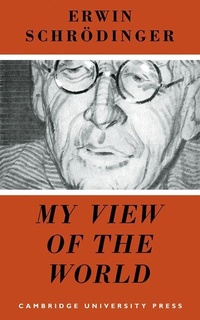
My View of the World
Published on 27. November 2008
Book
Paperback/Softback
120 pages
978-0-521-09048-3 (ISBN)
Description
A Nobel prize winner, a great man and a great scientist, Erwin Schroedinger has made his mark in physics, but his eye scans a far wider horizon: here are two stimulating and discursive essays which summarize his philosophical views on the nature of the world. Schroedinger's world view, derived from the Indian writings of the Vedanta, is that there is only a single consciousness of which we are all different aspects. He admits that this view is mystical and metaphysical and incapable of logical deduction. But he also insists that this is true of the belief in an external world capable of influencing the mind and of being influenced by it. Schroedinger's world view leads naturally to a philosophy of reverence for life.
More details
Language
English
Place of publication
Cambridge
United Kingdom
Target group
Professional and scholarly
Product notice
Paperback (trade)
Illustrations
Worked examples or Exercises
Dimensions
Height: 203 mm
Width: 127 mm
Thickness: 7 mm
Weight
138 gr
ISBN-13
978-0-521-09048-3 (9780521090483)
Copyright in bibliographic data and cover images is held by Nielsen Book Services Limited or by the publishers or by their respective licensors: all rights reserved.
Schweitzer Classification
Other editions
Additional editions
Erwin Schrodinger
My View of the World
E-Book
11/2008
Cambridge University Press
€15.99
Available for download

Erwin Schroedinger
My View of the World
Book
01/1951
Cambridge University Press
€1.98
Article exhausted; check for reprint
Erwin Schroedinger
My View of the World
E-Book
01/1951
1st Edition
Cambridge University Press
€17.49
Available for download
Previous edition
Erwin Schroedinger
My View of the World
Book
01/1951
Cambridge University Press
€1.98
Article exhausted; check for reprint
Content
Part I. Seek for the Road: 1. Metaphysics in general; 2. A cheerless balance-sheet; 3. Philosophical wonder; 4. The problem; 5. The Vedantic vision; 6. An exoteric introduction to scientific thought; 7. More about non-plurality; 8. Consciousness, organic, inorganic, mneme; 9. On becoming conscious; 10. The moral law; Part II. What is Real?: 11. Reasons for abandoning the dualism of thought and existence, or mind and matter; 12. Linguistic information and our common possession of the world; 13. The imperfection of understanding; 14. The doctrine of identity: light and shadow; 15. Two grounds for astonishment: pseudo-ethics.