

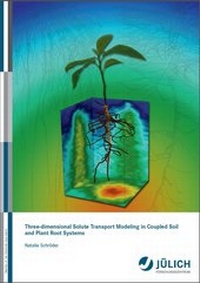
Three-dimensional Solute Transport Modeling in Coupled Soil and Plant Root Systems
Published in March 2014
Book
Paperback/Softback
126 pages
978-3-89336-923-2 (ISBN)
Description
Many environmental and agricultural challenges rely on the proper understanding of
water flow and solute transport in soils, for example the carbon cycle, crop growth, irrigation
scheduling or fate of pollutants in subsoil. Current modeling approaches typically
simulate plant uptake via empirical approaches, which neglect the three-dimensional
(3D) root architecture. Yet, nowadays 3D soil-root water and solute models on plantscale
exist, which can be used for assessing the impact of root architecture and root and
soil hydraulic resistances on the root uptake pattern and solute transport and water flow
in soil.
In this thesis, we used a numerical model, which offers the possibility to describe soil
and root interaction processes in a mechanistic manner avoiding empirical descriptions
of root water uptake as a function of averaged water potential and root length density.
Water flow is simulated along water potential gradients in the soil-root continuum and
the model accounts for solute movement and root solute uptake. Solute movement in
soils is modeled with a particle tracking algorithm. With this model, three research
questions are investigated.
The first study investigates how root water uptake affects the velocity field, and thus the
dispersivity length. The solute breakthrough curves from the three-dimensional results
and different simulation setups were fitted with an equivalent one-dimensional flow and
transport model. The obtained results of the apparent soil dispersivities show the effect
of the plant roots on solute movement, and illustrate the relevance of small scale 3D
water and solute fluxes, induced by root water and nutrient uptake.
Second, we show how local matric and osmotic potentials affect root water uptake. We
analyze the difference between upscaled time and root-zone integrated water potentials,
as often measured in experimental studies, and local water potentials at the root-soil
interface. In addition, we demonstrate the relation between the shape of local stress
function and the global (time-integrated) plant stress response to salinity.
The last part explores how water uptake could be deduced from tracer concentration
distribution monitored in a soil-plant system by magnetic resonance imaging (MRI). We
show the effects of root system architecture, fine roots, and root conductance on solute
and compare numerical and measured data. This shows the capabilities and limitations
of both, the model prediction and the MRI measurement methodology. Furthermore, it
points out the extensive effect of root architecture and its conductance parameters on
solute spreading.