

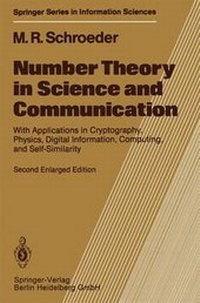
Number Theory in Science and Communication
With Applications in Cryptography, Physics, Digital Information, Computing, and Self-Similarity
2nd Edition
Published on 30. March 1990
Book
Paperback/Softback
XIX, 374 pages
978-3-540-15800-4 (ISBN)
Description
"Beauty is the first test: there is no permanent place in the world for ugly mathematics. " - G. H. Hardy Number theory has been considered since time immemorial to be the very paradigm of pure (some would say useless) mathematics. In fact, the Chinese characters for mathematics are Number Science. "Mathematics is the queen of sciences - and number theory is the queen of mathematics," according to Carl Friedrich Gauss, the lifelong Wunderkind, who himself enjoyed the epithet "Princeps Mathematicorum. " What could be more beautiful than a deep, satisfying relation between whole numbers. (One is almost tempted to call them wholesome numbers') In fact, it is hard to come up with a more appropriate designation than their learned name: the integers - meaning the "untouched ones". How high they rank, in the realms of pure thought and aesthetics, above their lesser brethren: the real and complex number- whose first names virtually exude unsavory involvement with the complex realities of everyday life! Yet, as we shall see in this book, the theory of integers can provide totally unexpected answers to real-world problems. In fact, discrete mathematics is taking on an ever more important role. If nothing else, the advent of the digital computer and digital communication has seen to that. But even earlier, in physics the emergence of quantum mechanics and discrete elementary particles put a premium on the methods and, indeed, the spirit of discrete mathematics.
Reviews / Votes
..."A lighthearted and readable volume with a wide range of applications to which the author has been a productive contributor - useful mathematics given outside the formalities of theorem and proof"... #Scientific American#1More details
Series
Edition
2nd enlarged ed. 1986. Corr. 2nd printing
Language
English
Place of publication
Heidelberg
Germany
Publishing group
Springer Berlin
Target group
College/higher education
Professional and scholarly
Illustrations
81 figures
Dimensions
Height: 23.5 cm
Width: 15.5 cm
Weight
605 gr
ISBN-13
978-3-540-15800-4 (9783540158004)
DOI
10.1007/978-3-662-22246-1
Schweitzer Classification
Other editions
New editions
Manfred Schroeder
Number Theory in Science and Communication
With Applications in Cryptography, Physics, Digital Information, Computing, and Self-Similarity
Book
11/2008
5th Edition
Springer
€80.24
Available immediately
Manfred Schroeder
Number Theory in Science and Communication
With Applications in Cryptography, Physics, Digital Information, Computing, and Self-Similarity
Book
06/1999
3rd Edition
Springer
€85.59
Article exhausted; check for reprint
Previous edition

Manfred R. Schroeder
Number Theory in Science and Communication
With Applications in Cryptography, Physics, Biology, Digital Information, and Computing
Book
06/1985
Springer
€22.54
Article exhausted; check for reprint
Content
A Few Fundamentals.- The Natural Numbers.- Primes.- The Prime Distribution.- Some Simple Applications.- Fractions: Continued, Egyptian and Farey.- Congruences and the Like.- Linear Congruences.- Diophantine Equations.- The Theorems of Fermat, Wilson and Euler.- Cryptography and Divisors.- Euler Trap Doors and Public-Key Encryption.- The Divisor Functions.- The Prime Divisor Functions.- Certified Signatures.- Primitive Roots.- Knapsack Encryption.- Residues and Diffraction.- Quadratic Residues.- Chinese and Other Fast Algorithms.- The Chinese Remainder Theorem and Simultaneous Congruences.- Fast Transformations and Kronecker Products.- Quadratic Congruences.- Pseudoprimes, Möbius Transform, and Partitions.- Pseudoprimes, Poker and Remote Coin Tossing.- The Möbius Function and the Möbius Transform.- Generating Functions and Partitions.- Cyclotomy and Polynomials.- Cyclotomic Polynomials.- Linear Systems and Polynomials.- Polynomial Theory.- Galois Fields and More Applications.- Galois Fields.- Spectral Properties of Galois Sequences.- Random Number Generators.- Waveforms and Radiation Patterns.- Number Theory, Randomness and "Art".- Self Similarity, Fractals and Art.- Self-Similarity, Fractals, Deterministic Chaos and a New State of Matter.