

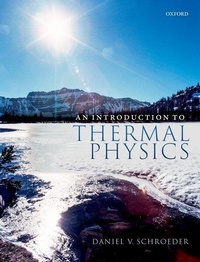
An Introduction to Thermal Physics
Published on 5. January 2021
Book
Paperback/Softback
448 pages
978-0-19-289555-4 (ISBN)
Description
Thermal physics deals with collections of large numbers of particles - typically 10 to the 23rd power or so. Examples include the air in a balloon, the water in a lake, the electrons in a chunk of metal, and the photons given off by the sun. We can't possibly follow every detail of the motions of so many particles. So in thermal physics we assume that these motions are random, and we use the laws of probability to predict how the material as a whole ought to behave. Alternatively, we can measure the bulk properties of a material, and from these infer something about the particles it is made of.
This book will give you a working understanding of thermal physics, assuming that you have already studied introductory physics and calculus. You will learn to apply the general laws of energy and entropy to engines, refrigerators, chemical reactions, phase transformations, and mixtures. You will also learn to use basic quantum physics and powerful statistical methods to predict in detail how temperature affects molecular speeds, vibrations of solids, electrical and magnetic behaviors, emission of light, and exotic low-temperature phenomena. The problems and worked examples explore applications not just within physics but also to engineering, chemistry, biology, geology, atmospheric science, astrophysics, cosmology, and everyday life.
This book will give you a working understanding of thermal physics, assuming that you have already studied introductory physics and calculus. You will learn to apply the general laws of energy and entropy to engines, refrigerators, chemical reactions, phase transformations, and mixtures. You will also learn to use basic quantum physics and powerful statistical methods to predict in detail how temperature affects molecular speeds, vibrations of solids, electrical and magnetic behaviors, emission of light, and exotic low-temperature phenomena. The problems and worked examples explore applications not just within physics but also to engineering, chemistry, biology, geology, atmospheric science, astrophysics, cosmology, and everyday life.
Reviews / Votes
I am a great admirer of Schroeder's book. While writing a graduate textbook in the subject, I studied many books in statistical mechanics, at various levels of sophistication. Of these, Schroeder's text stood out. Indeed, it was the only one I envied -- his sense of fun, his vivid explanations, and his deep insights into conceptual issues. * James P. Sethna, Cornell University, author of 'Statistical Mechanics: Entropy, Order Parameters, and Complexity', Second Edition, OUP 2021 *More details
Edition
1
Language
English
Place of publication
Oxford
United Kingdom
Target group
College/higher education
Illustrations
197 line drawings and halftones
Dimensions
Height: 247 mm
Width: 189 mm
Thickness: 22 mm
Weight
854 gr
ISBN-13
978-0-19-289555-4 (9780192895554)
Copyright in bibliographic data and cover images is held by Nielsen Book Services Limited or by the publishers or by their respective licensors: all rights reserved.
Schweitzer Classification
Other editions
Additional editions
Daniel V. Schroeder
An Introduction to Thermal Physics
Book
01/2021
Oxford University Press
€106.50
Shipment within 15-20 days
Daniel V. Schroeder
An Introduction to Thermal Physics
E-Book
12/2020
1st Edition
OUP eBook
€37.99
Available for download
Person
Daniel V. Schroeder is Professor of Physics at Weber State University in Ogden, Utah, USA. He earned his PhD in Physics at Stanford University, then taught briefly at Pomona College and Grinnell College before coming to Weber State in 1993. He is the coauthor, with Michael E. Peskin, of An Introduction to Quantum Field Theory. From 2012 through 2016 he served as Associate Editor of the American Journal of Physics.
Content
Preface
Part I: Fundamentals
1: Energy in Thermal Physics
2: The Second Law
3: Interactions and Implications
Part II: Thermodynamics
4: Engines and Refrigerators
5: Free Energy and Chemical Thermodynamics
Part III: Statistical Mechanics
6: Boltzmann Statistics
7: Quantum Statistics
8: Systems of Interacting Particles
Appendix A: Elements of Quantum Mechanics
Appendix B: Mathematical Results
Suggested Reading
Reference Data
Index
Part I: Fundamentals
1: Energy in Thermal Physics
2: The Second Law
3: Interactions and Implications
Part II: Thermodynamics
4: Engines and Refrigerators
5: Free Energy and Chemical Thermodynamics
Part III: Statistical Mechanics
6: Boltzmann Statistics
7: Quantum Statistics
8: Systems of Interacting Particles
Appendix A: Elements of Quantum Mechanics
Appendix B: Mathematical Results
Suggested Reading
Reference Data
Index