

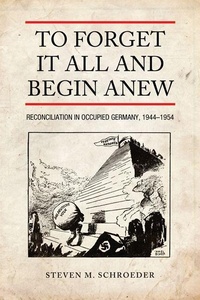
To Forget It All and Begin Anew
Reconciliation in Occupied Germany, 1944-1954
Published on 3. April 2013
Book
Paperback/Softback
256 pages
978-1-4426-1399-7 (ISBN)
Description
Germany's transition from Nazism to peaceful, if at times reluctant, integration into the western and Soviet spheres during the decade immediately following the Second World War is one of the most remarkable events of the twentieth century. Shattered relations between Germans and their wartime enemies and victims had rendered prospects for peaceful relations between these groups unimaginable, or a dream belonging to the distant future. However, numerous grassroots initiatives found varying degrees of success in fostering reconciliation.
Drawing on underutilized archival materials, To Forget It All and Begin Anew reveals a nuanced mosaic of like-minded people - from Germany and other countries, and from a wide variety of backgrounds and motives - who worked against considerable odds to make right the wrongs of the Nazi era. While acknowledging the enormous obstacles and challenges to reconciliatory work in postwar Germany, Steven M. Schroeder highlights the tangible and lasting achievements of this work, which marked the first steps toward new modes of peaceful engagement and cooperation in Germany and Europe.
Drawing on underutilized archival materials, To Forget It All and Begin Anew reveals a nuanced mosaic of like-minded people - from Germany and other countries, and from a wide variety of backgrounds and motives - who worked against considerable odds to make right the wrongs of the Nazi era. While acknowledging the enormous obstacles and challenges to reconciliatory work in postwar Germany, Steven M. Schroeder highlights the tangible and lasting achievements of this work, which marked the first steps toward new modes of peaceful engagement and cooperation in Germany and Europe.
Reviews / Votes
'Both researchers and students will find this book useful as a means of looking beyond the Cold War dynamic and state leaders to understand how prominent individuals, not always for the most altruistic reasons, sought to make Germans respectable again on the world stage after the horrors of Nazism.' - Andrew Demshuk (American Historical Review vol 119:02:2014) 'Schroeder's research successfully introduces into the historiography the work of a number of hitherto neglected post-war institutions based on thorough archival digging, which in itself is an important contribution to the social, political and intellectual history of the period.' - Camilo Erlichman (Reviews in History, 19 June 2014)More details
Series
Language
English
Place of publication
Toronto
Canada
Target group
Professional and scholarly
Product notice
Paperback (trade)
Dimensions
Height: 228 mm
Width: 151 mm
Thickness: 20 mm
Weight
385 gr
ISBN-13
978-1-4426-1399-7 (9781442613997)
Copyright in bibliographic data and cover images is held by Nielsen Book Services Limited or by the publishers or by their respective licensors: all rights reserved.
Schweitzer Classification
Other editions
Additional editions
E-Book
06/2013
1st Edition
University of Toronto Press
€66.95
Available for download
Person
Steven M. Schroeder is a faculty member in the History Department at the University of the Fraser Valley.
Content
Preface
Introduction
1 The German People and Allied Demands: Pressures and Initiatives toward Reconciliation, 1944-1946
2 German Church and Political Groups
3 Steps toward Christian-Jewish Reconciliation
4 Broadening of International Contacts and Reconciliation Work
5 The Politics of Reconciliation in the Two Germanies, 1949-1954
Conclusion
Bibliography
Introduction
1 The German People and Allied Demands: Pressures and Initiatives toward Reconciliation, 1944-1946
2 German Church and Political Groups
3 Steps toward Christian-Jewish Reconciliation
4 Broadening of International Contacts and Reconciliation Work
5 The Politics of Reconciliation in the Two Germanies, 1949-1954
Conclusion
Bibliography