

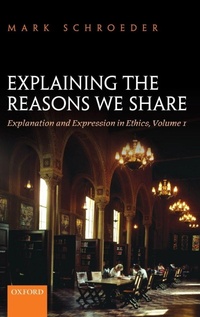
Explaining the Reasons We Share
Explanation and Expression in Ethics, Volume 1
Published on 22. May 2014
Book
Hardback
264 pages
978-0-19-871380-7 (ISBN)
Description
Normative ethical theories generally purport to be explanatory--to tell us not just what is good, or what conduct is right, but why. Drawing on both historical and contemporary approaches, Mark Schroeder offers a distinctive picture of how such explanations must work, and of the specific commitments that they incur. According to Schroeder, explanatory moral theories can be perfectly general only if they are reductive, offering accounts of what it is for something to be good, right, or what someone ought to do. So ambitious, highly general normative ethical theorizing is continuous with metaethical inquiry. Moreover, he argues that such explanatory theories face a special challenge in accounting for reasons or obligations that are universally shared, and develops an autonomy-based strategy for meeting this challenge, in the case of requirements of rationality.
Explaining the Reasons We Share pulls together over a decade of work by one of the leading figures in contemporary metaethics. One new and ten previously published papers weave together treatments of reasons, reduction, supervenience, instrumental rationality, and legislation, to paint a sharp contrast between two plausible but competing pictures of the nature and limits of moral explanation--one from Cudworth and one indebted to Kant. A substantive new introduction provides a map to reading these essays as a unified argument, and qualifies their conclusions in light of Schroeder's current views.
Along with its sister volume, Expressing Our Attitudes, this volume advances the theme that metaethical inquiry is continuous with other areas of philosophy.
Explaining the Reasons We Share pulls together over a decade of work by one of the leading figures in contemporary metaethics. One new and ten previously published papers weave together treatments of reasons, reduction, supervenience, instrumental rationality, and legislation, to paint a sharp contrast between two plausible but competing pictures of the nature and limits of moral explanation--one from Cudworth and one indebted to Kant. A substantive new introduction provides a map to reading these essays as a unified argument, and qualifies their conclusions in light of Schroeder's current views.
Along with its sister volume, Expressing Our Attitudes, this volume advances the theme that metaethical inquiry is continuous with other areas of philosophy.
Reviews / Votes
The papers are characteristically rich in ideas and detail. There is also an introductory chapter in which Schroeder gives a very helpful overview of his philosophical project, explaining how the individual papers hang together ... The papers are characterised by philosophical ingenuity and meticulousness ... I learned a great deal from engaging with Schroeder's papers, and I urge any serious metaethicist, who has not done so already, to do so as well. * Jonas Olson, Notre Dame Philosophical Reviews *More details
Language
English
Place of publication
Oxford
United Kingdom
Target group
College/higher education
Dimensions
Height: 240 mm
Width: 161 mm
Thickness: 19 mm
Weight
564 gr
ISBN-13
978-0-19-871380-7 (9780198713807)
Copyright in bibliographic data and cover images is held by Nielsen Book Services Limited or by the publishers or by their respective licensors: all rights reserved.
Schweitzer Classification
Other editions
Additional editions
E-Book
05/2014
1st Edition
OUP eBook
€17.49
Available for download
E-Book
05/2014
1st Edition
OUP eBook
€18.99
Available for download
Person
Mark Schroeder is the author of Slaves of the Passions (OUP 2007), Being For: Evaluating the Semantic Program of Expressivism (OUP 2008), and Noncognitivism in Ethics (Routledge 2010), as well as over fifty articles in ethics, epistemology, and the philosophy of language. His work has appeared in Ethics, Philosophical Review, Mind, Nous, Philosophy and Phenomenological Research, Oxford Studies in Metaethics, Philosophical Studies, and many other places. He is Professor of Philosophy at the University of Southern California.
Content
PART 1; PART 2; PART 3; PART 4