

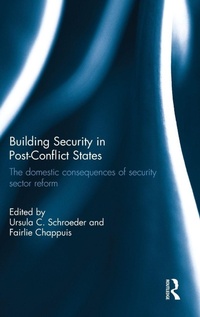
Building Security in Post-Conflict States
The Domestic Consequences of Security Sector Reform
1st Edition
Published on 25. June 2015
Book
Hardback
172 pages
978-1-138-90825-3 (ISBN)
Description
Support for security and justice institutions has become a crucial instrument of international engagement in fragile and conflict-affected states. In attempts to shore up security as a precondition for sustainable peace, international actors have become deeply engaged in reforming the security agencies and security governance institutions of states emerging from conflict. But despite their increasing importance in the field of international peace- and state-building, security sector reform (SSR) interventions remain both highly political and deeply contentious processes. Expanding on this theme, this edited volume identifies new directions in research on the domestic consequences of external support to security sector reform. Both empirically and theoretically, the focus lies on the so far neglected role of domestic actors, interests and political power constellations in recipient states. Based on a wide range of empirical cases, the volume discusses how the often conflictual and asymmetric encounters between external and domestic actors with divergent interests and perceptions affect the consequences of international interventions. By taking into account the plurality of state and non-state security actors and institutions beyond classical models of Weberian statehood, the contributions make the case for engaging more closely with the complexity of the domestic security governance configurations that can result from external engagement in the field of security sector reform.
This book was published as a special issue of International Peacekeeping.
This book was published as a special issue of International Peacekeeping.
More details
Language
English
Place of publication
London
United Kingdom
Publishing group
Taylor & Francis Ltd
Target group
College/higher education
Professional and scholarly
Dimensions
Height: 240 mm
Width: 161 mm
Thickness: 14 mm
Weight
429 gr
ISBN-13
978-1-138-90825-3 (9781138908253)
Copyright in bibliographic data and cover images is held by Nielsen Book Services Limited or by the publishers or by their respective licensors: all rights reserved.
Schweitzer Classification
Other editions
Additional editions
Ursula Schroeder | Fairlie Chappuis
Building Security in Post-Conflict States
The Domestic Consequences of Security Sector Reform
E-Book
10/2017
1st Edition
Routledge
€69.99
Available for download
Ursula Schroeder | Fairlie Chappuis
Building Security in Post-Conflict States
The Domestic Consequences of Security Sector Reform
E-Book
10/2017
1st Edition
Routledge
€69.99
Available for download
Ursula Schroeder | Fairlie Chappuis
Building Security in Post-Conflict States
The Domestic Consequences of Security Sector Reform
Book
06/2017
1st Edition
Routledge
€76.40
Shipment within 10-20 days
Persons
Ursula C. Schroeder is Professor of International Security at the Free University of Berlin, Germany, and directs the research project 'The Politics of State- and Security Building in Areas of Limited Statehood' at the Collaborative Research Center 700: Governance in Areas of Limited Statehood.
Fairlie Chappuis is a Programme Manager in the Geneva Centre for the Democratic Control of Armed Forces research division. Previously, she was a Research Associate at the Collaborative Research Center 700: Governance in Areas of Limited Statehood, at the Free University of Berlin, Germany.
Fairlie Chappuis is a Programme Manager in the Geneva Centre for the Democratic Control of Armed Forces research division. Previously, she was a Research Associate at the Collaborative Research Center 700: Governance in Areas of Limited Statehood, at the Free University of Berlin, Germany.
Content
1. New Perspectives on Security Sector Reform: The Role of Local Agency and Domestic Politics Ursula C. Schroeder and Fairlie Chappuis 2. From Weakness to Strength: The Political Roots of Security Sector Reform in Bosnia and Herzegovina Louis-Alexandre Berg 3. Security Sector or Security Arena? The Evidence from Somalia Alice Hills 4. Reformed or Deformed? Patronage Politics, International Influence, and the Palestinian Authority Security Forces Kimberly Marten 5. Resistance in the Time of Cholera: The Limits of Stabilization through Securitization in Haiti Nicolas Lemay-He 6. Security Sector Reform and the Emergence of Hybrid Security Governance Ursula C. Schroeder, Fairlie Chappuis and Deniz Kocak 7. The International Intervention and its Impact on Security Governance in North-East Afghanistan Jan Koehler and Kristof Gosztonyi 8. Overcoming the State/Non-state Divide: An End User Approach to Security and Justice Reform Lisa Denney 9. From Paternalism to Facilitation: SSR Shortcomings and the Potential of Social Anthropological Perspectives Sabine Mannitz