

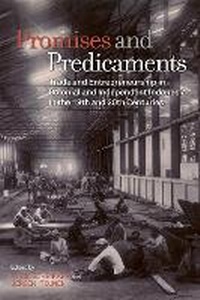
Promises and Predicaments
Trade and Entrepreneurship in Colonial and Independent Indonesia in the 19th and 20th Centuries
Will be published approx. on 31. March 2015
Book
Paperback/Softback
368 pages
978-9971-69-851-5 (ISBN)
Description
Indonesia's trajectory towards successful economic growth has been long and capricious. Studies of the process often focus either on the Netherlands Indies or independent Indonesia, suggesting the existence of fundamental discontinuities. The authors of the 17 essays in this book adopt a long-term perspective that transcends regimes and bridges dualist economic models in order to examine what did and did not change as the country moved across the colonial-postcolonial divide, and shifted from reliance on exports of primary products to a multi-centred economy. The aim is to analyse how economic development grew out of the interplay of foreign trade, new forms of entrepreneurship and the political economy.
The authors deal with entrepreneurship and economic specialization within different ethnic groups, the geographical distribution of exports and resource drains from exporting regions, and connections between an export economy and mass poverty. One recurring issue is the way actors from different ethnic groups occupied complementary niches, highlighting the rich variety of roles played by Asian entrepreneurs. A study of the international sugar trade shows how regime change fostered co-operation between different ethnic groups and nationalities involved in trading networks, inter-island shipping, urban public transport, and the construction sector. A comparison of export earnings and population groups involved in trade before and after 1900 shows that unexpected agricultural and industrial transitions could underpin a fundamental shift in income growth, with improved living standards for broad sectors of the population.
The authors deal with entrepreneurship and economic specialization within different ethnic groups, the geographical distribution of exports and resource drains from exporting regions, and connections between an export economy and mass poverty. One recurring issue is the way actors from different ethnic groups occupied complementary niches, highlighting the rich variety of roles played by Asian entrepreneurs. A study of the international sugar trade shows how regime change fostered co-operation between different ethnic groups and nationalities involved in trading networks, inter-island shipping, urban public transport, and the construction sector. A comparison of export earnings and population groups involved in trade before and after 1900 shows that unexpected agricultural and industrial transitions could underpin a fundamental shift in income growth, with improved living standards for broad sectors of the population.
More details
Language
English
Place of publication
Singapore
Singapore
Target group
Professional and scholarly
Dimensions
Height: 229 mm
Width: 152 mm
Weight
517 gr
ISBN-13
978-9971-69-851-5 (9789971698515)
Copyright in bibliographic data and cover images is held by Nielsen Book Services Limited or by the publishers or by their respective licensors: all rights reserved.
Schweitzer Classification
Persons
Alicia Schrikker is Lecturer in Colonial and Global History at Leiden University, Netherlands.
Jeroen Touwen is Senior Lecturer in Economic and Social History at Leiden University, Netherlands.
Jeroen Touwen is Senior Lecturer in Economic and Social History at Leiden University, Netherlands.