

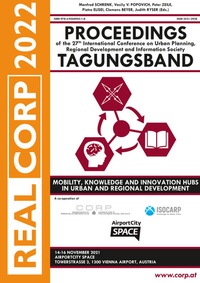
Mobility, Knowledge and Information Hubs in Urban and Regional Development
Proceedings of the 27th International Conference on Urban Planning, Regional Development and Information Society
Published on 16. November 2022
Book
Paperback/Softback
1050 pages
978-3-9504945-1-8 (ISBN)
Description
Mobility hubs are far from being limited to their function as transport hubs. They are multifunctional and versatile places of encounter. In places where many people come together, information and knowledge are exchanged and new ideas are developed. Since mankind has become sedentary, such hubs have formed where the exchange of people, goods, but also ideas and knowledge takes place. With the rise of cities, this process has intensified and today, when almost 60 % of the world's population lives in cities, dealing with this centre function is more important than ever.
New challenges keep emerging that keep us busy maintaining and developing the functions of such hubs:
Societal transformation and changes in population and ageing structures require adjustments to both urban structures and rural areas.
The climate crisis simply does not allow us to continue as before. Ecological footprint, energy performance certificate and climate governance are not mere buzzwords, but important fields of action to steer future developments.
The increasingly easy access to all forms of mobility on land, water and in the air is not only changing our settlement and social structure. The construction and operation of mobility infrastructure is often resource-intensive.
Above all this hovers the sphere of digitisation. Much is already possible without having to physically move for it - data, information and knowledge move instead.
In recent years, the pandemic has shown how quickly our structures can be shaken to their foundations even without "conventional" natural disasters. The diverse reactions and the struggle to return to normality, which continues to this day, have produced some remarkable results.
REAL CORP 2022 addresses the links between society's innovative achievements and the confronting demands of our environment, cities and settlements. In order to achieve acceptable sustainable development, spatial planning and related disciplines need to carefully address current trends and influence them with appropriate governance mechanisms to maintain and improve the quality of life, but also to decisively address the concerns of our ecosystem. We therefore invite contributions from all disciplines involved in urban development in order to analyse the challenges for the future of urban spaces in a holistic manner. In addition to science-based contributions, we also welcome practice-based reports on short-term measures and/or long-term strategies for urban and regional development.
New challenges keep emerging that keep us busy maintaining and developing the functions of such hubs:
Societal transformation and changes in population and ageing structures require adjustments to both urban structures and rural areas.
The climate crisis simply does not allow us to continue as before. Ecological footprint, energy performance certificate and climate governance are not mere buzzwords, but important fields of action to steer future developments.
The increasingly easy access to all forms of mobility on land, water and in the air is not only changing our settlement and social structure. The construction and operation of mobility infrastructure is often resource-intensive.
Above all this hovers the sphere of digitisation. Much is already possible without having to physically move for it - data, information and knowledge move instead.
In recent years, the pandemic has shown how quickly our structures can be shaken to their foundations even without "conventional" natural disasters. The diverse reactions and the struggle to return to normality, which continues to this day, have produced some remarkable results.
REAL CORP 2022 addresses the links between society's innovative achievements and the confronting demands of our environment, cities and settlements. In order to achieve acceptable sustainable development, spatial planning and related disciplines need to carefully address current trends and influence them with appropriate governance mechanisms to maintain and improve the quality of life, but also to decisively address the concerns of our ecosystem. We therefore invite contributions from all disciplines involved in urban development in order to analyse the challenges for the future of urban spaces in a holistic manner. In addition to science-based contributions, we also welcome practice-based reports on short-term measures and/or long-term strategies for urban and regional development.