

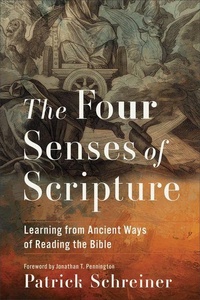
The Four Senses of Scripture
Learning from Ancient Ways of Reading the Bible
Will be published approx. on 4. August 2026
Book
Paperback/Softback
288 pages
978-1-5409-6879-1 (ISBN)
Description
Recovering the Church's Classical Approach to Biblical Interpretation
For nearly 1,700 years, the church read Scripture through four interwoven lenses--literal, allegorical, tropological, and anagogical--known as the quadriga. Modern biblical hermeneutics has largely set this tradition aside. In The Four Senses of Scripture, Patrick Schreiner argues the church hasn't moved beyond the ancient approach so much as it has lost something essential.
Schreiner doesn't reject the grammatical-historical method--he recovers what it leaves behind. This book
? covers all four senses--literal (grammatical-historical), allegorical (Christological), tropological (moral), and anagogical (eschatological)--with the what, why, and how of each;
? traces why early Christians used this method and makes the case for recovering a medieval mind for modern readers;
? demonstrates each sense in practice with examples drawn from across the biblical canon;
? engages exegetical, historical, and allegorical critiques of the quadriga with scholarly rigor; and
? includes an appendix written specifically for church application with scholars, students, and pastors in mind.
Drawing on patristic and medieval exegesis, Schreiner offers a coherent, historically grounded framework for reading Scripture through all four senses in conversation, a method that better honors the nature, goal, and ecclesial context of biblical interpretation. The book includes a foreword by Jonathan T. Pennington.
For nearly 1,700 years, the church read Scripture through four interwoven lenses--literal, allegorical, tropological, and anagogical--known as the quadriga. Modern biblical hermeneutics has largely set this tradition aside. In The Four Senses of Scripture, Patrick Schreiner argues the church hasn't moved beyond the ancient approach so much as it has lost something essential.
Schreiner doesn't reject the grammatical-historical method--he recovers what it leaves behind. This book
? covers all four senses--literal (grammatical-historical), allegorical (Christological), tropological (moral), and anagogical (eschatological)--with the what, why, and how of each;
? traces why early Christians used this method and makes the case for recovering a medieval mind for modern readers;
? demonstrates each sense in practice with examples drawn from across the biblical canon;
? engages exegetical, historical, and allegorical critiques of the quadriga with scholarly rigor; and
? includes an appendix written specifically for church application with scholars, students, and pastors in mind.
Drawing on patristic and medieval exegesis, Schreiner offers a coherent, historically grounded framework for reading Scripture through all four senses in conversation, a method that better honors the nature, goal, and ecclesial context of biblical interpretation. The book includes a foreword by Jonathan T. Pennington.
More details
Language
English
Place of publication
Ada, MI
United States
Publishing group
Baker Publishing Group
Target group
College/higher education
Product notice
Paperback (trade)
Unsewn / adhesive bound
Dimensions
Height: 229 mm
Width: 152 mm
ISBN-13
978-1-5409-6879-1 (9781540968791)
Copyright in bibliographic data and cover images is held by Nielsen Book Services Limited or by the publishers or by their respective licensors: all rights reserved.
Schweitzer Classification
Persons
Patrick Schreiner (PhD, The Southern Baptist Theological Seminary) is professor of New Testament and biblical theology at Midwestern Baptist Theological Seminary in Kansas City, Missouri. He is the author of numerous books, including Matthew: Disciple and Scribe and The Transfiguration of Christ.
Content
Foreword by Jonathan T. Pennington
Part 1: The Four Senses in Preparation
1. The Need for the Four Senses
2. The Four Senses: A House to Live In
3. Recovering a Medieval Mind
Part 2: The Four Senses in Principle
4. Literal: The Grammatical-Historical Sense
5. Allegory: The Christological Sense
6. Tropology: The Moral Sense
7. Anagogy: The Eschatological Sense
Part 3: The Four Senses and Problems
8. Responding to Exegetical Objections
9. Responding to Historical Objections
10. Responding to Allegorical Objections
Conclusion: How the Quadriga Differs from a Modern Reading
Appendix 1: Theses and Controls
Appendix 2: The Quadriga for the Church
Index
Part 1: The Four Senses in Preparation
1. The Need for the Four Senses
2. The Four Senses: A House to Live In
3. Recovering a Medieval Mind
Part 2: The Four Senses in Principle
4. Literal: The Grammatical-Historical Sense
5. Allegory: The Christological Sense
6. Tropology: The Moral Sense
7. Anagogy: The Eschatological Sense
Part 3: The Four Senses and Problems
8. Responding to Exegetical Objections
9. Responding to Historical Objections
10. Responding to Allegorical Objections
Conclusion: How the Quadriga Differs from a Modern Reading
Appendix 1: Theses and Controls
Appendix 2: The Quadriga for the Church
Index