

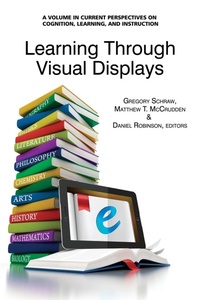
Learning Through Visual Displays
Published on 19. July 2013
Book
Paperback/Softback
460 pages
978-1-62396-233-3 (ISBN)
Description
The purpose of the volume is to explore the theory, development and use of visual displays and graphic organizers to improve instruction, learning and research. We anticipate five sections that address (1) frameworks for understanding different types of displays, (2) research-tested guidelines for constructing displays, (3) empirically-based instructional applications, (4) using displays to promote research and theory development, and (5) using displays to report test and research data to improve consumer understanding. Authors represent a variety of perspectives and areas of expertise, including instructional psychology, information technology, and research methodologies.
The volume is divided into four sections. Section 1 provides a conceptual overview of previous research, as well as the contents of the current volume. Section 2 includes theoretical perspectives on the design and instructional uses of visual displays from major theorists in the field. These chapters discuss ways that visual displays enhance general cognition and information processing. Section 3 provides eight chapters that address the use of visual displays to enhance student learning. These chapters provide examples of how to organize content and use visual displays in a variety of ways in the real and virtual classroom. Section 4 includes three chapters that discuss ways that visual displays may enhance the research process, but especially improved data display.
The volume is divided into four sections. Section 1 provides a conceptual overview of previous research, as well as the contents of the current volume. Section 2 includes theoretical perspectives on the design and instructional uses of visual displays from major theorists in the field. These chapters discuss ways that visual displays enhance general cognition and information processing. Section 3 provides eight chapters that address the use of visual displays to enhance student learning. These chapters provide examples of how to organize content and use visual displays in a variety of ways in the real and virtual classroom. Section 4 includes three chapters that discuss ways that visual displays may enhance the research process, but especially improved data display.
More details
Series
Language
English
Place of publication
Charlotte
United States
Publishing group
Emerald Publishing Inc
Target group
College/higher education
Professional and scholarly
Dimensions
Height: 234 mm
Width: 156 mm
Thickness: 25 mm
Weight
693 gr
ISBN-13
978-1-62396-233-3 (9781623962333)
Copyright in bibliographic data and cover images is held by Nielsen Book Services Limited or by the publishers or by their respective licensors: all rights reserved.
Schweitzer Classification
Other editions
Additional editions
Gregory Schraw | Matthew T. McCrudden
Learning Through Visual Displays
E-Book
07/2013
1st Edition
Information Age Publishing
from
€62.33
Available for download
Persons
Gregory Schraw, University of Nevada - Las Vegas, USA.
Matthew T. McCrudden, Victoria University of Wellington, New Zealand.
Daniel Robinson, Colorado State University, USA.
Matthew T. McCrudden, Victoria University of Wellington, New Zealand.
Daniel Robinson, Colorado State University, USA.
Content
Section I. Introduction
Chapter 1. Visual Displays and Learning: Theoretical and Practical Considerations, Schraw, McCrudden & Robinson
Section II. Theoretical Frameworks
Chapter 2. Some Instructional Consequences of Logical Relations Between Multiple Sources of Information, Low, Jin & Sweller
Chapter 3. Fostering Learning with Visual Displays, Mayer
Chapter 4. Knowledge and Working Memory Effects on Learning from Visual Displays, Kalyuga
Chapter 5. Toward a Typology of Instructional Visual Displays, Schraw & Paik
Section III. Using Visual Displays to Enhance Learning
Chapter 6. Static and Dynamic Visual Representations: Individual Differences in Processing, Hoeffler, Schmeck & Opfermann
Chapter 7. Static Visual Displays for Deeper Understanding: How to Help Learners Make Use of Them, Renkl & Schwonke
Chapter 8. Strategies for Note Taking on Computer-Based Graphic Organizers, Crooks & Cheon
Chapter 9. Strategy Training with Causal Diagrams to Improve Text Learning, Poloquin & Schraw
Chapter 10. Cognitive Model of Drawing Construction: Learning Through the Construction of Drawings, Van Meter & Firetto
Chapter 11. Graphic Organizers as Aids for Students with Learning Disabilities, Dexter & Hughes
Chapter 12. Concept Maps for Learning: Theory, Research and Design, Nesbit & Adesope
Chapter 13. Argument Diagrams and Learning: Cognitive and Educational Perspectives, Andriessen & Baker
Section IV. Using Visual Displays to Improve Research
Chapter 14. Using Visual Displays to Enhance Understanding of Quantitative Research, Pastor & Finney
Chapter 15. A Typology of Visual Displays in Qualitative Analyses, Olafson, Feucht & Marchand
Chapter 16. Using Visual Displays to Inform Assessment Design and Development, Foley & Buckendahl
Chapter 1. Visual Displays and Learning: Theoretical and Practical Considerations, Schraw, McCrudden & Robinson
Section II. Theoretical Frameworks
Chapter 2. Some Instructional Consequences of Logical Relations Between Multiple Sources of Information, Low, Jin & Sweller
Chapter 3. Fostering Learning with Visual Displays, Mayer
Chapter 4. Knowledge and Working Memory Effects on Learning from Visual Displays, Kalyuga
Chapter 5. Toward a Typology of Instructional Visual Displays, Schraw & Paik
Section III. Using Visual Displays to Enhance Learning
Chapter 6. Static and Dynamic Visual Representations: Individual Differences in Processing, Hoeffler, Schmeck & Opfermann
Chapter 7. Static Visual Displays for Deeper Understanding: How to Help Learners Make Use of Them, Renkl & Schwonke
Chapter 8. Strategies for Note Taking on Computer-Based Graphic Organizers, Crooks & Cheon
Chapter 9. Strategy Training with Causal Diagrams to Improve Text Learning, Poloquin & Schraw
Chapter 10. Cognitive Model of Drawing Construction: Learning Through the Construction of Drawings, Van Meter & Firetto
Chapter 11. Graphic Organizers as Aids for Students with Learning Disabilities, Dexter & Hughes
Chapter 12. Concept Maps for Learning: Theory, Research and Design, Nesbit & Adesope
Chapter 13. Argument Diagrams and Learning: Cognitive and Educational Perspectives, Andriessen & Baker
Section IV. Using Visual Displays to Improve Research
Chapter 14. Using Visual Displays to Enhance Understanding of Quantitative Research, Pastor & Finney
Chapter 15. A Typology of Visual Displays in Qualitative Analyses, Olafson, Feucht & Marchand
Chapter 16. Using Visual Displays to Inform Assessment Design and Development, Foley & Buckendahl