

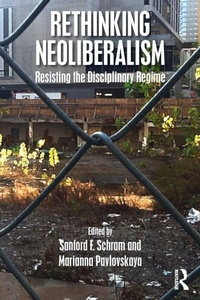
Rethinking Neoliberalism
Resisting the Disciplinary Regime
1st Edition
Published on 21. August 2017
Book
Paperback/Softback
266 pages
978-1-138-73596-5 (ISBN)
Description
Neoliberalism remains a flashpoint for political contestation around the world. For decades now, neoliberalism has been in the process of becoming a globally ascendant default logic that prioritizes using economic rationality for all major decisions, in all sectors of society, at the collective level of state policymaking as well as the personal level of individual choice-making. Donald Trump's recent presidential victory has been interpreted both as a repudiation and as a validation of neoliberalism's hegemony.
Rethinking Neoliberalism brings together theorists, social scientists, and public policy scholars to address neoliberalism as a governing ethic for our times. The chapters interrogate various dimensions of debates about neoliberalism while offering engaging empirical examples of neoliberalism's effects on social and urban policy in the USA, Europe, Russia, and elsewhere. Themes discussed include:
Relationship between neoliberalism, the state, and civil society
Neoliberalism and social policy to discipline citizens
Urban policy and how neoliberalism reshapes urban governance
What it will take politically to get beyond neoliberalism.
Written in a clear and accessible style, Rethinking Neoliberalism is a sophisticated synthesis of theory and practice, making it a compelling read for students of Political Science, Public Policy, Sociology, Geography, Urban Planning, Social Work and related fields, at both the advanced undergraduate and graduate levels.
Rethinking Neoliberalism brings together theorists, social scientists, and public policy scholars to address neoliberalism as a governing ethic for our times. The chapters interrogate various dimensions of debates about neoliberalism while offering engaging empirical examples of neoliberalism's effects on social and urban policy in the USA, Europe, Russia, and elsewhere. Themes discussed include:
Relationship between neoliberalism, the state, and civil society
Neoliberalism and social policy to discipline citizens
Urban policy and how neoliberalism reshapes urban governance
What it will take politically to get beyond neoliberalism.
Written in a clear and accessible style, Rethinking Neoliberalism is a sophisticated synthesis of theory and practice, making it a compelling read for students of Political Science, Public Policy, Sociology, Geography, Urban Planning, Social Work and related fields, at both the advanced undergraduate and graduate levels.
Reviews / Votes
'This interdisciplinary collection of essays does indeed rethink neoliberalism. Through an interrogation of ideologies, policies and practices, the contributors challenge not only neoliberalism itself but also established forms of academic and activist critique. At a time when developing progressive political alternatives is ever more imperative, the thought provoking contributions to this book are essential reading.' -Wendy Larner, Provost and Professor of Human Geography, Victoria University of Wellington, Aotearoa/New Zealand 'This interdisciplinary collection of essays does indeed rethink neoliberalism. Through an interrogation of ideologies, policies, and practices, the contributors challenge not only neoliberalism itself but also established forms of academic and activist critique. At a time when developing progressive political alternatives is ever more imperative, the thought-provoking contributions to this book are essential reading.' - Wendy Larner, Provost and Professor of Human Geography, Victoria University of Wellington, New Zealand'With Trump's election ensuring we are nowhere near the twilight of neoliberal capitalism, this interdisciplinary collection provides astute and compelling fodder for understanding and countering its theoretical premises, uneven spatialities, and modes of governance. Attentive to the varying grounds and effects of neoliberalism in social policy, subject formation, and everyday life, the essays in this volume offer timely and original insights into issues such as policing, neoliberal urbanism, "commanded individuality," and "critical counter-conduct" that recognize the stickiness and instability of neoliberalism and the possibilities for its undermining in multiple heres and nows.' - Cindi Katz, Professor of Geography in Environmental Psychology and Women's Studies, City University of New York, Graduate Center, USA
More details
Language
English
Place of publication
London
United Kingdom
Publishing group
Taylor & Francis Ltd
Target group
College/higher education
Illustrations
4 s/w Abbildungen, 4 s/w Zeichnungen, 1 s/w Tabelle
1 Tables, black and white; 4 Line drawings, black and white; 4 Illustrations, black and white
Dimensions
Height: 229 mm
Width: 152 mm
Thickness: 16 mm
Weight
435 gr
ISBN-13
978-1-138-73596-5 (9781138735965)
Copyright in bibliographic data and cover images is held by Nielsen Book Services Limited or by the publishers or by their respective licensors: all rights reserved.
Schweitzer Classification
Other editions
Additional editions
E-Book
08/2017
Routledge
€63.49
Available for download
E-Book
08/2017
Routledge
€63.49
Available for download
Book
08/2017
1st Edition
Routledge
€242.20
Shipment within 10-20 days
Persons
Sanford F. Schram teaches at Hunter College, CUNY where he is Professor of Political Science and Faculty Associate at the Roosevelt House Public Policy Institute. He also teaches at the CUNY Graduate Center. His published books include Words of Welfare: The Poverty of Social Science and the Social Science of Poverty (1995) and Disciplining the Poor: Neoliberal Paternalism and the Persistent Power of Race (2011)-co-authored with Joe Soss and Richard Fording. Both books won the Michael Harrington Award from the American Political Science Association. His latest book is The Return to Ordinary Capitalism: Neoliberalism, Precarity, Occupy (Oxford University Press, 2015). Schram is the 2012 recipient of the Charles McCoy Career Achievement Award from the Caucus for a New Political Science.
Marianna Pavlovskaya is Professor of Geography at Hunter College and CUNY Graduate Center. She has a MA in geography from Moscow State University and a PhD in geography from Clark University. Her major fields include urban geography, feminist geography, and critical GIS (Geographic Information Science). Her current research examines neoliberalism and the production of economic difference in post-Soviet Russia, the role of the census, statistics, and geo-spatial data in constitution of the social body, the relationship between gender, class, and work-related migration, and the emergence of the solidarity economy in the United States. Her work appeared in the Annals of the American Association of Geographers, Geoforum, Europe-Asia Studies, Environment and Planning A, Cartographica, Urban Geography, and many edited volumes. She worked on international research projects with colleagues from Norway, Uganda, and Russia.
Marianna Pavlovskaya is Professor of Geography at Hunter College and CUNY Graduate Center. She has a MA in geography from Moscow State University and a PhD in geography from Clark University. Her major fields include urban geography, feminist geography, and critical GIS (Geographic Information Science). Her current research examines neoliberalism and the production of economic difference in post-Soviet Russia, the role of the census, statistics, and geo-spatial data in constitution of the social body, the relationship between gender, class, and work-related migration, and the emergence of the solidarity economy in the United States. Her work appeared in the Annals of the American Association of Geographers, Geoforum, Europe-Asia Studies, Environment and Planning A, Cartographica, Urban Geography, and many edited volumes. She worked on international research projects with colleagues from Norway, Uganda, and Russia.
Content
Introduction [Sanford F. Schram and Marianna Pavlovskaya] Part 1: Theorizing Neoliberalism: The Individual, the Subject and the Power of the State 1. Nothing Personal [Jodi Dean] 2. The Secret Life of Neoliberal Subjectivity [Mitchell Dean] 3. Foucault's Three Ways of Decentering the State: Perspectives on the State, Civil Society and Neoliberalism [Kaspar Villadsen] Part 2: Reconstructing the Individual via Social Policy 4. Investing in Social Subjects: The European Turn to Social Investment as the Human Capital Theory of Social Citizenship [Bettina Leibetseder] 5. Ontologies of Poverty in Russia and Duplicities of Neoliberalism [Marianna Pavlovskaya] 6. Neoliberalism Viewed from the Bottom Up: A Qualitative Longitudinal Study of Benefit Claimants' Experiences of the Unemployment System [Sophie Danneris] 7. Neoliberal Talk: The Routinized Structures of Document-Focused Social Worker-Client Discourse [Maureen Matarese and Dorte Caswell] Part 3: The Neoliberal Disciplinary Regime: Policing Indentured Citizens 8. Criminal Justice Predation and Neoliberal Governance [Joshua Page and Joe Soss] 9. Neoliberalism and Police Reform [Leonard Feldman] Part 4: Urban Governance: At Home and Abroad 10. Neoliberalizing Detroit [Jamie Peck and Heather Whiteside] 11. Political Dissent Amman, Jordan: Neoliberal Geographies of Protest and Policing [Jillian Schwedler] Part 5: Forward: Working Through Neoliberalism 12. The Knight's Move: Social Policy Change in an Age of Consolidated Power [Sanford F. Schram] 13. Neoliberalism: Towards A Critical Counter-Conduct [Barbara Cruikshank]