

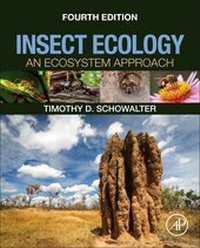
Insect Ecology
An Ecosystem Approach
4th Edition
Published on 15. August 2016
Book
Hardback
774 pages
978-0-12-803033-2 (ISBN)
Description
Insect Ecology: An Ecosystem Approach, Fourth Edition, follows a hierarchical organization that begins with relatively easy-to-understand chapters on adaptive responses of insect populations to various environmental changes, disturbances, and anthropogenic activities, how insects find food and habitat resources, and how insects allocate available energy and nutrients.
Chapters build on fundamental information to show how insect populations respond to changing environmental conditions, including spatial and temporal distribution of food and habitat. The next section integrates populations of interacting species within communities and how these interactions determine structure of communities over time and space.
Other works in insect ecology stop there, essentially limiting presentation of insect ecology to evolutionary responses of insects to their environment, including the activities of other species. The unique aspect of this book is its four chapters on ecosystem structure and function, and how herbivores, pollinators, seed predators, and detritivores drive ecosystem dynamics and contribute to ecosystem stability.
Chapters build on fundamental information to show how insect populations respond to changing environmental conditions, including spatial and temporal distribution of food and habitat. The next section integrates populations of interacting species within communities and how these interactions determine structure of communities over time and space.
Other works in insect ecology stop there, essentially limiting presentation of insect ecology to evolutionary responses of insects to their environment, including the activities of other species. The unique aspect of this book is its four chapters on ecosystem structure and function, and how herbivores, pollinators, seed predators, and detritivores drive ecosystem dynamics and contribute to ecosystem stability.
Reviews / Votes
"I consider Schowalter's Insect Ecology to be the consummate text on the topic as the author has a very broad and diverse perspective on insect ecology. The ecosystem-level perspective Schowalter takes in this book fills the need to incorporate insects and their influence into a larger, applied context. Insects have huge impacts on timber availability, large scale fires, and the carbon sink capacity of our forests. Understanding insects' influence on these disturbances and ecosystem services is essential for land managers, restoration project managers, and environmental consultants, in addition to research scientists." --Dr. Samantha Chapman, Associate Professor, Department of Biology, Villanova UniversityMore details
Edition
4th edition
Language
English
Place of publication
San Diego
United States
Publishing group
Elsevier Science Publishing Co Inc
Target group
Professional and scholarly
Primarily professional entomologists, ecologists and others with interest in how insects engineer our global ecosystem, as well as how they respond to environmental changes. This book can be, and has been, used in graduate Insect Ecology courses. Reviewers of previous editions also have recommended it for undergraduate Insect Ecology students
Dimensions
Height: 235 mm
Width: 191 mm
Weight
2410 gr
ISBN-13
978-0-12-803033-2 (9780128030332)
Copyright in bibliographic data and cover images is held by Nielsen Book Services Limited or by the publishers or by their respective licensors: all rights reserved.
Schweitzer Classification
Other editions
New editions
Book
02/2022
5th Edition
Academic Press
€161.50
Shipment within 15-20 days
Additional editions
E-Book
07/2016
4th Edition
Academic Press
€71.95
Available for download
Previous edition
Book
05/2011
3rd Edition
Academic Press
€90.51
Article exhausted; check for reprint
Person
Timothy D. Schowalter received his Ph.D. degree in Entomology from the University of Georgia in 1979. He is currently a Professor of Entomology at Louisiana State University, where he also served as the department head until 2015. Previously, he was a professor of entomology at Oregon State University, Corvallis. Dr. Schowalter served as Program Director for Integrative and Theoretical Ecology at the National Science Foundation, where he was involved in developing global change and terrestrial ecosystem research initiatives at the federal level. He also served as a U.S. delegate to international conventions to develop collaboration between U.S. Long Term Ecological Research (LTER) sites and long-term sites in Hungary and East Asia and the Pacific.
Content
1. Overview
Section I: Ecology of individual insects2. Responses to Abiotic Conditions3. Resource Acquisition4. Resource Allocation
Section II: Population ecology5. Population Systems6. Population Dynamics7. Biogeography
Section III: Community ecology8. Species Interactions9. Community Structure10. Community Dynamics
Section IV: Ecosystem level11. Ecosystem Structure and Function12. Herbivory13. Pollination, Seed Predation, and Seed Dispersal14. Decomposition and Pedogenesis15. Insects as Regulators of Ecosystem Processes
Section V: Applications and synthesis16. Application to Sustainability of Ecosystem Services17. Management of Insect Populations18. Summary and Synthesis
Section I: Ecology of individual insects2. Responses to Abiotic Conditions3. Resource Acquisition4. Resource Allocation
Section II: Population ecology5. Population Systems6. Population Dynamics7. Biogeography
Section III: Community ecology8. Species Interactions9. Community Structure10. Community Dynamics
Section IV: Ecosystem level11. Ecosystem Structure and Function12. Herbivory13. Pollination, Seed Predation, and Seed Dispersal14. Decomposition and Pedogenesis15. Insects as Regulators of Ecosystem Processes
Section V: Applications and synthesis16. Application to Sustainability of Ecosystem Services17. Management of Insect Populations18. Summary and Synthesis