

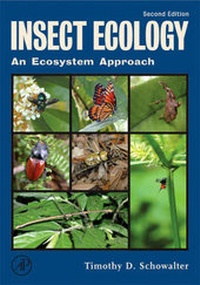
Insect Ecology
An Ecosystem Approach
2nd Edition
Published on 10. April 2006
Book
Hardback
576 pages
978-0-12-088772-9 (ISBN)
Description
Dr. Timothy Schowalter has succeeded in creating a unique, updated treatment of insect ecology. This revised and expanded text looks at how insects adapt to environmental conditions while maintaining the ability to substantially alter their environment. It covers a range of topics- from individual insects that respond to local changes in the environment and affect resource distribution, to entire insect communities that have the capacity to modify ecosystem conditions.
Insect Ecology, Second Edition, synthesizes the latest research in the field and has been produced in full color throughout. It is ideal for students in both entomology and ecology-focused programs.
Insect Ecology, Second Edition, synthesizes the latest research in the field and has been produced in full color throughout. It is ideal for students in both entomology and ecology-focused programs.
Reviews / Votes
"Schowalter's 2nd edition of Insect Ecology: An Ecosystem Approach is a gem - a complete course in modern ecology from the vantage point of insects in ecological systems. Accessible and engaging, yet it treats the most complex ecological phenomena from individual behavior and population processes through landscape and regional-scale issues." --Dan Simberloff, University of Tennessee "Schowalter provides a well-illustrated, comprehensive integration of population, community, and ecosystem ecology that demonstrates the global importance of insects in terrestrial and aquatic domains. Examples from temperate and tropical studies are related to a wide range of fundamental ecological concepts. The synthesis of current literature is thoroughly developed and will be widely appreciated by beginning students and established professionals." --Alan Covich, Institute of Ecology, University of Georgia "This very stimulating book will interest entomologists and ecologists alike. Schowalter broadens the traditional scope of insect ecology to communities and ecosystems. He gives an excellent overview how insects shape ecosystem functioning, including their critical role in major trophic interactions such as decomposition, pollination, herbivory and biological control." --Teja Tscharntke, University of Goettingen, GermanyMore details
Edition
2nd edition
Language
English
Place of publication
San Diego
United States
Publishing group
Elsevier Science Publishing Co Inc
Target group
Professional and scholarly
Edition type
New edition
Dimensions
Height: 260 mm
Width: 184 mm
Weight
1430 gr
ISBN-13
978-0-12-088772-9 (9780120887729)
Copyright in bibliographic data and cover images is held by Nielsen Book Services Limited or by the publishers or by their respective licensors: all rights reserved.
Schweitzer Classification
Other editions
New editions
Book
05/2011
3rd Edition
Academic Press
€90.51
Article exhausted; check for reprint
Additional editions
E-Book
02/2006
2nd Edition
Academic Press
€74.95
Available for download
Previous edition

Book
01/2000
Academic Press
€58.27
Article exhausted; check for reprint
Person
Timothy D. Schowalter received his Ph.D. degree in Entomology from the University of Georgia in 1979. He is currently a Professor of Entomology at Louisiana State University, where he also served as the department head until 2015. Previously, he was a professor of entomology at Oregon State University, Corvallis. Dr. Schowalter served as Program Director for Integrative and Theoretical Ecology at the National Science Foundation, where he was involved in developing global change and terrestrial ecosystem research initiatives at the federal level. He also served as a U.S. delegate to international conventions to develop collaboration between U.S. Long Term Ecological Research (LTER) sites and long-term sites in Hungary and East Asia and the Pacific.
Content
1 Overview; 2 Responses to Abiotic Conditions; 3 Resource Acquisition; 4 Resource Allocation; 5 Population Systems; 6 Population Dynamics; 7 Biogeography; 8 Species Interactions; 9 Community Structure; 10 Community Dynamics; 11 Ecosystem Structure and Function; 12 Herbivory; 13 Pollination, Seed Predation and Seed Dispersal; 14 Decomposition and Pedogenesis; 15 Insects as Regulators of Ecosystem Processes; 16 Synthesis