

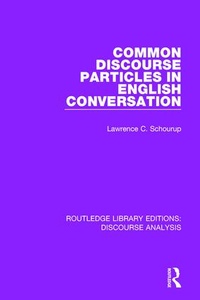
Common Discourse Particles in English Conversation
1st Edition
Published on 2. November 2016
Book
Hardback
188 pages
978-1-138-22479-7 (ISBN)
Description
First published in 1985, this book studies several common items in English conversation known variously as 'discourse particles', 'interjections', 'discourse markers', and, more informally, 'hesitations' or 'fillers'. While the analysis primarily focuses on 'like', 'well' and 'you know', the larger concern is the entire set of items of which these are members and as such 'I mean', 'now', 'oh', 'hey', and 'aha' are also examined. These discourse particles are analysed at length and then a framework is proposed in which their use individually makes sense and allows revealing comparisons to be made between them. This book will be of interest to students of linguistics
More details
Series
Language
English
Place of publication
London
United Kingdom
Publishing group
Taylor & Francis Ltd
Target group
College/higher education
Dimensions
Height: 234 mm
Width: 156 mm
Weight
430 gr
ISBN-13
978-1-138-22479-7 (9781138224797)
Copyright in bibliographic data and cover images is held by Nielsen Book Services Limited or by the publishers or by their respective licensors: all rights reserved.
Schweitzer Classification
Other editions
Additional editions
Lawrence C. Schourup
Common Discourse Particles in English Conversation
Book
05/2018
1st Edition
Routledge
€62.90
Shipment within 10-20 days
Lawrence C. Schourup
Common Discourse Particles in English Conversation
E-Book
11/2016
Routledge
€52.49
Available for download
Lawrence C. Schourup
Common Discourse Particles in English Conversation
E-Book
11/2016
Routledge
€52.49
Available for download
Person
Lawrence C. Schourup
Content
Preface; List of Symbols; 1 Introduction; 1.1 General Remarks 1.2 Covert Thinking in Conversation 1.3 Three 'Worlds' of the Speaker 1.4 Routinization 1.5 Use of speech Materials 1.6 Outline of Remaining Chapters; 2 Evinces; 2.1 Interjections and Evincives 2.2 Evincives in Quotations 2.2.1 'Well' and 'Oh' in quotations 2.3 Enquoting 2.4 Quotation 2.5 Summary; 3 'Like'; 3.1 'Like' in conversation 3.2 'Like' Introducing Direct Discourse 3.3 'Like' After Questions 3.4 The 'For Example' Use 3.5 'Like as an Interjection 3.6 'It's Like' 3.7 conclusion; 4 'Well'; 4.1 Introduction 4.2 'Well' Before Exclamations 4.3 'Well' Introducing Direct Discourse 4.4 Topic Shifting 4.5 'Well' Before Answers 4.6 'Well' Before Questions 4.7 'Well' and Self-Repair 4.8 'Well' and Other-Repair 4.9 Sentence-Final 'Well' 4.10 Reduced 'Well' 4.11 'Well' and Narrative Elision 4.12 'Well' and 'Intension' 4.13 Conclusion; 5 'You Know'; 5.1 Preliminary Remarks 5.2 YK as a Truth Parenthetical 5.3 YK and Properties of Truth Parentheticals 5.4 Evidence for two Types of YK 5.5 The Use of YKb 5.6 A Third YK? 5.7 Discourse Functions of YKb 5.7.1 Topic Introduction 5.7.2 Topic Tracking 5.7.3 YKb and Repair 5.8 YKb as a 'Sociocentric Sequence' 5.9 Interrogative YK 5.10 YK and Turn Taking 5.11 Distribution of YK: Some Quantitative Results 5.12 Conclusion; 6 The Role of Discourse Particles in Conversation; 6.1 General Remarks 6.2 'Now' 6.3 'I Mean' 6.4 'Mind You' 6.5 'Sort O(f)', 'Kind O(f)', 'An(d) Stuff', 'An(d) Everything', 'An(d) so on', etc. 6.6 Interjections 6.7 Types of Disclosure Functions 6.8 General Summary; Footnotes; References