

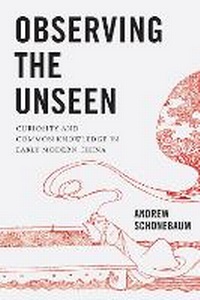
Observing the Unseen
Curiosity and Common Knowledge in Early Modern China
Published on 28. April 2026
Book
Hardback
258 pages
978-0-295-75422-2 (ISBN)
Description
Explores the relationship between fantastical literature and scientific inquiryWhat did early modern Chinese readers believe about dragons, thunder, or fate, and where did they learn it? Observing the Unseen explores how literate and marginally literate people in China between the sixteenth and nineteenth centuries investigated the invisible, the ubiquitous, and the inexplicable. Whether through medical encyclopedias, daily-use almanacs, or novels and anecdotes, readers pursued knowledge of the natural world with curiosity shaped as much by wonder as by empiricism.
Andrew Schonebaum reveals that for many readers, stories were an important source of reliable information about the world. Knowledge of the natural world evolved in the margins of "fiction." Entertainment literature and practical texts alike conveyed information that was collected, debated, and even used to treat illness or predict the future. Drawing from overlooked genres such as brush notes, court records, and sequels to popular stories, Schonebaum demonstrates that common knowledge was constructed through a patchwork of sources-elite and vernacular, empirical and fantastical.
Rather than privileging science as courtly or Western, Observing the Unseen shows how ordinary readers made sense of the cosmos in an age of expanding literacy and print culture. It challenges assumptions about what Chinese literature was and how it was read, offering a nuanced picture of everyday life in early modern China. This is a work for scholars of Chinese history and literature, historians of science, and anyone interested in the complicated ways humans seek to understand the unseen.
Andrew Schonebaum reveals that for many readers, stories were an important source of reliable information about the world. Knowledge of the natural world evolved in the margins of "fiction." Entertainment literature and practical texts alike conveyed information that was collected, debated, and even used to treat illness or predict the future. Drawing from overlooked genres such as brush notes, court records, and sequels to popular stories, Schonebaum demonstrates that common knowledge was constructed through a patchwork of sources-elite and vernacular, empirical and fantastical.
Rather than privileging science as courtly or Western, Observing the Unseen shows how ordinary readers made sense of the cosmos in an age of expanding literacy and print culture. It challenges assumptions about what Chinese literature was and how it was read, offering a nuanced picture of everyday life in early modern China. This is a work for scholars of Chinese history and literature, historians of science, and anyone interested in the complicated ways humans seek to understand the unseen.
More details
Language
English
Place of publication
Seattle
United States
Target group
College/higher education
US School Grade: College Graduate Student
Illustrations
20 Illustrations, black and white; 20 Illustrations, black and white; 20 Illustrations, black and white; 20 Illustrations, black and white; 20 Illustrations, black and white; 20 Illustrations, black and white; 20 Illustrations, black and white; 20 Illustrations, black and white; 20 Illustrations, black and white; 20 Illustrations, black and white; 20 Illustrations, black and white; 20 Illustrations, black and white; 20 Illustrations, black and white; 20 Illustrations, black and white; 20 Illustrations, black and white; 20 Illustrations, black and white; 20 Illustrations, black and white; 20 Illustrations, black and white; 20 Illustrations, black and white; 20 Illustrations, black and white
Dimensions
Height: 229 mm
Width: 152 mm
Weight
499 gr
ISBN-13
978-0-295-75422-2 (9780295754222)
Copyright in bibliographic data and cover images is held by Nielsen Book Services Limited or by the publishers or by their respective licensors: all rights reserved.
Schweitzer Classification
Person
Andrew Schonebaum is associate professor of Chinese literary and cultural studies at the University of Maryland. He is author of Novel Medicine: Healing, Literature, and Popular Knowledge in Early Modern China and editor of Approaches to Teaching "The Plum in the Golden Vase" (The Golden Lotus).