

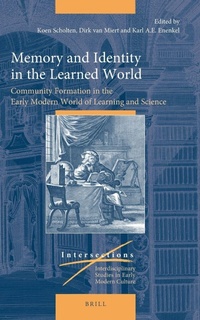
Memory and Identity in the Learned World
Community Formation in the Early Modern World of Learning and Science
Published on 24. March 2022
Book
Hardback
368 pages
978-90-04-50714-2 (ISBN)
Description
Memory and Identity in the Learned World offers a detailed and varied account of community formation in the early modern world of learning and science. The book traces how collective identity, institutional memory and modes of remembrance helped to shape learned and scientific communities.
The case studies in this book analyse how learned communities and individuals presented and represented themselves, for example in letters, biographies, histories, journals, opera omnia, monuments, academic travels and memorials. By bringing together the perspectives of historians of literature, scholarship, universities, science, and art, this volume studies knowledge communities by looking at the centrality of collective identity and memory in their formations and reformations.
Contributors: Lieke van Deinsen, Karl Enenkel, Constance Hardesty, Paul Hulsenboom, Dirk van Miert, Alan Moss, Richard Kirwan, Koen Scholten, Floris Solleveld, and Esther M. Villegas de la Torre.
The case studies in this book analyse how learned communities and individuals presented and represented themselves, for example in letters, biographies, histories, journals, opera omnia, monuments, academic travels and memorials. By bringing together the perspectives of historians of literature, scholarship, universities, science, and art, this volume studies knowledge communities by looking at the centrality of collective identity and memory in their formations and reformations.
Contributors: Lieke van Deinsen, Karl Enenkel, Constance Hardesty, Paul Hulsenboom, Dirk van Miert, Alan Moss, Richard Kirwan, Koen Scholten, Floris Solleveld, and Esther M. Villegas de la Torre.
More details
Series
Language
English
Place of publication
Leiden
Netherlands
Target group
Professional and scholarly
Product notice
sewn/stitched
Cloth over boards
Dimensions
Height: 234 mm
Width: 155 mm
Thickness: 21 mm
Weight
680 gr
ISBN-13
978-90-04-50714-2 (9789004507142)
Copyright in bibliographic data and cover images is held by Nielsen Book Services Limited or by the publishers or by their respective licensors: all rights reserved.
Schweitzer Classification
Persons
Koen Scholten is a PhD candidate and researcher at the Research Institute for History at Utrecht University. He has published articles on early modern science and scholarship as well as on scholarly travels. His current research focuses on how scholarly communities form and reform in early modern Europe.
Dirk van Miert is Associate Professor of Early Modern Culture at Utrecht University and Director of the Huygens Institute (Royal Netherlands Academy of Arts and Sciences). He has published widely on the history of learning, scholarship, universities and the Republic of Letters.
Karl A.E. Enenkel is Professor of Medieval Latin and Neo-Latin at the University of Muenster. Previously he was Professor of Neo-Latin at the University of Leiden. He has published widely on international Humanism, early modern culture, paratexts, literary genres 1300-1600, Neo-Latin emblems, word and image relationships, and the history of scholarship and science.
Dirk van Miert is Associate Professor of Early Modern Culture at Utrecht University and Director of the Huygens Institute (Royal Netherlands Academy of Arts and Sciences). He has published widely on the history of learning, scholarship, universities and the Republic of Letters.
Karl A.E. Enenkel is Professor of Medieval Latin and Neo-Latin at the University of Muenster. Previously he was Professor of Neo-Latin at the University of Leiden. He has published widely on international Humanism, early modern culture, paratexts, literary genres 1300-1600, Neo-Latin emblems, word and image relationships, and the history of scholarship and science.
Content
Contents
List of Illustrations
Notes on the Editors
Notes on the Contributors
1 Introduction: Memory and Identity in Learned Communities
?Koen Scholten
Part 1: Collective Identity
2 "Identities" in Humanist Autobiographies and Related Self-Presentations
?Karl A.E. Enenkel
3 Female Faces and Learned Likenesses: Author Portraits and the Construction of Female Authorship and Intellectual Authority
?Lieke van Deinsen
4 Scholarly Identity and Gender in the Respublica litteraria: The Cases of Luisa Sigea (1522-1560) and Margaret Cavendish (1623-1673)
?Esther M. Villegas de la Torre
5 The Republic of Letters Mapping the Republic of Letters: Jacob Brucker's Pinacotheca (1741-1755) and Its Antecedents
?Floris Solleveld
Part 2: Institutional Memory as a Shared Past
6 Mirror, Model, Muse: Institutional Memory and Identity in the Dublin, Oxford and Royal Societies
?Constance Hardesty
7 Miscellanies of Memory: From Scholarly Biography to Institutional History in the Early Modern German University
?Richard Kirwan
Part 3: Memory Cultures and Modes of Remembrance
8 Tracing the Sites of Learned Men: Places and Objects of Knowledge on the Dutch and Polish Grand Tour
?Paul Hulsenboom and Alan Moss
9 The Curious Case of Isaac Casaubon's Monstrous Bladder: The Networked Construction of Learned Memory within the Seventeenth-Century Reformed World of Learning
?Dirk van Miert
Index Nominum
List of Illustrations
Notes on the Editors
Notes on the Contributors
1 Introduction: Memory and Identity in Learned Communities
?Koen Scholten
Part 1: Collective Identity
2 "Identities" in Humanist Autobiographies and Related Self-Presentations
?Karl A.E. Enenkel
3 Female Faces and Learned Likenesses: Author Portraits and the Construction of Female Authorship and Intellectual Authority
?Lieke van Deinsen
4 Scholarly Identity and Gender in the Respublica litteraria: The Cases of Luisa Sigea (1522-1560) and Margaret Cavendish (1623-1673)
?Esther M. Villegas de la Torre
5 The Republic of Letters Mapping the Republic of Letters: Jacob Brucker's Pinacotheca (1741-1755) and Its Antecedents
?Floris Solleveld
Part 2: Institutional Memory as a Shared Past
6 Mirror, Model, Muse: Institutional Memory and Identity in the Dublin, Oxford and Royal Societies
?Constance Hardesty
7 Miscellanies of Memory: From Scholarly Biography to Institutional History in the Early Modern German University
?Richard Kirwan
Part 3: Memory Cultures and Modes of Remembrance
8 Tracing the Sites of Learned Men: Places and Objects of Knowledge on the Dutch and Polish Grand Tour
?Paul Hulsenboom and Alan Moss
9 The Curious Case of Isaac Casaubon's Monstrous Bladder: The Networked Construction of Learned Memory within the Seventeenth-Century Reformed World of Learning
?Dirk van Miert
Index Nominum