

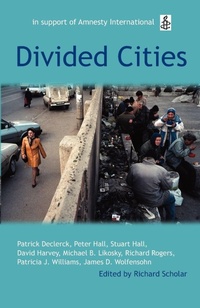
Divided Cities
The Oxford Amnesty Lectures 2003
Published on 26. January 2006
Book
Paperback/Softback
240 pages
978-0-19-280708-3 (ISBN)
Description
Cities, at their best, are cradles of diversity, opportunity, and citizenship. Why, then, do so many cities today seem scarred by divisions separating the powerful and privileged from the victims of deprivation and injustice? What is it like to live on the wrong side of the divide in Paris, London, New York, Sao Paolo, and other cities all over the world?
In this book, based on the internationally renowned Oxford Amnesty Lectures, eight leading urban thinkers argue about why divisions arise in cities and about what could and should be done to bring those divisions to an end. The book features essays by Patrick Declerck, Stuart Hall, David Harvey, Richard Rogers, Patricia Williams, and James Wolfensohn, with commentaries from Peter Hall, Michael Likosky, and others. The many contemporary issues that the book addresses include the impact of globalization and migration on the urban environment, the consequences of the 'war on terror' for those living in cities, the new development paradigm being adopted by international institutions in the developing world, the need for a genuine urban renaissance in Britain and elsewhere, and the suffering of the homeless.
These controversial and sometimes conflicting essays, linked by Richard Scholar's incisive introduction, aim to encourage and inform debate about the challenges to human rights in our increasingly urban world.
In this book, based on the internationally renowned Oxford Amnesty Lectures, eight leading urban thinkers argue about why divisions arise in cities and about what could and should be done to bring those divisions to an end. The book features essays by Patrick Declerck, Stuart Hall, David Harvey, Richard Rogers, Patricia Williams, and James Wolfensohn, with commentaries from Peter Hall, Michael Likosky, and others. The many contemporary issues that the book addresses include the impact of globalization and migration on the urban environment, the consequences of the 'war on terror' for those living in cities, the new development paradigm being adopted by international institutions in the developing world, the need for a genuine urban renaissance in Britain and elsewhere, and the suffering of the homeless.
These controversial and sometimes conflicting essays, linked by Richard Scholar's incisive introduction, aim to encourage and inform debate about the challenges to human rights in our increasingly urban world.
More details
Series
Language
English
Place of publication
Oxford
United Kingdom
Target group
Professional and scholarly
Students and specialists in the fields of urban geography and architecture, development economics, law, political theory, sociology, and psychoanalysis, human rights and development. Supporters of Amnesty International.
Dimensions
Height: 198 mm
Width: 129 mm
Thickness: 13 mm
Weight
260 gr
ISBN-13
978-0-19-280708-3 (9780192807083)
Copyright in bibliographic data and cover images is held by Nielsen Book Services Limited or by the publishers or by their respective licensors: all rights reserved.
Schweitzer Classification
Person
Richard Scholar is a Director of Oxford Amnesty Lectures, Lecturer in French at Durham University, and the author of The Je-Ne-Sais-Quoi in Early Modern Europe: Encounters with a Certain Something (OUP, 2005).
Content
PART I: LECTURES ; PART II: RESPONSES