

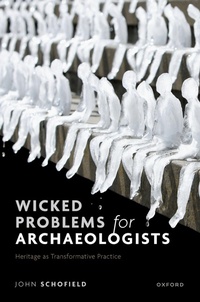
Wicked Problems for Archaeologists
Heritage as Transformative Practice
Published on 30. May 2024
Book
Hardback
360 pages
978-0-19-284488-0 (ISBN)
Description
'Wicked Problems' are those problems facing the planet and its inhabitants, present and future, which are hard (if not impossible) to resolve and for which bold, creative, and messy solutions are typically required. The adjective 'wicked' describes the mischievous and even evil quality of these problems, where proposed solutions often turn out to be worse than the symptoms. This wide-ranging and innovative book encourages readers to think about archaeology in an entirely new way, as fresh, relevant, and future-oriented. It examines some of the novel ways that archaeology (alongside cultural heritage practice) can contribute to resolving some of the world's most wicked problems, or global challenges as they are sometimes known. With chapters covering climate change, environmental pollution, health and wellbeing, social injustice, and conflict, the book uses many and diverse examples to explain how, through studying the past and present through an archaeological lens, in ways that are creative, ambitious, and both inter- and transdisciplinary, significant 'small wins' can be achieved. Through these small wins, archaeologists can help to mitigate some of those most pressing of wicked problems, contributing therefore to a safer, healthier, and more stable world.
Reviews / Votes
Archaeology isn't the first subject that comes to mind when researching wicked problems. Yet, according to this important and intriguing book, archaeology is exactly where we can look to gain small wins that carry us towards resolution. In presenting this case, John Schofield may just have redefined the true purpose of archaeology. * Professor Brian Head, Political Science and International Studies, University of Queensland * This book not only offers insightful views on wicked problems but also considers how archaeologists and heritage practitioners might most productively apply their work to concrete solutions. Rather than making exaggerated claims for his disciplines' capacities to solve humanity's existential crises, John Schofield instead advocates a pragmatic long game, accumulating 'small wins' delivered by savvy disciplinary leaders operating as policy entrepreneurs to nudge government and business in the desired direction. Modest, certainly, in the face of such crises, but it is much better to under-promise and over-deliver than the reverse when the future of humankind is at stake! * Professor Ian Lilley, Archaeology, University of Leiden * Wicked Problems is a timely contribution to the scholarship of contemporary archaeology and heritage studies. Covering topics ranging from climate change and pollution to social justice and wellbeing, Schofield shows why archaeological and deep-time perspectives matter in the present and for the future. A book that deserves a broad readership. * Professor ?ora Petursdottir, University of Oslo * Archaeology has the ability to travel through time and to consider contemporary phenomena in relation to the deep history of human existence. According to John Schofield, this gives archaeology nothing less than superpowers in tackling some of today's most pressing questions. In this book he shows how our knowledge of the past actually may help guide the way to a better world. * Professor Mats Burstroem, Archaeology and Classical Studies, Stockholm University * John Schofield is a wide-ranging and innovative book that encourages readers to think about archaeology in an entirely new way, as fresh, relevant, and future-oriented. It examines some of the novel ways that archaeology (alongside cultural heritage practice) can contribute to resolving some of the world's most wicked problems, or global challenges as they are sometimes known. * Dr. Miranda Melcher, New Books Network * The volume presents a critical overview of where archaeology is positioned right now in relation to these wicked problems and how archaeologists could enhance their own contribution to solving them in the future. The book is structured in detailed thematic sections on different wicked problems and how archaeologists have been, and could be, contributing to understanding them and thus help transform the world. Schofield's agenda is intellectualand theoretical but it is also practical and engages with questions of policy, leadership, socialplanetary boundaries and the United Nation's sustainable development goals (SDGs). * Cornelius Holtorf, Antiquity Reviews *More details
Language
English
Place of publication
Oxford
United Kingdom
Target group
Professional and scholarly
Product notice
sewn/stitched
Cloth over boards
Illustrations
c. 35
Dimensions
Height: 239 mm
Width: 161 mm
Thickness: 23 mm
Weight
738 gr
ISBN-13
978-0-19-284488-0 (9780192844880)
Copyright in bibliographic data and cover images is held by Nielsen Book Services Limited or by the publishers or by their respective licensors: all rights reserved.
Schweitzer Classification
Other editions
Additional editions
E-Book
07/2024
1st Edition
OUP eBook
€32.99
Available for download
E-Book
05/2024
1st Edition
OUP eBook
€32.99
Available for download
Person
John Schofield is a Professor in the Archaeology Department at the University of York (UK). Following a PhD at Southampton University, John spent 21 years with English Heritage (now Historic England) before being appointed to the University of York in 2010, going on to serve as Head of Archaeology. John holds adjunct positions at Griffith and Flinders universities (Australia), and is Docent at the University of Turku (Finland). John is a Fellow of the Society of Antiquaries of London, a Corresponding Fellow of the Australian Academy of the Humanities and Member of the Chartered Institute for Archaeologists.
Content
Preface
1: Wicked Problems
2: Climate Change
3: Environmental Pollution
4: Health and Wellbeing
5: Entanglement
6: Social Injustice
7: Conflict
8: Transformations
Some Questions for Book-group Discussions, Essays and Exams
Bibliography
1: Wicked Problems
2: Climate Change
3: Environmental Pollution
4: Health and Wellbeing
5: Entanglement
6: Social Injustice
7: Conflict
8: Transformations
Some Questions for Book-group Discussions, Essays and Exams
Bibliography