

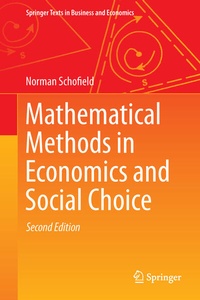
Mathematical Methods in Economics and Social Choice
2nd Edition
Published on 23. October 2013
Book
Hardback
XV, 262 pages
978-3-642-39817-9 (ISBN)
Description
In recent years, the usual optimization techniques, which have proved so useful in microeconomic theory, have been extended to incorporate more powerful topological and differential methods, and these methods have led to new results on the qualitative behavior of general economic and political systems. These developments have necessarily resulted in an increase in the degree of formalism in the publications in the academic journals. This formalism can often deter graduate students. The progression of ideas presented in this book will familiarize the student with the geometric concepts underlying these topological methods, and, as a result, make mathematical economics, general equilibrium theory, and social choice theory more accessible.
More details
Series
Edition
2nd ed. 2014
Language
English
Place of publication
Berlin
Germany
Publishing group
Springer Berlin
Target group
Professional and scholarly
Research
Edition type
Revised edition
Illustrations
100 s/w Abbildungen
XV, 262 p. 100 illus.
Dimensions
Height: 241 mm
Width: 160 mm
Thickness: 21 mm
Weight
588 gr
ISBN-13
978-3-642-39817-9 (9783642398179)
DOI
10.1007/978-3-642-39818-6
Schweitzer Classification
Other editions
Additional editions
Norman Schofield
Mathematical Methods in Economics and Social Choice
Book
09/2016
2nd Edition
Springer
€53.49
Shipment within 7-9 days
Norman Schofield
Mathematical Methods in Economics and Social Choice
E-Book
10/2013
2nd Edition
Springer
€53.49
Available for download
Previous edition
Norman Schofield
Mathematical Methods in Economics and Social Choice
Book
03/2004
Springer
€80.20
Article exhausted; check for reprint
Content
Sets, Relations and Preferences.- Linear Spaces and Transformations.- Topology and Convex Optimisation.- Differential Calculus and Smooth Optimisation.- Singularity Theory and General Equilibria.- Topology and Social Choice.