

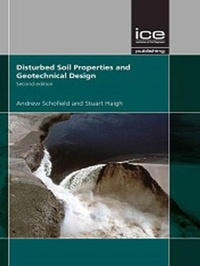
Disturbed Soil Properties and Geotechnical Design
2nd Edition
Published on 24. November 2017
Book
Hardback
208 pages
978-0-7277-6155-2 (ISBN)
Description
Disturbed Soil Properties and Geotechnical Design, Second edition describes the developments leading to the Original Cam Clay model, focusing on fundamentals of the shearing of soil. The first edition explained and illustrated fallacies in past work of engineering geologists, and laid groundwork for the understanding that should form the basis of modern geotechnical design.
With the changing environment, and the increasing size of construction projects, engineers now need a better understanding of ground behaviour to prevent future catastrophes such as the 1976 Teton Dam failure shown on the cover. The further additions in this book will help geotechnical engineers acquire this knowledge.
Disturbed Soil Properties and Geotechnical Design, Second edition
provides an outline of the energy-based Cam-clay approach that can predict geotechnical deformations
illustrates further fallacies in commonly used c-? Coulomb soil mechanics
describes the use of centrifuge modelling in geotechnical design, based on examples from the last four decades
Once armed with the simple concepts of wet/weepy and dry/thirsty sides of the critical state line, readers will better understand if soil will tend to contract or dilate in drained shearing, and if pore pressures caused by undrained shearing will be positive or negative
Full of technical and personal insights, this is a rewarding book that forces the rethinking of modern geotechnical engineering. Much like the first edition, this book remains an invitation for the unconverted to re-examine the basic understanding of soil behaviour, and for the converted to ensure that the teaching, vocabulary and nomenclature used in describing strength models for soil, accurately reflect the underlying concepts.
With the changing environment, and the increasing size of construction projects, engineers now need a better understanding of ground behaviour to prevent future catastrophes such as the 1976 Teton Dam failure shown on the cover. The further additions in this book will help geotechnical engineers acquire this knowledge.
Disturbed Soil Properties and Geotechnical Design, Second edition
provides an outline of the energy-based Cam-clay approach that can predict geotechnical deformations
illustrates further fallacies in commonly used c-? Coulomb soil mechanics
describes the use of centrifuge modelling in geotechnical design, based on examples from the last four decades
Once armed with the simple concepts of wet/weepy and dry/thirsty sides of the critical state line, readers will better understand if soil will tend to contract or dilate in drained shearing, and if pore pressures caused by undrained shearing will be positive or negative
Full of technical and personal insights, this is a rewarding book that forces the rethinking of modern geotechnical engineering. Much like the first edition, this book remains an invitation for the unconverted to re-examine the basic understanding of soil behaviour, and for the converted to ensure that the teaching, vocabulary and nomenclature used in describing strength models for soil, accurately reflect the underlying concepts.
Reviews / Votes
This 182-page book is a useful reference for anyone interested in or gaining knowledge of the development of critical-state soil mechanics, a theory of plasticity which was initially jointly developed by Schofield in the 1950s. Topics covered range from simple planar sliding of soil to plastic design in geotechnical engineering. Historical coverage starts with Coulomb's theory of strength, through Taylor's recognition that interlocking between grains provides a component of strength, to Schofield's work on the Cam clay soil model and critical state concepts. Many other seminal geotechnical engineering contributions are discussed, critically reviewed and in some cases refuted. Limitations of the Cam clay model with regard to anisotropy, soil sensitivity and cyclic loading are acknowledged. The establishment and development of geotechnical centrifuge model testing in the UK is included together with mobilisable strength design, where calculations of the deformation of geotechnical systems are based on energy dissipation. -- Colin Rawlings Jacobs/High Speed Two, UKMore details
Edition
2nd Edition
Language
English
Place of publication
United Kingdom
Publishing group
Emerald Publishing Limited
Target group
Professional and scholarly
Edition type
New edition
Product notice
sewn/stitched
Cloth over boards
Dimensions
Height: 236 mm
Width: 147 mm
Thickness: 18 mm
Weight
431 gr
ISBN-13
978-0-7277-6155-2 (9780727761552)
Copyright in bibliographic data and cover images is held by Nielsen Book Services Limited or by the publishers or by their respective licensors: all rights reserved.
Schweitzer Classification