

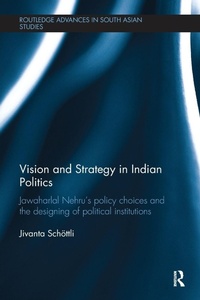
Vision and Strategy in Indian Politics
Jawaharlal Nehru's Policy Choices and the Designing of Political Institutions
1st Edition
Published on 24. May 2017
Book
Paperback/Softback
230 pages
978-1-138-10248-4 (ISBN)
Description
The 1950s in India were a crucial transition phase where the legacy and institutions of British rule had to be transformed to fit the needs of a post-colonial state. This period is closely associated with India's first Prime Minister, Jawaharlal Nehru (1947 - 64). Selecting three key policies closely associated with him, the book traces the political origins of the Panchasheela Agreement with China in 1954, the Hindu Code Bills of 1955 and 1956 and the founding of the Planning Commission in 1950. Each provides a window into the compulsions of Indian domestic politics at the time as well as the parameters of parliamentary debate.
The book goes on to discuss how these policies correspond to the pillars of Nehru's vision for a modern, independent India that encapsulated socialism, nonalignment and secularism and assesses their long-run impact in Indian politics. With a growing recognition of the resilience of India's political arrangements, the analysis is particularly relevant to those interested in the politics of transition and modernisation, and contributes to studies on Political Institutions and South Asian Politics.
The book goes on to discuss how these policies correspond to the pillars of Nehru's vision for a modern, independent India that encapsulated socialism, nonalignment and secularism and assesses their long-run impact in Indian politics. With a growing recognition of the resilience of India's political arrangements, the analysis is particularly relevant to those interested in the politics of transition and modernisation, and contributes to studies on Political Institutions and South Asian Politics.
Reviews / Votes
"This book is a timely volume at a time when founding figures in a space such as India have been deified to the point where even mild criticism leads to extreme governmental backlash; her work also restores to one of these figures his rightful place in history." - Bodhisattva Chattopadhyay, University of Oslo; Journal of International and Global Studies Volume 4, Number 1, (November 2012).More details
Series
Language
English
Place of publication
London
United Kingdom
Publishing group
Taylor & Francis Ltd
Target group
College/higher education
Product notice
Paperback (trade)
Illustrations
4 s/w Zeichnungen, 9 s/w Tabellen, 4 s/w Abbildungen
9 Tables, black and white; 4 Line drawings, black and white; 4 Illustrations, black and white
Dimensions
Height: 234 mm
Width: 156 mm
Thickness: 13 mm
Weight
346 gr
ISBN-13
978-1-138-10248-4 (9781138102484)
Copyright in bibliographic data and cover images is held by Nielsen Book Services Limited or by the publishers or by their respective licensors: all rights reserved.
Schweitzer Classification
Other editions
Additional editions
Jivanta Schoettli
Vision and Strategy in Indian Politics
Jawaharlal Nehru's Policy Choices and the Designing of Political Institutions
E-Book
02/2012
1st Edition
Routledge
€69.99
Available for download
Jivanta Schoettli
Vision and Strategy in Indian Politics
Jawaharlal Nehru's Policy Choices and the Designing of Political Institutions
E-Book
02/2012
1st Edition
Routledge
€69.99
Available for download
Jivanta Schoettli
Vision and Strategy in Indian Politics
Jawaharlal Nehru's Policy Choices and the Designing of Political Institutions
Book
09/2011
1st Edition
Routledge
€238.09
Shipment within 15-20 days
Person
Jivanta Schoettli is a Lecturer in the Department of Political Science at the South Asia Institute, Heidelberg University, Germany. Her research interests include Indian politics and foreign policy.
Content
1. The art and craft of policy-making 2. The Analytic Framework 3. Nehru, his world view 4. Contextualising Nehru: his contemporaries and 'the structure of opportunities' 5. The Planning Commission 6. Case Study: The Panchasheela Agreement 7. The Hindu Code Bills 8. The shelf life of Nehru's Institutions: a comparative study of three policies