

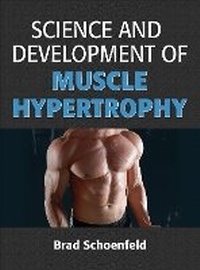
Science and Development of Muscle Hypertrophy
Published on 24. June 2016
Book
Hardback
224 pages
978-1-4925-1960-7 (ISBN)
Description
Muscle hypertrophy-defined as an increase in muscular size-is one of the primary outcomes of resistance training. Science and Development of Muscle Hypertrophy is a comprehensive compilation of science-based principles to help professionals develop muscle hypertrophy in athletes and clients. With more than 825 references and applied guidelines throughout, no other resource offers a comparable quantity of content solely focused on muscle hypertrophy. Readers will find up-to-date content so they fully understand the science of muscle hypertrophy and its application to designing training programs.
Written by Brad Schoenfeld, PhD, a leading authority on muscle hypertrophy, this text provides strength and conditioning professionals, personal trainers, sport scientists, researchers, and exercise science instructors with a definitive resource for information regarding muscle hypertrophy-the mechanism of its development, how the body structurally and hormonally changes when exposed to stress, ways to most effectively design training programs, and current nutrition guidelines for eliciting hypertrophic changes. The full-color book offers several features to make the content accessible to readers:
* Research Findings sidebars highlight the aspects of muscle hypertrophy currently being examined to encourage readers to re-evaluate their knowledge and ensure their training practices are up to date.
* Practical Applications sidebars outline how to apply the research conclusions for maximal hypertrophic development.
* Comprehensive subject and author indexes optimize the book's utility as a reference tool.
* An image bank containing most of the art, photos, and tables from the text allows instructors and presenters to easily teach the material outlined in the book.
Although muscle hypertrophy can be attained through a range of training programs, this text allows readers to understand and apply the specific responses and mechanisms that promote optimal muscle hypertrophy in their athletes and clients. It explores how genetic background, age, sex, and other factors have been shown to mediate the hypertrophic response to exercise, affecting both the rate and the total gain in lean muscle mass. Sample programs in the text show how to design a three- or four-day-per-week undulating periodized program and a modified linear periodized program for maximizing muscular development.
Science and Development of Muscle Hypertrophy is an invaluable resource for strength and conditioning professionals seeking to maximize hypertrophic gains and those searching for the most comprehensive, authoritative, and current research in the field.
Written by Brad Schoenfeld, PhD, a leading authority on muscle hypertrophy, this text provides strength and conditioning professionals, personal trainers, sport scientists, researchers, and exercise science instructors with a definitive resource for information regarding muscle hypertrophy-the mechanism of its development, how the body structurally and hormonally changes when exposed to stress, ways to most effectively design training programs, and current nutrition guidelines for eliciting hypertrophic changes. The full-color book offers several features to make the content accessible to readers:
* Research Findings sidebars highlight the aspects of muscle hypertrophy currently being examined to encourage readers to re-evaluate their knowledge and ensure their training practices are up to date.
* Practical Applications sidebars outline how to apply the research conclusions for maximal hypertrophic development.
* Comprehensive subject and author indexes optimize the book's utility as a reference tool.
* An image bank containing most of the art, photos, and tables from the text allows instructors and presenters to easily teach the material outlined in the book.
Although muscle hypertrophy can be attained through a range of training programs, this text allows readers to understand and apply the specific responses and mechanisms that promote optimal muscle hypertrophy in their athletes and clients. It explores how genetic background, age, sex, and other factors have been shown to mediate the hypertrophic response to exercise, affecting both the rate and the total gain in lean muscle mass. Sample programs in the text show how to design a three- or four-day-per-week undulating periodized program and a modified linear periodized program for maximizing muscular development.
Science and Development of Muscle Hypertrophy is an invaluable resource for strength and conditioning professionals seeking to maximize hypertrophic gains and those searching for the most comprehensive, authoritative, and current research in the field.
More details
Edition
New edition
Language
English
Place of publication
Champaign, IL
United States
Publishing group
Human Kinetics Publishers
Target group
Interest Age: From 18 to 99 years
Edition type
New edition
Product notice
Cloth over boards
Dimensions
Height: 279 mm
Width: 216 mm
Weight
1043 gr
ISBN-13
978-1-4925-1960-7 (9781492519607)
Copyright in bibliographic data and cover images is held by Nielsen Book Services Limited or by the publishers or by their respective licensors: all rights reserved.
Schweitzer Classification
Other editions
New editions
Brad J. Schoenfeld
Science and Development of Muscle Hypertrophy
Book
04/2020
2nd Edition
Human Kinetics
€68.50
Shipment within 15-20 days
Person
Brad Schoenfeld, PhD, CSCS, CSPS, FNSCA, is widely regarded as one of the leading strength and fitness experts in the United States. The 2011 NSCA Personal Trainer of the Year is a lifetime drug-free bodybuilder who has won numerous natural bodybuilding titles, including the All-Natural Physique and Power Conference (ANPPC) Tri-State Naturals and USA Mixed Pairs crowns. As a personal trainer, Schoenfeld has worked with numerous elite-level physique athletes, including many top pros. Also, he was elected to the National Strength and Conditioning Association's Board of Directors in 2012.
Schoenfeld is the author of multiple consumer-oriented fitness books, including The M.A.X. Muscle Plan and Strong and Sculpted (formerly Sculpting Her Body Perfect). He is a regular columnist for Muscular Development magazine, has been published or featured in virtually every major fitness magazine (including Muscle and Fitness, MuscleMag, Ironman, Oxygen, and Shape), and has appeared on hundreds of television shows and radio programs across the United States.
Schoenfeld earned his PhD in health promotion and wellness at Rocky Mountain University, where his research focused on elucidating the mechanisms of muscle hypertrophy and their application to resistance training. He has published more than 80 peer-reviewed scientific papers and serves on the editorial advisory boards for several journals, including the Journal of Strength and Conditioning Research and Journal of the International Society of Sports Nutrition. He is an assistant professor of exercise science at Lehman College in the Bronx, New York, and heads their human performance laboratory.
Schoenfeld is the author of multiple consumer-oriented fitness books, including The M.A.X. Muscle Plan and Strong and Sculpted (formerly Sculpting Her Body Perfect). He is a regular columnist for Muscular Development magazine, has been published or featured in virtually every major fitness magazine (including Muscle and Fitness, MuscleMag, Ironman, Oxygen, and Shape), and has appeared on hundreds of television shows and radio programs across the United States.
Schoenfeld earned his PhD in health promotion and wellness at Rocky Mountain University, where his research focused on elucidating the mechanisms of muscle hypertrophy and their application to resistance training. He has published more than 80 peer-reviewed scientific papers and serves on the editorial advisory boards for several journals, including the Journal of Strength and Conditioning Research and Journal of the International Society of Sports Nutrition. He is an assistant professor of exercise science at Lehman College in the Bronx, New York, and heads their human performance laboratory.
Content
Chapter 1. Hypertrophy-Related Responses and Adaptations to Exercise Stress
Neuromuscular System
Endocrine, Paracrine, and Autocrine Systems
Chapter 2. Mechanisms of Hypertrophy
Mechanical Tension
Metabolic Stress
Muscle Damage
Chapter 3. Role of Resistance Training Variables in Hypertrophy
Volume
Frequency
Load
Exercise Selection
Type of Muscle Action
Rest Interval Length
Repetition Duration
Exercise Order
Range of Motion
Intensity of Effort
Chapter 4. Role of Aerobic Training in Hypertrophy
Hypertrophic Effects From Aerobic-Only Training
Concurrent Training
Chapter 5. Factors in Maximal Hypertrophic Development
Genetics
Age
Sex
Training Status
Chapter 6. Program Design for Maximal Hypertrophy
Biomechanics
Exercise Selection Strategies
Periodization
Chapter 7. Nutrition for Hypertrophy
Energy Balance
Macronutrient Intake
Feeding Frequency
Nutrient Timing
Neuromuscular System
Endocrine, Paracrine, and Autocrine Systems
Chapter 2. Mechanisms of Hypertrophy
Mechanical Tension
Metabolic Stress
Muscle Damage
Chapter 3. Role of Resistance Training Variables in Hypertrophy
Volume
Frequency
Load
Exercise Selection
Type of Muscle Action
Rest Interval Length
Repetition Duration
Exercise Order
Range of Motion
Intensity of Effort
Chapter 4. Role of Aerobic Training in Hypertrophy
Hypertrophic Effects From Aerobic-Only Training
Concurrent Training
Chapter 5. Factors in Maximal Hypertrophic Development
Genetics
Age
Sex
Training Status
Chapter 6. Program Design for Maximal Hypertrophy
Biomechanics
Exercise Selection Strategies
Periodization
Chapter 7. Nutrition for Hypertrophy
Energy Balance
Macronutrient Intake
Feeding Frequency
Nutrient Timing