

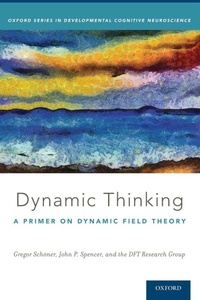
Dynamic Thinking
A Primer on Dynamic Field Theory
Published on 21. January 2016
Book
Hardback
418 pages
978-0-19-930056-3 (ISBN)
Description
Dynamic Thinking: A Primer on Dynamic Field Theory introduces the reader to a new approach to understanding cognitive and neural dynamics using the concepts of Dynamic Field Theory (DFT). Dynamic Neural Fields are formalizations of how neural populations represent the continuous dimensions of perceptual features, movements, and cognitive decisions. The concepts of DFT establish links between brain and behavior, revealing ways in which models of brain function can be tested with both neural and behavioral measures. Thus, DFT bridges the gap between brain and behavior, between neuroscience and the behavioral sciences. The book provides systematic tutorials on the central concepts of DFT and their grounding in both dynamical systems theory and neurophysiology. The concrete mathematical implementation of these concepts is laid out, supported by hands-on exercises that make use of interactive simulators in MATLAB. The book also contains a large set of exemplary case studies in which the concepts and associated models are used to understand how elementary forms of embodied cognition emerge and develop.
Reviews / Votes
"A thorough and systematic introduction to dynamic field theory and its applications to perception, cognition, and action. This book will allow students and researchers interested in this important modeling framework to learn all about it, and join in its future development. "-Jay McClelland, Director, Center for Mind, Brain, and Computation, Stanford UniversityMore details
Other editions
Additional editions

E-Book
11/2015
1st Edition
OUP eBook
€141.99
Available for download

E-Book
11/2015
1st Edition
OUP eBook
€141.99
Available for download
Persons
Gregor Schoener is a Professor and Chair of Theory of Cognitive Systems as well as the Director at the Institut fuer Neuroinformatik, Ruhr-Universitaet Bochum.
John P. Spencer is a Professor of Psychology at the University of East Anglia in Norwich, UK.
John P. Spencer is a Professor of Psychology at the University of East Anglia in Norwich, UK.
Content
Contributors
Abbreviations
General Introduction
John Spencer and Gregor Schoener
Part 1 Integrating Lower-Level Perception-Action with Higher-Level Cognition
Introduction to Part 1
Gregor Schoener and John P. Spencer
Chapter 1: The Dynamics of Neural Activation Variables
Gregor Schoener, Hendrik Reimann, and Jonas Lins
Chapter 2: Dynamic Field Theory
Gregor Schoener and Anne Schutte
Chapter 3: The Ties of DFT to Neurophyisology
Sebastian Schneegans, Jonas Lins, and Gregor Schoener
Chapter 4: Embodied Neural Dynamics
Gregor Schoener, Christian Faubel, Evelina Dineva, and Estela Bicho
Part 2 Integrating Lower-Level Perception-Action with Higher-Level Cognition
Introduction to Part 2
John P. Spencer and Gregor Schoener
Chapter 5: Integration and Selection in Multi-Dimensional Dynamic Fields.
Sebastian Schneegans, Jonas Lins, and John P. Spencer
Chapter 6: Integrating Perception and Working Memory in a Three-Layer Dynamic Field Model
Jeffrey S. Johnson and Vanessa R. Simmering
Chapter 7: Sensory-Motor and Cognitive Transformation
Sebastian Schneegans
Chapter 8: Integrating "What" and "Where": Visual Working Memory for Objects in a Scene
Sebastian Schneegans, John P. Spencer, and Gregor Schoener
Chapter 9: Dynamic Scene Representations and Autonomous Robotics
Stephan K. U. Zibner and Christian Faubel
Part 3 Integrating Thinking over Multiple Timescales
Introduction to Part 3
John P. Spencer and Gregor Schoener
Chapter 10: Developmental Dynamics: The Spatial Precision Hypothesis
Vanessa Simmering and Anne Schutte
Chapter 11: A Process View of Learning and Development in an Autonomous Exploratory System
Sammy Perone and Joseph P. Ambrose
Chapter 12: Grounding Word Learning in Space and Time
Larissa K. Samuelson and Christian Faubel
Chapter 13: The Emergence of Higher-level Cognitive Flexibility: DFT and Executive Function
Aaron T. Buss, Timothy Wifall, and Eliot Hazeltine
Chapter 14: Autonomous Sequence Generation in Dynamic Field Theory
Yulia Sandamirskaya
Conclusions: A 'How-to' Guide to Modeling with Dynamic Field Theory
Joseph Ambrose, Sebastian Schneegans, Gregor Schoener,
and John P. Spencer
Abbreviations
General Introduction
John Spencer and Gregor Schoener
Part 1 Integrating Lower-Level Perception-Action with Higher-Level Cognition
Introduction to Part 1
Gregor Schoener and John P. Spencer
Chapter 1: The Dynamics of Neural Activation Variables
Gregor Schoener, Hendrik Reimann, and Jonas Lins
Chapter 2: Dynamic Field Theory
Gregor Schoener and Anne Schutte
Chapter 3: The Ties of DFT to Neurophyisology
Sebastian Schneegans, Jonas Lins, and Gregor Schoener
Chapter 4: Embodied Neural Dynamics
Gregor Schoener, Christian Faubel, Evelina Dineva, and Estela Bicho
Part 2 Integrating Lower-Level Perception-Action with Higher-Level Cognition
Introduction to Part 2
John P. Spencer and Gregor Schoener
Chapter 5: Integration and Selection in Multi-Dimensional Dynamic Fields.
Sebastian Schneegans, Jonas Lins, and John P. Spencer
Chapter 6: Integrating Perception and Working Memory in a Three-Layer Dynamic Field Model
Jeffrey S. Johnson and Vanessa R. Simmering
Chapter 7: Sensory-Motor and Cognitive Transformation
Sebastian Schneegans
Chapter 8: Integrating "What" and "Where": Visual Working Memory for Objects in a Scene
Sebastian Schneegans, John P. Spencer, and Gregor Schoener
Chapter 9: Dynamic Scene Representations and Autonomous Robotics
Stephan K. U. Zibner and Christian Faubel
Part 3 Integrating Thinking over Multiple Timescales
Introduction to Part 3
John P. Spencer and Gregor Schoener
Chapter 10: Developmental Dynamics: The Spatial Precision Hypothesis
Vanessa Simmering and Anne Schutte
Chapter 11: A Process View of Learning and Development in an Autonomous Exploratory System
Sammy Perone and Joseph P. Ambrose
Chapter 12: Grounding Word Learning in Space and Time
Larissa K. Samuelson and Christian Faubel
Chapter 13: The Emergence of Higher-level Cognitive Flexibility: DFT and Executive Function
Aaron T. Buss, Timothy Wifall, and Eliot Hazeltine
Chapter 14: Autonomous Sequence Generation in Dynamic Field Theory
Yulia Sandamirskaya
Conclusions: A 'How-to' Guide to Modeling with Dynamic Field Theory
Joseph Ambrose, Sebastian Schneegans, Gregor Schoener,
and John P. Spencer