

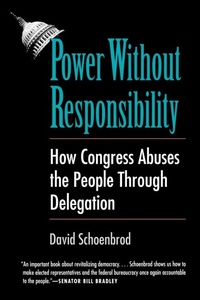
Power Without Responsibility
How Congress Abuses the People through Delegation
Will be published approx. on 26. September 1995
Book
Paperback/Softback
276 pages
978-0-300-06518-3 (ISBN)
Description
This book argues that Congress's process for making law is as corrosive to the nation as unchecked deficit spending.
David Schoenbrod shows that Congress and the president, instead of making the laws that govern us, generally give bureaucrats the power to make laws through agency regulations. Our elected "lawmakers" then take credit for proclaiming popular but inconsistent statutory goals and later blame the inevitable burdens and disappointments on the unelected bureaucrats. The 1970 Clean Air Act, for example, gave the Environmental Protection Agency the impossible task of making law that would satisfy both industry and environmentalists. Delegation allows Congress and the president to wield power by pressuring agency lawmakers in private, but shed responsibility by avoiding the need to personally support or oppose the laws, as they must in enacting laws themselves.
Schoenbrod draws on his experience as an attorney with the Natural Resources Defense Council and on studies of how delegation actually works to show that this practice produces a regulatory system so cumbersome that it cannot provide the protection that people need, so large that it needlessly stifles the economy, and so complex that it keeps the voters from knowing whom to hold accountable for the consequences. Contending that delegation is unnecessary and unconstitutional, Schoenbrod has written the first book that shows how, as a practical matter, delegation can be stopped.
David Schoenbrod shows that Congress and the president, instead of making the laws that govern us, generally give bureaucrats the power to make laws through agency regulations. Our elected "lawmakers" then take credit for proclaiming popular but inconsistent statutory goals and later blame the inevitable burdens and disappointments on the unelected bureaucrats. The 1970 Clean Air Act, for example, gave the Environmental Protection Agency the impossible task of making law that would satisfy both industry and environmentalists. Delegation allows Congress and the president to wield power by pressuring agency lawmakers in private, but shed responsibility by avoiding the need to personally support or oppose the laws, as they must in enacting laws themselves.
Schoenbrod draws on his experience as an attorney with the Natural Resources Defense Council and on studies of how delegation actually works to show that this practice produces a regulatory system so cumbersome that it cannot provide the protection that people need, so large that it needlessly stifles the economy, and so complex that it keeps the voters from knowing whom to hold accountable for the consequences. Contending that delegation is unnecessary and unconstitutional, Schoenbrod has written the first book that shows how, as a practical matter, delegation can be stopped.
More details
Language
English
Place of publication
United States
Target group
College/higher education
Professional and scholarly
Edition type
Large type / large print edition
Product notice
Paperback (trade)
Dimensions
Height: 229 mm
Width: 152 mm
Thickness: 16 mm
Weight
407 gr
ISBN-13
978-0-300-06518-3 (9780300065183)
Copyright in bibliographic data and cover images is held by Nielsen Book Services Limited or by the publishers or by their respective licensors: all rights reserved.
Schweitzer Classification
Other editions
Additional editions
E-Book
02/2002
1st Edition
Yale University Press
€59.95
Available for download