

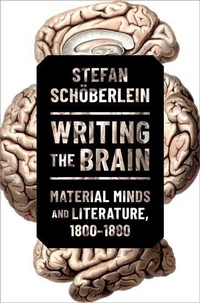
Writing the Brain
Material Minds and Literature, 1800-1880
Published on 7. November 2023
Book
Hardback
280 pages
978-0-19-769368-1 (ISBN)
Description
In the nineteenth century, American and British culture experienced an explosion of interest in writings about the brain. The years between 1800 and 1880 are often described as the emergence of modern neuroscience, with new areas of the brain being discovered and named. Naming was quickly followed by a drive to hypothesize functioning, a process that suggested thinking itself may be a mere physiological act. In Writing the Brain, Stefan Schoeberlein tracks how literature encountered such novel, scientific theories of cognition-and how it, in turn, shaped scientific thinking.
Before the era of modern psychology, a heterogeneous group of alienists, self-help gurus, and anatomists proposed that the structure of the brain could be used to explain how the mind worked. Suddenly, nineteenth-century readers and writers had to contend with the idea that qualities once ascribed to disembodied souls may arise from a mere lump of cranial matter. In a period when scientists and literary writers frequently published in the same periodicals, the ensuing debate over the material mind was a public one. Writing the Brain demonstrates, by examining several canonical works and textual rediscoveries, that these exchanges not only influenced how poets and novelists fictionalized the mind but also how scientists thought and talked about their discoveries. From George Combe to Charles Dickens, from Emily Dickinson to Pliny Earle, from Benjamin Rush to Alfred Tennyson, 1800s debated what it means to have or, rather, be a brain.
Before the era of modern psychology, a heterogeneous group of alienists, self-help gurus, and anatomists proposed that the structure of the brain could be used to explain how the mind worked. Suddenly, nineteenth-century readers and writers had to contend with the idea that qualities once ascribed to disembodied souls may arise from a mere lump of cranial matter. In a period when scientists and literary writers frequently published in the same periodicals, the ensuing debate over the material mind was a public one. Writing the Brain demonstrates, by examining several canonical works and textual rediscoveries, that these exchanges not only influenced how poets and novelists fictionalized the mind but also how scientists thought and talked about their discoveries. From George Combe to Charles Dickens, from Emily Dickinson to Pliny Earle, from Benjamin Rush to Alfred Tennyson, 1800s debated what it means to have or, rather, be a brain.
Reviews / Votes
Writing the Brain is an outstanding contribution to the growing body of work on nineteenth-century brain science and literature. The author brings extensive knowledge of Anglophone and European neurology to bear on canonical works like Wuthering Heights, Leaves of Grass, and the poems of Emily Dickinson, producing compelling original readings. Schoeberlein's adept use of anecdote and illustration makes this a particularly accessible resource that is well-suited for the classroom. * Anne Stiles, St Louis University * The brain contains multitudes. This revisionist and often surprising book rewrites that organ, fighting against forgetting. Our worries about neuropharmaceuticals and machine learning have a long pre-history. The brain as a cybernetic network of matter and metaphors, protoplasm and electricity, was born around 1800 and nineteenth-century explorations of the material mind glisten here with fresh relevance. As a literary and cultural historian, Stefan Schoeberlein is both truffle-hunter and landscape painter. He has a knack for finding things on both sides of the Atlantic no one has read in a century to rediscover authors we never stopped reading...Writing the Brain orchestrates a scintillating call-and-response between literature and science. Farewell to the two cultures. The brain is their meeting-point. * John Durham Peters, Yale University * Writing the Brain makes a considerable contribution to the study of literature and science... Writing the Brain delineates a compelling account of the literary life of the material mind. * Erica Fretwell, The British Society for Literature and Science *More details
Language
English
Place of publication
New York
United States
Target group
College/higher education
Product notice
sewn/stitched
Cloth over boards
Illustrations
30 illustrations
Dimensions
Height: 229 mm
Width: 160 mm
Thickness: 36 mm
Weight
544 gr
ISBN-13
978-0-19-769368-1 (9780197693681)
Copyright in bibliographic data and cover images is held by Nielsen Book Services Limited or by the publishers or by their respective licensors: all rights reserved.
Schweitzer Classification
Other editions
Additional editions
E-Book
09/2023
OUP eBook
€53.99
Available for download
E-Book
09/2023
OUP eBook
€53.99
Available for download
Person
Stefan Schoeberlein is Assistant Professor of English at Texas A&M University-Central Texas. He has edited Walt Whitman's New Orleans, co-edited the Oxford Handbook of Walt Whitman, and published literary translations into German. He has served as president of the Digital Americanists Society and is currently a contributing editor of the Walt Whitman Archive.
Content
Acknowledgements The First Century of the Brain: An Introduction Chapter 1. Nature's Mind and Mind's Nature: Romantic Cognition Between Harp and Atom
Harp-Strings Mind-Strings Mind-Matter Mind-Atoms Chapter 2. Split Brains, Doubled Minds: The Gothic's Bicameral Vision
The Sleepers Dialoging the Self Hemispheric Voices Master-Minds Chapter 3: Skulls and Society: Reading the Mind as a Multi-Organ Entity
Brain-Damage
Phrenology as Sociology
Phrenological Victorianism
Phrenological Americanism
Phrenology's Real Chapter 4: Cranial Reconstruction: Racialized Brains and the Psychometric Real
Uncommon Minds
Great Brains
A Cranial Case Study
Realism as Psychometry Chapter 5: Rattle-Brained: Insanity as Material Metacognition
You, Me, Brain
Metempsychosis as Metacognition
Insanity as Pop Culture
Psychosis as Metacognition Chapter 6: The Telegraphed Brain: Wires as Proto-Neurons
Thoughts on Wires
Telegraphed Minds
Introspective Brain-Machines Afterword
References
Index
Harp-Strings Mind-Strings Mind-Matter Mind-Atoms Chapter 2. Split Brains, Doubled Minds: The Gothic's Bicameral Vision
The Sleepers Dialoging the Self Hemispheric Voices Master-Minds Chapter 3: Skulls and Society: Reading the Mind as a Multi-Organ Entity
Brain-Damage
Phrenology as Sociology
Phrenological Victorianism
Phrenological Americanism
Phrenology's Real Chapter 4: Cranial Reconstruction: Racialized Brains and the Psychometric Real
Uncommon Minds
Great Brains
A Cranial Case Study
Realism as Psychometry Chapter 5: Rattle-Brained: Insanity as Material Metacognition
You, Me, Brain
Metempsychosis as Metacognition
Insanity as Pop Culture
Psychosis as Metacognition Chapter 6: The Telegraphed Brain: Wires as Proto-Neurons
Thoughts on Wires
Telegraphed Minds
Introspective Brain-Machines Afterword
References
Index