

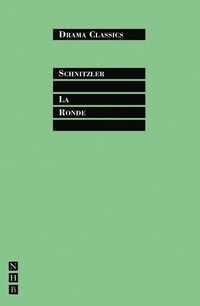
La Ronde
Published on 1. December 2007
Book
Paperback/Softback
128 pages
978-1-85459-587-4 (ISBN)
Description
Drama Classics: The World's Great Plays at a Great Little Price
Arthur Schnitzler's famous 'daisy-chain' play of sexual coupling, set in Vienna in the 1890s.
La Ronde is a play of ten scenes, each depicting a couple in a sexual liaison. There are ten characters altogether, each appearing in two adjacent scenes, forming an endless chain of sexual links across all the layers of Viennese society.
This edition, in the Nick Hern Books Drama Classics series, features a translation by Stephen Unwin and Peter Zombory-Moldovan.
Arthur Schnitzler's famous 'daisy-chain' play of sexual coupling, set in Vienna in the 1890s.
La Ronde is a play of ten scenes, each depicting a couple in a sexual liaison. There are ten characters altogether, each appearing in two adjacent scenes, forming an endless chain of sexual links across all the layers of Viennese society.
This edition, in the Nick Hern Books Drama Classics series, features a translation by Stephen Unwin and Peter Zombory-Moldovan.
More details
Series
Language
English
Place of publication
London
United Kingdom
Product notice
Paperback (trade)
Unsewn / adhesive bound
Dimensions
Height: 160 mm
Width: 108 mm
Thickness: 12 mm
Weight
101 gr
ISBN-13
978-1-85459-587-4 (9781854595874)
Copyright in bibliographic data and cover images is held by Nielsen Book Services Limited or by the publishers or by their respective licensors: all rights reserved.
Schweitzer Classification
Other editions
Additional editions
E-Book
11/2015
Nick Hern Books
€6.99
Available for download
Persons
Arthur Schnitzler's Reigen (its original title, conventionally translated as La Ronde) was written in Vienna in 1896/7 but, because of its scandalous subject-matter, was not performed in full until 1920. It has been adapted often (notably by David Hare as The Blue Room), and filmed several times (including by Max Ophuls, 1950; Roger Vadim, 1964; and Otto Schenk, 1973).