

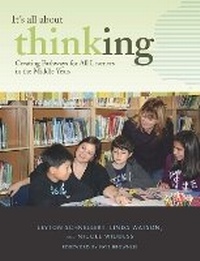
Creating Pathways for All Learners in the Middle Years
Will be published approx. on 26. February 2015
Book
Paperback/Softback
229 pages
978-1-55379-509-4 (ISBN)
Description
In this third volume of It's All About Thinking, the authors focus on teaching and learning in the middle years, transforming principles into practices, and exploring such questions as: How can we help students develop the competencies they need to become successful learners? How can we create pathways to deep learning of important concepts? How can we engage and support diverse learners in inclusive classrooms? Nicole, Linda, and Leyton explore these questions and offer classroom examples to help busy teachers develop communities where all students learn, focusing on the big ideas in middle years education today.
More details
Series
Language
English
Place of publication
Canada
Target group
Interest Age: From 5 to 8 years
Product notice
Paperback (trade)
Illustrations
Illustrations
Dimensions
Height: 264 mm
Width: 201 mm
Thickness: 18 mm
Weight
621 gr
ISBN-13
978-1-55379-509-4 (9781553795094)
Copyright in bibliographic data and cover images is held by Nielsen Book Services Limited or by the publishers or by their respective licensors: all rights reserved.
Schweitzer Classification
Other editions
Additional editions
Leyton Schnellert | Linda Watson | Nicole Widdess
Creating Pathways for All Learners in the Middle Years
E-Book
09/2011
Portage & Main Press
€22.49
Available for download
Persons
Leyton Schnellert, PhD, (he/his/him) is an associate professor in UBC's Department of Curriculum & Pedagogy and Eleanor Rix Professor in Rural Teacher Education. He focuses on how teachers and teaching and learners and learning can mindfully embrace student diversity and inclusive education. Dr. Schnellert is the Pedagogy and Participation research cluster lead in UBC's Institute for Community Engaged Research, inclusive education research lead in the Canadian Institute for Inclusion and Citizenship, and co-chair of BC's Rural Education Advisory. His community-based collaborative work contributes a counter argument to top-down approaches that operate from deficit models, instead drawing from communities' funds of knowledge to build participatory, place-conscious, and culturally responsive practices. Leyton works and learns on the traditional, ancestral, and unceded territory of the Sinixt who were declared extinct by Canada's government in 1956 and stands in solidarity with the Sinixt in their reclamation efforts.
Leyton has been a middle and secondary years classroom teacher and a learning resource teacher for grades K-12. His books, films, and research articles are widely referenced locally, nationally, and globally.
Nicole Widdess currently works in the Richmond School District as an Elementary School Principal. She has been working for 20 years in both an elementary and high school setting. Multiple roles such as Resource teacher and ELL teacher have benefited her in understanding individual student needs. She is committed to teaching diverse learners and is passionate about literacy. She is co-author with Leyton Schnellert and Linda Watson to It's all about thinking: Creating Pathways for All Learners in the Middle Years.
Faye Brownlie's (she/her/hers) goal is to build capacity with teachers, co-planning and co-teaching, providing seminars, workshops, and keynote presentations in Canada, the United States, Europe, and Asia. Passionate about including and supporting all learners, her work focuses on literacy, teaching for thinking, assessment, and inclusion. She has co-authored many books for teachers, including It's All About Thinking series for Portage & Main Press and most recently, a 2nd edition of Grand Conversations Thoughtful Responses. Faye believes, 'We know enough, collectively, to teach all our students to read, and more importantly, to create readers who not only can read but want to read."
Leyton has been a middle and secondary years classroom teacher and a learning resource teacher for grades K-12. His books, films, and research articles are widely referenced locally, nationally, and globally.
Nicole Widdess currently works in the Richmond School District as an Elementary School Principal. She has been working for 20 years in both an elementary and high school setting. Multiple roles such as Resource teacher and ELL teacher have benefited her in understanding individual student needs. She is committed to teaching diverse learners and is passionate about literacy. She is co-author with Leyton Schnellert and Linda Watson to It's all about thinking: Creating Pathways for All Learners in the Middle Years.
Faye Brownlie's (she/her/hers) goal is to build capacity with teachers, co-planning and co-teaching, providing seminars, workshops, and keynote presentations in Canada, the United States, Europe, and Asia. Passionate about including and supporting all learners, her work focuses on literacy, teaching for thinking, assessment, and inclusion. She has co-authored many books for teachers, including It's All About Thinking series for Portage & Main Press and most recently, a 2nd edition of Grand Conversations Thoughtful Responses. Faye believes, 'We know enough, collectively, to teach all our students to read, and more importantly, to create readers who not only can read but want to read."
Content
Table of Contents
Foreword xi
Chapter 1 Teaching and Learning in the Middle Years: Diversity as Strength 1
Developing and Sharing Our Practice 2
Middle Years Philosophy and Practice 2
Identity Development in the Middle Years 8
Conclusion 10
Chapter 2 Pathways to Professional Learning: Inquiry, Collaboration, and Professional Reading 11
All Teachers, All Subjects 13
Working Together for All Learners 13
A Collaborative Model of Support 16
Collaborating to Teach Math to Combined Grades 18
Lesson Study: A Powerful Approach to Teacher Teams 21
Teacher Leaders as Facilitators and Co-Learners 24
Conclusion 26
Chapter 3 Responsive Teaching: Connecting Assessment, Planning, and Instruction 27
(In)formative Assessment: Getting Started 28
Using a Performance-Based Assessment to Guide
Your Teaching 32
Assessing Student Work 35
The Cycle of Assessing, Planning, Teaching, and Assessing 38
Planning to Use Formative Assessment Information 39
From Assessment to Instruction 41
Grouping Students for Optimal Learning 43
Differentiation 51
Conclusion 51
Chapter 4 Deep Learning: Integrating Content, Process, and Product 53
The Curriculum We Need 54
Including Students with Significant Learning Challenges 58
Using Diverse Texts and Big Ideas to Enhance Student Engagement 68
Information Circles Using Text Sets 75
Conclusion 79
Chapter 5 Creating Pathways by Integrating the Arts 81
Rationale for Integrating the Arts 82
Drama as a Pathway 84
Dance and Music as Pathways 91
Visual Arts as a Pathway 97
Conclusion 104
Chapter 6 Creating Pathways Using Inquiry and Project-Based Learning 105
Project-Based Learning 106
Lessons in Decoding Texts and Constructing Meaning 110
Inquiry-Based Research 114
Inquiry in a Differentiated Math Class 126
Developing Powerful Questions in Humanities 131
Deep Inquiry Learning: An Integrative Unit 136
Conclusion 150
Chapter 7 Creating Pathways through Social-Emotional Learning 153
Developing a Learning Community 154
Integrating Social-Emotional Learning and
Project-Based Learning 158
Service Learning 167
Challenge-Based Projects in Community Learning 172
Effective Essential Questions and Challenge Statements 175
Conclusion 180
Chapter 8 Creating Pathways to Self-Regulated Learning 181
Helping Students Self-Regulate 182
Building Criteria with Students 189
Making Shakespeare Accessible 190
Engaging Students as Critical Thinkers 195
Numeracy Circles: Tackling Problems Together 197
Conclusion 204
Chapter 9 Creating Pathways Using Diverse Texts 205
What is a text? 206
The Power of Text Sets 206
First Nations Community-Generated Texts 209
Information Texts: Synthesis and Inference 212
Graphic Novels Expand Our Repertoire of Text 216
Integrating Diverse Texts 227
Stop Cyberbullying Unit 231
Conclusion 236
Chapter 10 Creating Pathways through Writing 237
The Pleasure of Writing 238
Poetic Play Pays Off 239
A Pathway into Personal Writing 243
Writing Informational Texts through Inquiry 246
Conclusion 259
Chapter 11 Creating Pathways through Technology and New Literacies 261
Making the World a Better Place Together 263
Musqueam Inquiry - Using iPads 269
Creating Pathways with New Technologies 277
Conclusion 288
References 289
Index of Frameworks, Approaches, or Strategies 297
Foreword xi
Chapter 1 Teaching and Learning in the Middle Years: Diversity as Strength 1
Developing and Sharing Our Practice 2
Middle Years Philosophy and Practice 2
Identity Development in the Middle Years 8
Conclusion 10
Chapter 2 Pathways to Professional Learning: Inquiry, Collaboration, and Professional Reading 11
All Teachers, All Subjects 13
Working Together for All Learners 13
A Collaborative Model of Support 16
Collaborating to Teach Math to Combined Grades 18
Lesson Study: A Powerful Approach to Teacher Teams 21
Teacher Leaders as Facilitators and Co-Learners 24
Conclusion 26
Chapter 3 Responsive Teaching: Connecting Assessment, Planning, and Instruction 27
(In)formative Assessment: Getting Started 28
Using a Performance-Based Assessment to Guide
Your Teaching 32
Assessing Student Work 35
The Cycle of Assessing, Planning, Teaching, and Assessing 38
Planning to Use Formative Assessment Information 39
From Assessment to Instruction 41
Grouping Students for Optimal Learning 43
Differentiation 51
Conclusion 51
Chapter 4 Deep Learning: Integrating Content, Process, and Product 53
The Curriculum We Need 54
Including Students with Significant Learning Challenges 58
Using Diverse Texts and Big Ideas to Enhance Student Engagement 68
Information Circles Using Text Sets 75
Conclusion 79
Chapter 5 Creating Pathways by Integrating the Arts 81
Rationale for Integrating the Arts 82
Drama as a Pathway 84
Dance and Music as Pathways 91
Visual Arts as a Pathway 97
Conclusion 104
Chapter 6 Creating Pathways Using Inquiry and Project-Based Learning 105
Project-Based Learning 106
Lessons in Decoding Texts and Constructing Meaning 110
Inquiry-Based Research 114
Inquiry in a Differentiated Math Class 126
Developing Powerful Questions in Humanities 131
Deep Inquiry Learning: An Integrative Unit 136
Conclusion 150
Chapter 7 Creating Pathways through Social-Emotional Learning 153
Developing a Learning Community 154
Integrating Social-Emotional Learning and
Project-Based Learning 158
Service Learning 167
Challenge-Based Projects in Community Learning 172
Effective Essential Questions and Challenge Statements 175
Conclusion 180
Chapter 8 Creating Pathways to Self-Regulated Learning 181
Helping Students Self-Regulate 182
Building Criteria with Students 189
Making Shakespeare Accessible 190
Engaging Students as Critical Thinkers 195
Numeracy Circles: Tackling Problems Together 197
Conclusion 204
Chapter 9 Creating Pathways Using Diverse Texts 205
What is a text? 206
The Power of Text Sets 206
First Nations Community-Generated Texts 209
Information Texts: Synthesis and Inference 212
Graphic Novels Expand Our Repertoire of Text 216
Integrating Diverse Texts 227
Stop Cyberbullying Unit 231
Conclusion 236
Chapter 10 Creating Pathways through Writing 237
The Pleasure of Writing 238
Poetic Play Pays Off 239
A Pathway into Personal Writing 243
Writing Informational Texts through Inquiry 246
Conclusion 259
Chapter 11 Creating Pathways through Technology and New Literacies 261
Making the World a Better Place Together 263
Musqueam Inquiry - Using iPads 269
Creating Pathways with New Technologies 277
Conclusion 288
References 289
Index of Frameworks, Approaches, or Strategies 297