

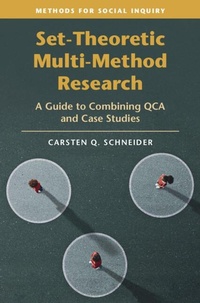
Set-Theoretic Multi-Method Research
A Guide to Combining QCA and Case Studies
Published on 29. February 2024
Book
Hardback
276 pages
978-1-009-30714-7 (ISBN)
Description
A state-of-the-art comprehensive exposition of combining Qualitative Comparative Analysis (QCA) and case studies, this book facilitates the efficient use and independent learning of this form of SMMR (set-theoretic multi-method research) with the best available software. It will reduce the time and effort required when performing both QCA and case studies within the same research project. This is achieved by spelling out the conceptual principles and practices in SMMR, and by introducing a tailor-made R software package. With an applied and practical focus, this is an intuitive resource for implementing the most complete protocol of SMMR. Features include Learning Goals, Core Points, and Empirical Examples, as well as boxed examples of R codes and the R output it produces. There is also a glossary for key SMMR terms. Additional online material is available, comprising machine-readable datasets and R scripts for replication and independent learning.
Reviews / Votes
'Carsten Schneider has forgotten more about set-theoretic methods than you and I can ever hope to know. This book is the one you need if you are an (applied) researcher, looking to combine cross-case inferences and within-case analysis. It's so insightful you better not put it on the shelf but on your desk.' Bart Cambre, Professor Business Research Methods, Antwerp Management School and University of Antwerp 'Combining QCA and case study tools has long been emphasized for stronger causal inference, but Carsten Schneider's book takes it to another level by developing a comprehensive approach for just how to do it right. Well-argued and chock full of insight, with many empirical illustrations, it makes a compelling case for multi-method research. I consider it required reading for anyone working in the comparative perspective.' Peer C. Fiss, Jill and Frank Fertitta Chair in Business Administration, University of Southern California Marshall School of Business 'This long awaited volume is a must-read for anyone striving to build on the respective strengths of QCA and case-based work. It enables the fruitful bridging of cross-case and within-case analysis by providing both a robust conceptual framework and technically precise protocols.' Benoit Rihoux, Full Professor, University of Louvain (UCLouvain), Belgium 'This much awaited book is an essential, incredibly useful resource for all scholars who seek to take cases seriously and improve their descriptive and causal inferences using set-theoretic methods in a systematic, rigorous, yet intuitive way. Seemingly effortlessly, Schneider takes case-oriented set-theoretic methodology to the next level while putting practice centerstage, so that the book is both cutting-edge and accessible, and speaks to readers with basic or advanced knowledge of set-theoretic methods.' Eva Thomann, University of KonstanzMore details
Series
Language
English
Place of publication
Cambridge
United Kingdom
Product notice
sewn/stitched
Cloth over boards
Illustrations
Worked examples or Exercises
Dimensions
Height: 229 mm
Width: 152 mm
Thickness: 16 mm
Weight
531 gr
ISBN-13
978-1-009-30714-7 (9781009307147)
Copyright in bibliographic data and cover images is held by Nielsen Book Services Limited or by the publishers or by their respective licensors: all rights reserved.
Schweitzer Classification
Other editions
Additional editions
Book
02/2024
Cambridge University Press
€29.50
Shipment within 15-20 days
E-Book
02/2024
Cambridge University Press
€27.99
Available for download
E-Book
11/2023
Cambridge University Press
€27.99
Available for download
Person
Carsten Q. Schneider is Pro-Rector for External Relations and Professor of Political Science at Central European University (CEU). He teaches set-theoretic methods worldwide and his research in comparative politics and social science methodology has appeared in leading international journals and publishing houses.
Content
Preface; 1. Introduction: SMMR in a nutshell; 2. Basics of SMMR; 3. Disjunctions; 4. Conjunctions; 5. INUS conditions; 6. Necessary conditions; 7. Conclusions and outlook; Appendix: Principles; Glossary.