

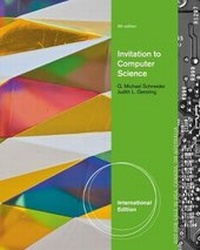
Invitation to Computer Science, International Edition
6th Edition
Published on 12. January 2012
Book
Paperback/Softback
744 pages
978-1-133-19108-7 (ISBN)
Description
INVITATION TO COMPUTER SCIENCE, 6E, International Edition is a well-respected text that provides an overview of the computer science field. Using a flexible, non-language specific model, INVITATION TO COMPUTER SCIENCE, 6E, International Edition offers a solid foundation for the first course in a Computer Science curriculum. INVITATION TO COMPUTER SCIENCE, 6E, International Edition maintains its bestselling, algorithm-driven approach and includes expanded chapter exercises and practice problems, as well as new boxes dedicated to mobile applications and current issues throughout. Online language modules are available in C++, Java, Python, C#, and Ada, allowing the option of incorporating a programming language to expand concepts from the text.
INVITATION TO COMPUTER SCIENCE, 6E, International Edition offers an optional CourseMate with study tools such as flashcards, quizzing, and games. CourseMate Activities speak to and engage students while developing abstract thinking and problem solving skills.
Also available with INVITATION TO COMPUTER SCIENCE, 6E, International Edition, an optional Lab Manual containing 20 laboratory projects that map directly to the main text. The Lab Manual and accompanying software provide both visual and hands-on activities, allowing students to experience the fundamentals of computer science.
INVITATION TO COMPUTER SCIENCE, 6E, International Edition offers an optional CourseMate with study tools such as flashcards, quizzing, and games. CourseMate Activities speak to and engage students while developing abstract thinking and problem solving skills.
Also available with INVITATION TO COMPUTER SCIENCE, 6E, International Edition, an optional Lab Manual containing 20 laboratory projects that map directly to the main text. The Lab Manual and accompanying software provide both visual and hands-on activities, allowing students to experience the fundamentals of computer science.
Reviews / Votes
1. An Introduction to Computer Science. 2. Algorithm Discovery and Design. 3. The Efficiency of Algorithms. 4. The Building Blocks: Binary Numbers, Boolean Logic, and Gates. 5. Computer Systems Organization. 6. An Introduction to System Software and Virtual Machines. 7. Computer Networks, the Internet, and the World Wide Web. 8. Information Security. 9. Introduction to High-Level Language Programming. 10. The Tower of Babel: Multiple Programming Voices. 11. Compilers and Language Translation. 12. Models of Computation. 13. Simulation and Modeling. 14. Electronic Commerce and Databases. 15. Artificial Intelligence. 16. Computer Graphics and Entertainment: Movies, Games, and Virtual Communities. 17. Making Ethical Decisions.More details
Edition
6th edition
Language
English
Place of publication
Boston, MA
United States
Publishing group
Cengage Learning, Inc
Target group
College/higher education
Dimensions
Height: 33 mm
Width: 203 mm
Thickness: 251 mm
Weight
1474 gr
ISBN-13
978-1-133-19108-7 (9781133191087)
Copyright in bibliographic data and cover images is held by Nielsen Book Services Limited or by the publishers or by their respective licensors: all rights reserved.
Schweitzer Classification
Persons
G. Michael Schneider is Professor Emeritus of Mathematics and Computer Science at Macalester College in St. Paul, Minnesota. He also served as a Visiting Professor of Computer Science at Columbia University in New York. His professional interests include parallel processing, computer networks, programming methodology, and computer science education. He has written many successful textbooks on software development, data structures, computer organization, and a breadth-first overview of computer science. Dr. Schneider was a member of the committee that authored the ACM/IEEE Computing Curriculum 2001. He has received Fulbright Grants to teach computer science and applied mathematics in Mauritius, Malaysia, Nepal, and Mongolia. He received his B.S. from Michigan University and his M.Sc. and Ph.D. in computer science from the University of Wisconsin-Madison. Judith Gersting is a Professor Emeritus of Computer Science at the University of Hawaii at Hilo and at Indiana University-Purdue University at Indianapolis, where she now teaches part-time. An experienced educator and respected professional, Dr. Gersting has written a number of leading college textbooks. Her areas of specialization include theoretical computer science and computer science education. She earned her B.S. from Stetson University and her M.A. and Ph.D. in mathematics from Arizona State University.
Content
1. An Introduction to Computer Science.
2. Algorithm Discovery and Design.
3. The Efficiency of Algorithms.
4. The Building Blocks: Binary Numbers, Boolean Logic, and Gates.
5. Computer Systems Organization.
6. An Introduction to System Software and Virtual Machines.
7. Computer Networks, the Internet, and the World Wide Web.
8. Information Security.
9. Introduction to High-Level Language Programming.
10. The Tower of Babel: Multiple Programming Voices.
11. Compilers and Language Translation.
12. Models of Computation.
13. Simulation and Modeling.
14. Electronic Commerce and Databases.
15. Artificial Intelligence.
16. Computer Graphics and Entertainment: Movies, Games, and Virtual Communities.
17. Making Ethical Decisions.
2. Algorithm Discovery and Design.
3. The Efficiency of Algorithms.
4. The Building Blocks: Binary Numbers, Boolean Logic, and Gates.
5. Computer Systems Organization.
6. An Introduction to System Software and Virtual Machines.
7. Computer Networks, the Internet, and the World Wide Web.
8. Information Security.
9. Introduction to High-Level Language Programming.
10. The Tower of Babel: Multiple Programming Voices.
11. Compilers and Language Translation.
12. Models of Computation.
13. Simulation and Modeling.
14. Electronic Commerce and Databases.
15. Artificial Intelligence.
16. Computer Graphics and Entertainment: Movies, Games, and Virtual Communities.
17. Making Ethical Decisions.