

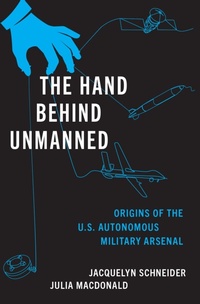
The Hand Behind Unmanned
Origins of the US Autonomous Military Arsenal
Published on 23. May 2025
Book
Hardback
280 pages
978-0-19-006438-9 (ISBN)
Description
The Hand Behind Unmanned tells the fascinating story of the people, processes, and beliefs that led to the contemporary American unmanned arsenal. It takes an expansive look at automated and autonomous technologies, from mines and torpedoes, to guided bombs and missiles, satellites, and ultimately drones. Instead of asking the question: "why unmanned rather than manned," the book explains why certain types of unmanned systems became popular while others languished in research or in small pockets of the American military.
In order to answer this question, Jacquelyn Schneider and Julia Macdonald use interviews of senior decisionmakers, military doctrine and writings, and historical sources to detail the proliferation of over a hundred years of unmanned weapons in the US arsenal, from mines and balloons to Reapers and Global Hawks. Their exploration reveals how multiple factors--key policy entrepreneurs, like Andy Marshall in the Office of Net Assessment; critical junctures like the fall of the USSR or the 9/11 attacks; beliefs that emerged in the wake of the Vietnam War; and US military service culture--all interacted in complex ways to form today's unmanned arsenal.
The Hand Behind Unmanned uses theories of organizational innovation and process tracing of historical cases to explain recent developments, including US precision munition shortfalls and the rise of unmanned aerial platforms. It also foreshadows where the US unmanned arsenal may be headed in the future. Ultimately, the book uses a remarkable case study to illustrate how ideas diffuse across people and organizations to build the weapons of modern warfare.
In order to answer this question, Jacquelyn Schneider and Julia Macdonald use interviews of senior decisionmakers, military doctrine and writings, and historical sources to detail the proliferation of over a hundred years of unmanned weapons in the US arsenal, from mines and balloons to Reapers and Global Hawks. Their exploration reveals how multiple factors--key policy entrepreneurs, like Andy Marshall in the Office of Net Assessment; critical junctures like the fall of the USSR or the 9/11 attacks; beliefs that emerged in the wake of the Vietnam War; and US military service culture--all interacted in complex ways to form today's unmanned arsenal.
The Hand Behind Unmanned uses theories of organizational innovation and process tracing of historical cases to explain recent developments, including US precision munition shortfalls and the rise of unmanned aerial platforms. It also foreshadows where the US unmanned arsenal may be headed in the future. Ultimately, the book uses a remarkable case study to illustrate how ideas diffuse across people and organizations to build the weapons of modern warfare.
More details
Series
Language
English
Place of publication
New York
United States
Target group
Professional and scholarly
Dimensions
Height: 241 mm
Width: 159 mm
Thickness: 27 mm
Weight
522 gr
ISBN-13
978-0-19-006438-9 (9780190064389)
Copyright in bibliographic data and cover images is held by Nielsen Book Services Limited or by the publishers or by their respective licensors: all rights reserved.
Schweitzer Classification
Other editions
Additional editions
Jacquelyn Schneider | Julia MacDonald
The Hand Behind Unmanned
Origins of the US Autonomous Military Arsenal
E-Book
01/2025
OUP eBook
€24.99
Available for download
Jacquelyn Schneider | Julia MacDonald
The Hand Behind Unmanned
Origins of the US Autonomous Military Arsenal
E-Book
01/2025
OUP eBook
€24.99
Available for download
Persons
Jacquelyn Schneider is a Hoover Fellow and Director of the Wargaming and Crisis Simulation Initiative. Her research focuses on the intersection of technology, national security, and political psychology. Dr. Schneider is an active member of the defense policy community with previous positions with the Naval War College, Cyberspace Solarium Commission, Center for a New American Security, and the RAND Corporation. Before beginning her academic career, she spent six years as an Air Force officer and is currently a reservist. She has a BA from Columbia University, MA from Arizona State University, and PhD from George Washington University.
Julia Macdonald is a Research Professor at the Korbel School of International Studies, University of Denver, and Director of Research and Engagement at the Asia New Zealand Foundation. Her research focuses on state threat assessments, use of force decisions, and military strategy and effectiveness. She has held positions at the RAND Corporation, the
New Zealand Ministry of Defence, and most recently New Zealand's Department of the Prime Minister and Cabinet where she led development of New Zealand's first National Security Strategy. She holds a Ph.D. from the George Washington University, an M.A. (Hons) from the University of Chicago, and a B.A. (Hons) from the University of Canterbury, New Zealand.
Julia Macdonald is a Research Professor at the Korbel School of International Studies, University of Denver, and Director of Research and Engagement at the Asia New Zealand Foundation. Her research focuses on state threat assessments, use of force decisions, and military strategy and effectiveness. She has held positions at the RAND Corporation, the
New Zealand Ministry of Defence, and most recently New Zealand's Department of the Prime Minister and Cabinet where she led development of New Zealand's first National Security Strategy. She holds a Ph.D. from the George Washington University, an M.A. (Hons) from the University of Chicago, and a B.A. (Hons) from the University of Canterbury, New Zealand.
Content
Introduction
Chapter 1: The Rise of Unmanned Technology
Chapter 2: A Theory of Unmanned Proliferation
Chapter 3: Military Revolutions and Technological Determinism
Chapter 4: Casualty Aversion and Force Protection
Chapter 5: Service Identity
Chapter 6: Conclusion
Bibliography
Chapter 1: The Rise of Unmanned Technology
Chapter 2: A Theory of Unmanned Proliferation
Chapter 3: Military Revolutions and Technological Determinism
Chapter 4: Casualty Aversion and Force Protection
Chapter 5: Service Identity
Chapter 6: Conclusion
Bibliography