


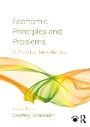
Economic Principles and Problems
A Pluralist Introduction
2nd Edition
Published on 18. March 2025
Book
Hardback
998 pages
978-1-032-61976-7 (ISBN)
Description
Economic Principles and Problems: A Pluralistic Introduction offers a comprehensive introduction to the major perspectives in modern economics, including mainstream and heterodox approaches. Through providing multiple views of markets and how they work, it leaves readers better able to understand and analyze the complex behaviors of consumers, firms, and government officials, as well as the likely impact of a variety of economic events and policies.
Including explicit coverage of mainstream economics and the major heterodox schools of economic thought-institutionalists, feminists, radical political economists, post-Keynesians, Austrians, and social economists-it allows the reader to choose which ideas they find most compelling in explaining modern economic realities. This second edition includes new and expanded material on international trade (to include disintegration and Brexit), climate issues and perspectives, including degrowth, inter-temporal exchanges and games, non-market exchanges, job opportunities, cost of education, and social media as an industry, as well as additional examples and case studies. The book's suite of digital resources has been updated to include a test bank of multiple-choice and short-answer questions and answers, end-of-chapter questions and answers, and PowerPoint slides.
Written in an engaging style and focused on real-world examples, this textbook brings economics to life. Economic Principles and Problems offers the most contemporary and complete package for any pluralist economics class.
Including explicit coverage of mainstream economics and the major heterodox schools of economic thought-institutionalists, feminists, radical political economists, post-Keynesians, Austrians, and social economists-it allows the reader to choose which ideas they find most compelling in explaining modern economic realities. This second edition includes new and expanded material on international trade (to include disintegration and Brexit), climate issues and perspectives, including degrowth, inter-temporal exchanges and games, non-market exchanges, job opportunities, cost of education, and social media as an industry, as well as additional examples and case studies. The book's suite of digital resources has been updated to include a test bank of multiple-choice and short-answer questions and answers, end-of-chapter questions and answers, and PowerPoint slides.
Written in an engaging style and focused on real-world examples, this textbook brings economics to life. Economic Principles and Problems offers the most contemporary and complete package for any pluralist economics class.
More details
Series
Edition
2nd edition
Language
English
Place of publication
London
United Kingdom
Publishing group
Taylor & Francis Ltd
Target group
College/higher education
Postgraduate and Undergraduate
Illustrations
320 farbige Abbildungen, 15 Farbfotos bzw. farbige Rasterbilder, 305 farbige Zeichnungen
305 Line drawings, color; 15 Halftones, color; 320 Illustrations, color
Dimensions
Height: 246 mm
Width: 174 mm
Weight
2160 gr
ISBN-13
978-1-032-61976-7 (9781032619767)
Copyright in bibliographic data and cover images is held by Nielsen Book Services Limited or by the publishers or by their respective licensors: all rights reserved.
Schweitzer Classification
Other editions
Additional editions

E-Book
03/2025
2nd Edition
Routledge
€129.99
Available for download

E-Book
03/2025
2nd Edition
Routledge
€129.99
Available for download
Book
03/2025
2nd Edition
Routledge
€138.14
Shipment within 10-20 days
Previous edition

Book
11/2021
1st Edition
Routledge
€401.11
Article exhausted; check for reprint
Person
Geoffrey Schneider is Presidential Professor of Economics at Bucknell University, Pennsylvania, U.S.A. He is an award-winning teacher, author or co-author of seven books and numerous scholarly articles, and executive director of the International Confederation of Associations for Pluralism in Economics.
Content
PART I Economics: a pluralist definition 1 What is economics? The answer depends on who you ask; 2 Scarcity, choice, and opportunity cost: the mainstream PPC model, its limits, and the importance of institutions; PART II The evolution of economic ideas and systems 3 The evolution of pre-capitalist economic systems: from communal societies to empires, feudalism, and mercantilism; 4 Adam Smith and the rise of capitalism: the era of laissez-faire; 5 Karl Marx and the dark ages of capitalism: historical materialism, surplus value, and the exploitation of labor; 6 Thorstein Veblen and monopoly capitalism: the rise of manufacturing and the fall of laissez-faire; 7 Keynes and mixed market capitalism: how to save capitalism from itself; 8 Modern economic systems: market-dominated, social market, and state-dominated economies; PART III Markets, supply, and demand 9 Markets and how they work: the institutional foundations of markets, and the supply and demand model; 10 Applications of supply and demand: wages, advertising, price floors and ceilings, excise taxes and subsidies, consumer and producer surplus, and elasticity; 11 Consumer and supplier behavior: the complexities of market analysis; PART IV Market structures and corporations 12 Different types of market structures: how market outcomes differ by market structure; 13 Theories of firm behavior: short-run and long-run costs of production; 14 Perfect competition and competitive markets: the perfect, Smithian market structure; 15 Monopoly and monopoly power: natural and non-natural monopolies and how the government regulates them; 16 Monopolistic competition: the market for local services and easy-to-enter industries with unique products; 17 Oligopoly and strategic behavior: large firm competition and an introduction to game theory; 18 Corporations and their role in society: the good and bad side of limited liability corporations; PART V Government intervention in microeconomic markets 19 Market failure and government failure: the role for government in microeconomic markets; 20 The economics of the environment and climate change: a key issue of our time; 21 Public goods and services: do we have the right balance of public and private goods and services?; PART VI Labor markets and inequality 22 Working for a living: the labor market and forces that affect your working life; 23 Inequality, a key modern issue: class, race, gender, and distribution; PART VII Macroeconomic issues and problems 24 Modern macroeconomics: the evolution of macroeconomic theory and the macroeconomy in the modern era; 25 Macroeconomic well-being: measuring and setting goals for the macroeconomy; 26 Unemployment and price instability: the major macroeconomic market failures; PART VIII Macroeconomic models 27 Aggregate demand and aggregate supply: a mainstream economics model of the macroeconomy; 28 The Keynesian aggregate expenditure model: the foundation of modern macroeconomics; PART IX Stabilization policy 29 Fiscal policy, debt, and deficits: the macroeconomic role of government: fiscal activism vs. austerity; 30 Money, banking, and the financial sector: how money markets make the world go around; 31 Monetary policy: central banks, stabilization policy, and regulating financial markets; 32 Crises, financial and otherwise: the causes and consequences of economic crises and how they can be averted; PART X Growth and global interconnectedness 33 Economic growth: the forces that stimulate economic development; 34 International trade and integration: how unregulated trade, protectionism, and trade agreements affect economies; 35 International finance and open economy macro-economics: exchange rates, financial flows, and the balance of payments