

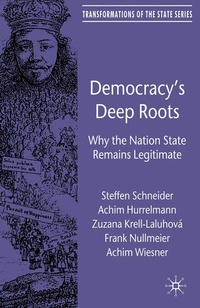
Democracy's Deep Roots
Why the Nation State Remains Legitimate
Published on 9. April 2010
Book
Paperback/Softback
XIV, 253 pages
978-1-349-32021-9 (ISBN)
Description
Does the democratic nation state remain a legitimate regime form in the current age of globalization? This book uses a novel, analytical approach to probe this topical question, drawing on a comparative study of legitimation discourses in the media of four Western democracies (Switzerland, Germany, Britain, and the United States.)
More details
Series
Edition
1st ed. 2010
Language
English
Place of publication
London
United Kingdom
Target group
Professional and scholarly
Illustrations
9 s/w Abbildungen
XIV, 253 p. 9 illus.
Dimensions
Height: 216 mm
Width: 140 mm
Thickness: 15 mm
Weight
342 gr
ISBN-13
978-1-349-32021-9 (9781349320219)
DOI
10.1057/9780230275331
Schweitzer Classification
Other editions
Additional editions
S. Schneider | A. Hurrelmann | Zuzana Krell-Laluhová
Democracy's Deep Roots
Why the Nation State Remains Legitimate
E-Book
12/2015
1st Edition
Palgrave Macmillan
€53.49
Available for download
S. Schneider | A. Hurrelmann | Zuzana Krell-Laluhová
Democracy's Deep Roots
Why the Nation State Remains Legitimate
Book
04/2010
Palgrave Macmillan
€53.49
Shipment within 15-20 days
Persons
ACHIM HURRELMANN is Assistant Professor of Political Science at Carleton University, Ottawa, Canada. His research focuses on democracy and legitimacy in the European Union, multilevel governance, and European integration theory.
ZUZANA KRELL-LALUHOVÁ was a Research Associate at the TranState Research Centre, University of Bremen, Germany, and now works for the European Commission. In her academic research, she focuses on the legitimation of the nation state, with a special emphasis on the new EU member states.
FRANK NULLMEIER is Professor of Political Science at the Centre for Social Policy Research, University of Bremen, Germany. His areas of research include social policy analysis in a sociology-of-knowledge perspective and the micro-analysis of decision-making processes.
STEFFEN SCHNEIDER is a Research Associate at the TranState Research Centre, University of Bremen, Germany. His research focuses on the legitimacy of national and international political orders, on single-party dominance in Western democracies, and on labour market policy-making in advanced industrial economies.
ACHIM WIESNER was a Research Associate at the Centre for Social Policy Research and currently holds an administrative position at the University of Bremen, Germany. His research interests are in the areas of political ethnography, post-secondary education policy and federalism.
ZUZANA KRELL-LALUHOVÁ was a Research Associate at the TranState Research Centre, University of Bremen, Germany, and now works for the European Commission. In her academic research, she focuses on the legitimation of the nation state, with a special emphasis on the new EU member states.
FRANK NULLMEIER is Professor of Political Science at the Centre for Social Policy Research, University of Bremen, Germany. His areas of research include social policy analysis in a sociology-of-knowledge perspective and the micro-analysis of decision-making processes.
STEFFEN SCHNEIDER is a Research Associate at the TranState Research Centre, University of Bremen, Germany. His research focuses on the legitimacy of national and international political orders, on single-party dominance in Western democracies, and on labour market policy-making in advanced industrial economies.
ACHIM WIESNER was a Research Associate at the Centre for Social Policy Research and currently holds an administrative position at the University of Bremen, Germany. His research interests are in the areas of political ethnography, post-secondary education policy and federalism.
Content
Introduction: A Legitimacy Crisis of the Democratic Nation State? The Communicative Dimension of Legitimacy: A Text Analytical Perspective How Stable is the Legitimacy of the Democratic Nation State? How Democratic is the Legitimacy of the Nation State? Re-legitimation Strategies: Countering Threats to the Legitimacy of Political Systems Conclusion: Broadening the Agenda of Legitimacy Research Methodological Appendix