


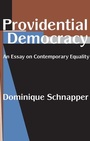
Providential Democracy
An Essay on Contemporary Equality
1st Edition
Published on 31. January 2006
Book
Hardback
248 pages
978-0-7658-0306-1 (ISBN)
Description
Democracy posits the universality of the equality principle: a community of citizens is governed by the principle of the formal equality of all individuals, whatever their real social, cultural, or other inequalities. Democratization, on the other hand, is motivated by the ambition of ensuring the real equality of citizens, and not simply their formal equality. The dynamics of democracy are thus insured by the development of a welfare state that increasingly intervenes in order to satisfy the social and economic needs of individuals. Especially focused on France, yet informed by the experiences of other European countries, this book examines the dilemmas of the search for equality in society and politics.
Democratization guarantees the rights of salaried workers and employees, the rights to material survival and housing, as well as health care, education, and culture. Today, however, as Schnapper observes, its action has become paradoxical. As the fruit of a praiseworthy concern to ensure the universality of rights, what Schnapper identifies as a "Providence State" now aims, by means of positive discrimination and other specific promotion policies, to defend the particular rights of certain categories of individuals. The action of the Providence State thus nourishes an aspiration: that the identities of historical collectivities gathered within the same national society be publicly recognized, and that these have rights. Equity thus supplants equality; and multiculturalism, universality. Such is the ordeal currently experienced by Western democracies, which are faced with the increasingly "providential" nature of their societies. Indeed, the author asks, how can a united political Europe be constructed on the ideals and institutions of citizenship, when European nations are becoming providential democracies?
Providential Democracy offers a searching and timely critique of democratization that will be of interest to sociologists, political scientists, and historians.
Democratization guarantees the rights of salaried workers and employees, the rights to material survival and housing, as well as health care, education, and culture. Today, however, as Schnapper observes, its action has become paradoxical. As the fruit of a praiseworthy concern to ensure the universality of rights, what Schnapper identifies as a "Providence State" now aims, by means of positive discrimination and other specific promotion policies, to defend the particular rights of certain categories of individuals. The action of the Providence State thus nourishes an aspiration: that the identities of historical collectivities gathered within the same national society be publicly recognized, and that these have rights. Equity thus supplants equality; and multiculturalism, universality. Such is the ordeal currently experienced by Western democracies, which are faced with the increasingly "providential" nature of their societies. Indeed, the author asks, how can a united political Europe be constructed on the ideals and institutions of citizenship, when European nations are becoming providential democracies?
Providential Democracy offers a searching and timely critique of democratization that will be of interest to sociologists, political scientists, and historians.
More details
Language
English
Place of publication
Somerset
United Kingdom
Publishing group
Taylor & Francis Inc
Target group
College/higher education
Professional and scholarly
Dimensions
Height: 229 mm
Width: 152 mm
Weight
620 gr
ISBN-13
978-0-7658-0306-1 (9780765803061)
Copyright in bibliographic data and cover images is held by Nielsen Book Services Limited or by the publishers or by their respective licensors: all rights reserved.
Schweitzer Classification
Other editions
Additional editions

E-Book
07/2017
Routledge
€44.99
Available for download

E-Book
07/2017
Routledge
€44.99
Available for download
Book
11/2008
1st Edition
Routledge
€59.60
Shipment within 10-15 days
Person
Dominique Schnapper is professor at the Ecole des Hautes Etudes en Sciences Sociales and a member of the French Constitutional Council. Among her seventeen books are Community of Citizens: On the Modern Idea of Nationality (available from Transaction), The France of Integration, and A Europe of Immigrants. John Taylor is the auuthor of four collections of stories and short prose and Paths to Contemporary French Literature (available from Transaction).
Content
Introduction, 1. The Dynamics of Democracy, 2. An Impatience with Respect to Limits, 3. The Aspiration to Autonomy, 4. The Dialectics of Equality and Authenticity, 5. The End of the "Republic by Divine Right"?, Conclusion: The Erosion of Collective Transcendence, Bibliography, Name Index, Subject Index