

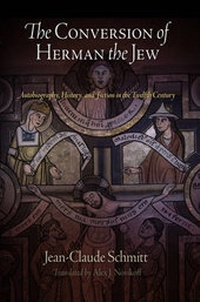
The Conversion of Herman the Jew
Autobiography, History, and Fiction in the Twelfth Century
Published on 15. July 2010
Book
Hardback
320 pages
978-0-8122-4254-6 (ISBN)
Description
Sometime toward the middle of the twelfth century, it is supposed, an otherwise obscure figure, born a Jew in Cologne and later ordained as a priest in Cappenberg in Westphalia, wrote a Latin account of his conversion to Christianity. Known as the Opusculum, this book purportedly by "Herman, the former Jew" may well be the first autobiography to be written in the West after the Confessions of Saint Augustine. It may also be something else entirely.
In The Conversion of Herman the Jew the eminent French historian Jean-Claude Schmitt examines this singular text and the ways in which it has divided its readers. Where some have seen it as an authentic conversion narrative, others have asked whether it is not a complete fabrication forged by Christian clerics. For Schmitt the question is poorly posed. The work is at once true and fictional, and the search for its lone author-whether converted Jew or not-fruitless. Herman may well have existed and contributed to the writing of his life, but the Opusculum is a collective work, perhaps framed to meet a specific institutional agenda.
With agility and erudition, Schmitt examines the text to explore its meaning within the society and culture of its period and its participation in both a Christian and Jewish imaginary. What can it tell us about autobiography and subjectivity, about the function of dreams and the legitimacy of religious images, about individual and collective conversion, and about names and identities? In The Conversion of Herman the Jew Schmitt masterfully seizes upon the debates surrounding the Opusculum (the text of which is newly translated for this volume) to ponder more fundamentally the ways in which historians think and write.
In The Conversion of Herman the Jew the eminent French historian Jean-Claude Schmitt examines this singular text and the ways in which it has divided its readers. Where some have seen it as an authentic conversion narrative, others have asked whether it is not a complete fabrication forged by Christian clerics. For Schmitt the question is poorly posed. The work is at once true and fictional, and the search for its lone author-whether converted Jew or not-fruitless. Herman may well have existed and contributed to the writing of his life, but the Opusculum is a collective work, perhaps framed to meet a specific institutional agenda.
With agility and erudition, Schmitt examines the text to explore its meaning within the society and culture of its period and its participation in both a Christian and Jewish imaginary. What can it tell us about autobiography and subjectivity, about the function of dreams and the legitimacy of religious images, about individual and collective conversion, and about names and identities? In The Conversion of Herman the Jew Schmitt masterfully seizes upon the debates surrounding the Opusculum (the text of which is newly translated for this volume) to ponder more fundamentally the ways in which historians think and write.
Reviews / Votes
"A fascinating reflection on the role of truth in medieval history."-Isabelle Ruef, Le Temps Praise for the French edition:"A captivating reflection on the writing of history, more indispensable now than ever."-Philippe-Jean Catinchi, Le Monde des Livres "An important book that will stimulate historians to reflect anew on how to approach the multilayered realities of the past."-American Historical Review "Schmitt takes us on a delightful journey through some of the topics that have interested medievalists most in recent years, through discussions of medieval autobiography, of dreams and images, and of the meaning of conversion, illuminating the ways in which the Opusculum is a text of its time."-Journal of Religion "Jean-Claude Schmitt demonstrates the fluidity of the line between history and fiction during the Middle Ages."-Sciences humaines et sociales
More details
Series
Language
English
Place of publication
Pennsylvania
United States
Target group
Professional and scholarly
Illustrations
9 illus.
Dimensions
Height: 229 mm
Width: 152 mm
ISBN-13
978-0-8122-4254-6 (9780812242546)
Copyright in bibliographic data and cover images is held by Nielsen Book Services Limited or by the publishers or by their respective licensors: all rights reserved.
Schweitzer Classification
Persons
Jean-Claude Schmitt is Directeur d'Etudes, Ecole des Hautes Etudes en Sciences Sociales. He is the author of many books, including Ghosts in the Middle Ages and The Holy Greyhound. Alex J. Novikoff teaches medieval history at Rhodes College.
Content
Introduction
Chapter 1. Fiction and Truth
Chapter 2. Medieval Autobiography
Chapter 3. The Dream and Its Interpretation
Chapter 4. Conversion to Images
Chapter 5. Baptism and Name
Chapter 6. "A New Era of Conversion"
Conclusion
Extract from the Vita of Godfried, Count of Cappenburg
Herman the Former Jew: Short Work on the Subject of His Conversion
Notes
Index
Chapter 1. Fiction and Truth
Chapter 2. Medieval Autobiography
Chapter 3. The Dream and Its Interpretation
Chapter 4. Conversion to Images
Chapter 5. Baptism and Name
Chapter 6. "A New Era of Conversion"
Conclusion
Extract from the Vita of Godfried, Count of Cappenburg
Herman the Former Jew: Short Work on the Subject of His Conversion
Notes
Index