

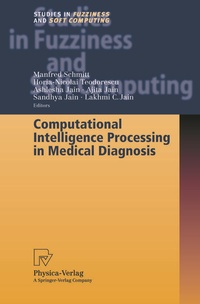
Computational Intelligence Processing in Medical Diagnosis
Published on 21. October 2010
Book
Paperback/Softback
XX, 496 pages
978-3-7908-2509-1 (ISBN)
Description
Computational intelligence techniques are gaining momentum in the medical prognosis and diagnosis. This volume presents advanced applications of machine intelligence in medicine and bio-medical engineering. Applied methods include knowledge bases, expert systems, neural networks, neuro-fuzzy systems, evolvable systems, wavelet transforms, and specific internet applications. The volume is written in view of explaining to the practitioner the fundamental issues related to computational intelligence paradigms and to offer a fast and friendly-managed introduction to the most recent methods based on computer intelligence in medicine.
More details
Series
Edition
Softcover reprint of hardcover 1st ed. 2002
Language
English
Place of publication
Heidelberg
Germany
Target group
Professional and scholarly
Professional/practitioner
Illustrations
XX, 496 p.
Dimensions
Height: 235 mm
Width: 155 mm
Thickness: 28 mm
Weight
779 gr
ISBN-13
978-3-7908-2509-1 (9783790825091)
DOI
10.1007/978-3-7908-1788-1
Schweitzer Classification
Other editions
Additional editions
Manfred Schmitt | Horia-Nicolai Teodorescu | Ashlesha Jain
Computational Intelligence Processing in Medical Diagnosis
Book
03/2002
Physica
€160.49
Shipment within 10-15 days
Content
Introduction.- Computational intelligence techniques in medical decision making: the data mining perspective.- Internet-based decision support for evidence-based medicine.- Integrating kernel methods into a knowledge-based approach to evidence-based medicine.- Case-based reasoning prognosis for temporal courses.- Pattern recognition in intensive care online monitoring.- Artificial neural network models for timely assessment of trauma complication risk.- Artificial neural networks in medical diagnosis.- The application of neural networks in the classification of the electrocardiogram.- Neural network predictions of significant coronary artery stenosis in women.- A modular neural network system for the analysis of nuclei in histopathological sections.- Septic shock diagnosis by neural networks and rule based systems.- Monitoring depth of anesthesia.- Combining evolutionary and fuzzy techniques in medical diagnosis.- Genetic algorithms for feature selection in computer-aided diagnosis.