

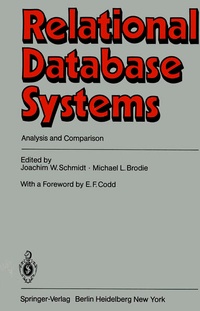
Relational Database Systems
Analysis and Comparison
Published on 10. December 2011
Book
Paperback/Softback
XVI, 620 pages
978-3-642-68849-2 (ISBN)
Description
After a long period of research, development, test and trial, relational database management systems are at last being marketed in force. The feedback from early installations of these systems is overwhelmingly positive. The most frequent comment by users is that productivity has been increased by a significant factor (from 5 to 20 times what it was using previous approaches). Another comment is that, in many cases, end users can now handle their own problems by direct use of the system instead of using application programmers as mediators between them and the system. As the reputation of relational systems for ease of use and enhanced productivity has grown, there has been a strong temptation for vendors of other approaches to exploit the label "relational" somewhat indiscriminately. In some cases the label is being misapplied to a whole data system; in others it is being misapplied to an interface. It is therefore worth developing criteria which database management systems (DBMSs) should have in order to be called "relational". The Relational Task Group (RTG) of the American National Standards Institute (ANSI) undertook such an effort by developing a characterization of RDBMSs and analyzing fourteen DBMSs per this characterization. The result of this work is presented in this book. The conclusions of the RTG are in agreement with my view that a DBMS should not be called "relational" unless it satisfies at least the following conditions: 1. All information in the database is represented as values in tables.
More details
Edition
Softcover reprint of the original 1st ed. 1983
Language
English
Place of publication
Berlin
Germany
Publishing group
Springer Berlin
Target group
Professional and scholarly
Research
Illustrations
XVI, 620 p.
Dimensions
Height: 244 mm
Width: 170 mm
Thickness: 35 mm
Weight
1087 gr
ISBN-13
978-3-642-68849-2 (9783642688492)
DOI
10.1007/978-3-642-68847-8
Schweitzer Classification
Other editions
Additional editions
Book
12/1982
Springer
€117.69
Article exhausted; check different version
Content
1. Introduction.- 2. Features of Relational Database Systems.- 2.1 Development of the Feature Catalogue.- 2.2 The Feature Catalogue.- 3. Analysis of Relational Database Management Systems.- 3.1 ASTRAL (University of Trondheim).- 3.2 IDAMS (IBM Heidelberg).- 3.3 IDM (Britton-Lee).- 3.4 INGRES (University of California, Berkeley).- 3.5 MRDS (Honeywell).- 3.6 MRS (University of Toronto).- 3.7 NOMAD (National CSS, Inc.).- 3.8 ORACLE (Relational Software Incorporated).- 3.9 PASCAL/R (University of Hamburg).- 3.10 PRTV (IBM, United Kingdom).- 3.11 QBE (IBM, Thomas J. Watson).- 3.12 RAPID (Statistics Canada).- 3.13 RAPPORT (LOGICA, United Kingdom).- 3.14 SYSTEM R (IBM, San Jose).- 4. Feature Summaries and Comparisons.- 4.1 Database Constituents.- 4.2 Functional Capabilities.- 4.3 Schema Definitions.- 4.4 Additional Definition, Generation and Administration Facilities.- 4.5 Functional Classes.- 4.6 Interface Flavours.- 4.7 System Architecture.- 4.8 Operational Aspects.- 5. References.