

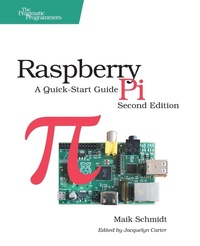
Raspberry Pi 2ed
A Quick-Start Guide
2nd Edition
Published on 12. June 2014
Book
Paperback/Softback
160 pages
978-1-937785-80-2 (ISBN)
Description
Printed in full color.
Most of the book is targeted at beginners in computing and programming. A few parts, such as the small electronics project and setting up a web server, assume some intermediate skills.
The Raspberry Pi is one of the most successful open source hardware projects ever. For less than $40, you get a full-blown PC, a multimedia center, and a web server--and this book gives you everything you need to get started. You'll learn the basics, progress to controlling the Pi, and then build your own electronics projects. This new edition is revised and updated with two new chapters on adding digital and analog sensors, and creating videos and a burglar alarm with the Pi camera.
Get your Raspberry Pi up and running and doing cool stuff. You'll start with the basics: adding hardware, installing and configuring Debian Linux, and customizing the Pi's firmware to get the most out of your hardware.
Then the fun begins. You'll connect the Pi to your home network, surf the web, and tweet messages. You'll learn how to get the most out of Midori, the Pi's standard browser, and control the desktops of other PCs with the Pi. Then you'll explore the Pi's versatility with a series of home projects. Turn it into a web server in your home network; convert the Pi into a powerful multimedia center so you can watch high-definition video and listen to your favorite music; and play classic video games.
Then you'll use the GPIO pins on the Raspberry Pi to build your own electronics projects, such as an "out of memory" alarm. You'll learn how to use digital and analog sensors with the Pi, even though the Pi doesn't have analog input ports! Finally, you'll set up the Pi camera, create your own time-lapse videos, and build an automatic e-mailing burglar alarm. Power to the Pi!
What You Need
You need a Raspberry Pi and several things that you probably already have at home, such as a keyboard, a mouse, a monitor/TV set, and an SD card. To build the electronic projects you need a few cheap parts and the Pi camera.
Most of the book is targeted at beginners in computing and programming. A few parts, such as the small electronics project and setting up a web server, assume some intermediate skills.
The Raspberry Pi is one of the most successful open source hardware projects ever. For less than $40, you get a full-blown PC, a multimedia center, and a web server--and this book gives you everything you need to get started. You'll learn the basics, progress to controlling the Pi, and then build your own electronics projects. This new edition is revised and updated with two new chapters on adding digital and analog sensors, and creating videos and a burglar alarm with the Pi camera.
Get your Raspberry Pi up and running and doing cool stuff. You'll start with the basics: adding hardware, installing and configuring Debian Linux, and customizing the Pi's firmware to get the most out of your hardware.
Then the fun begins. You'll connect the Pi to your home network, surf the web, and tweet messages. You'll learn how to get the most out of Midori, the Pi's standard browser, and control the desktops of other PCs with the Pi. Then you'll explore the Pi's versatility with a series of home projects. Turn it into a web server in your home network; convert the Pi into a powerful multimedia center so you can watch high-definition video and listen to your favorite music; and play classic video games.
Then you'll use the GPIO pins on the Raspberry Pi to build your own electronics projects, such as an "out of memory" alarm. You'll learn how to use digital and analog sensors with the Pi, even though the Pi doesn't have analog input ports! Finally, you'll set up the Pi camera, create your own time-lapse videos, and build an automatic e-mailing burglar alarm. Power to the Pi!
What You Need
You need a Raspberry Pi and several things that you probably already have at home, such as a keyboard, a mouse, a monitor/TV set, and an SD card. To build the electronic projects you need a few cheap parts and the Pi camera.
More details
Edition
2nd edition
Language
English
Place of publication
Raleigh
United States
Product notice
Paperback (trade)
Unsewn / adhesive bound
Dimensions
Height: 233 mm
Width: 189 mm
Thickness: 17 mm
Weight
328 gr
ISBN-13
978-1-937785-80-2 (9781937785802)
Copyright in bibliographic data and cover images is held by Nielsen Book Services Limited or by the publishers or by their respective licensors: all rights reserved.
Schweitzer Classification
Other editions
Additional editions
E-Book
03/2014
Pragmatic Bookshelf
€18.49
Available for download
E-Book
03/2014
Pragmatic Bookshelf
€18.49
Available for download
Previous edition

Book
09/2012
The Pragmatic Programmers
€36.08
Article exhausted; check for reprint
Person
Maik Schmidt has worked as a software developer for nearly 20 years and makes a living creating complex solutions for large enterprises. Outside his day job, he writes book reviews and articles for computer science magazines. He is the author of Arduino: A Quick-Start Guide, Enterprise Recipes with Ruby and Rails, and Enterprise Integration with Ruby for Pragmatic Bookshelf.