

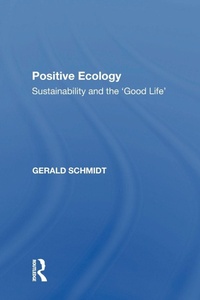
Positive Ecology
Sustainability and the 'Good Life'
1st Edition
Published on 12. October 2020
Book
Paperback/Softback
206 pages
978-1-138-61867-1 (ISBN)
Description
Until recently, there has been a widespread view that we must give up amenities of modern life in order to achieve environmental sustainability. While newspapers and other popular media tend to focus on the negative aspects of environmental change, this volume examines the alternative notion of 'positive ecology'. Initially gleaned from the orientation of 'positive psychology', this argues that environmental science has been all too focused on analysing negative 'pathologies' and forgetting to provide more positive analysis and activism for sustainability. Bringing together a wide range of 'positive ecology' orientated case studies for the first time, the book discusses the wider contexts of how humanity is dependent on a functioning, biodiverse ecosphere of which we are only one part. It provides an original and previously undervalued approach to sustainability, and suggests that work towards sustainability is not only a necessity for our children's future, but necessary, sensible and meaningful in the present.
More details
Language
English
Place of publication
London
United Kingdom
Publishing group
Taylor & Francis Ltd
Target group
College/higher education
Dimensions
Height: 234 mm
Width: 156 mm
Thickness: 11 mm
Weight
324 gr
ISBN-13
978-1-138-61867-1 (9781138618671)
Copyright in bibliographic data and cover images is held by Nielsen Book Services Limited or by the publishers or by their respective licensors: all rights reserved.
Schweitzer Classification
Other editions
Additional editions
E-Book
01/2018
1st Edition
Routledge
€59.49
Available for download
E-Book
01/2018
1st Edition
Routledge
€59.49
Available for download
Book
01/2018
1st Edition
Routledge
€215.77
Shipment within 15-20 days
Content
Contents: Introduction. Contexts and Approaches: A Plurality of Perspectives: The biospheric perspective; Human perspectives; Biospheric dependence; The paradox of the human position; 'Personal' perspectives. Towards a Synthetic Theory: Map and Territory; Evolutionary-ecological exigencies; Anthropological contexts; 'Integration'. Fundamentals of Integration: Basic needs and ecology; Conditions and contexts; Water; Nutrition; Clothing: (not just) temperature regulation; Architecture: temperature regulation and safety; Security and sustainability; Health. Eco-Cultural Integration: Ecology in Culture and 'The Good Life': Rest and arousal; Social needs and the company of nature; Spirituality; Nature, knowledge, and creativity; Sustainability and self-efficacy; Conclusion; Bibliography; Index.