

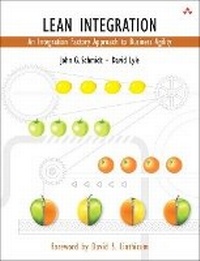
Lean Integration
An Integration Factory Approach to Business Agility
Published on 27. May 2010
Book
Paperback/Softback
464 pages
978-0-321-71231-8 (ISBN)
Description
"Lean Integration is an excellent resource for anyone struggling with the challenges of performing integration for a complex enterprise."
-Steve J. Dennis, Integration Competency Center Director, Nike
Use Lean Techniques to Integrate Enterprise Systems Faster, with Far Less Cost and Risk
By some estimates, 40 percent of IT budgets are devoted to integration. However, most organizations still attack integration on a project-by-project basis, causing unnecessary expense, waste, risk, and delay. They struggle with integration "hairballs": complex point-to-point information exchanges that are expensive to maintain, difficult to change, and unpredictable in operation.
The solution is Lean Integration. This book demonstrates how to use proven "lean" techniques to take control over the entire integration process. John Schmidt and David Lyle show how to establish "integration factories" that leverage the powerful benefits of repeatability and continuous improvement across every integration project you undertake.
Drawing on their immense experience, Schmidt and Lyle bring together best practices; solid management principles; and specific, measurable actions for streamlining integration development and maintenance.
Whether you're an IT manager, project leader, architect, analyst, or developer, this book will help you systematically improve the way you integrate-adding value that is both substantial and sustainable.
Coverage includes
Treating integration as a business strategy and implementing management disciplines that systematically address its people, process, policy, and technology dimensions
Providing maximum business flexibility and supporting rapid change without compromising stability, quality, control, or efficiency
Applying improvements incrementally without "Boiling the Ocean"
Automating processes so you can deliver IT solutions faster-while avoiding the pitfalls of automation
Building in both data and integration quality up front, rather than inspecting quality in later
More than a dozen in-depth case studies that show how real organizations are applying Lean Integration practices and the lessons they've learned
Visit integrationfactory.com for additional resources, including more case studies, best practices, templates, software demos, and reference links, plus a direct connection to lean integration practitioners worldwide.
-Steve J. Dennis, Integration Competency Center Director, Nike
Use Lean Techniques to Integrate Enterprise Systems Faster, with Far Less Cost and Risk
By some estimates, 40 percent of IT budgets are devoted to integration. However, most organizations still attack integration on a project-by-project basis, causing unnecessary expense, waste, risk, and delay. They struggle with integration "hairballs": complex point-to-point information exchanges that are expensive to maintain, difficult to change, and unpredictable in operation.
The solution is Lean Integration. This book demonstrates how to use proven "lean" techniques to take control over the entire integration process. John Schmidt and David Lyle show how to establish "integration factories" that leverage the powerful benefits of repeatability and continuous improvement across every integration project you undertake.
Drawing on their immense experience, Schmidt and Lyle bring together best practices; solid management principles; and specific, measurable actions for streamlining integration development and maintenance.
Whether you're an IT manager, project leader, architect, analyst, or developer, this book will help you systematically improve the way you integrate-adding value that is both substantial and sustainable.
Coverage includes
Treating integration as a business strategy and implementing management disciplines that systematically address its people, process, policy, and technology dimensions
Providing maximum business flexibility and supporting rapid change without compromising stability, quality, control, or efficiency
Applying improvements incrementally without "Boiling the Ocean"
Automating processes so you can deliver IT solutions faster-while avoiding the pitfalls of automation
Building in both data and integration quality up front, rather than inspecting quality in later
More than a dozen in-depth case studies that show how real organizations are applying Lean Integration practices and the lessons they've learned
Visit integrationfactory.com for additional resources, including more case studies, best practices, templates, software demos, and reference links, plus a direct connection to lean integration practitioners worldwide.
Reviews / Votes
"What the authors have set out here is a philosophy built on best practices from both the fields of manufacturing and software development, but they do so with examples that bring the material alive, come from real life, and offer specific, measurable actions and practical alternatives. This work is fantastic, not just from a technical standpoint; it has a maturity that's vacant from other works, an understanding of internal business politics and human resources concerns, all the while wrapped in solid management principles and practices."-Kevin P. Davis, Senior Technical Architect
"Technology is a key enabler within any industry and a key success measure is the 'alignment' between business and information technology. Schmidt and Lyle provide practical advice for a fundamental shift in thinking, from IT as an internal services function to IT as an integral part of a company's strategy, creating value for customers. IT internal and external service providers have to operate as one management team. Lean Integration presents compelling examples of how integration teams play a role in leadership, strategic planning, and IT governance as some of the critical factors in achieving organizational alignment."
-Zahid Afzal, Executive Vice President/Chief Information Officer, Huntington National Bank
"In today's world, enterprises struggle with increasing global competition, the need for speed to market, and the ability for IT to enable the strategic intent of the business. One of the core tenets of lean that many integration professionals lose sight of is the need to put the customer first. This book serves as a reminder to our fiduciary responsibility to leverage IT as a competitive tool for planning and execution."
-James McGovern, Enterprise Architect, The Hartford
"This book should help the IT executive and practitioner, alike, align on goals and objectives that drive long-term value to their enterprise. The Integration Competency Center can drive as much or more value for the IT department than any other capital investment it will make in the next decade."
-Clark T. Becker, Former SVP and CTO, Best Buy Co., Inc.
"In this highly communicative world, one filled with a high degree of turbulence and uncertainty, the one key that will separate successful businesses from the rest is their ability to be agile and wield just-in-time, focused, trustworthy information. I am extremely pleased to see that John and David have written on such an important topic."
-Mark Albala, President, InfoSight Partners, LLC
"John Schmidt and David Lyle have written an important book with a new perspective on lean thinking in the software development world. This is a must-read for leaders in all functional areas."
-Arthur V. Hill, Lindahl Professor and Professor of Operations and Management Science, Carlson School of Management, University of Minnesota
"At OMG we have always believed that integration, repeatable processes and methodology, and high-quality, widely available standards were the missing links in the software world. Given the huge number of lessons to learn from other engineering and management sciences, it's natural to apply the lessons of lean manufacturing to software production. John Schmidt has recognized the challenges and fought to integrate hard-won knowledge from other disciplines, and this book is a great example of what solid, clear, everyday lessons we can learn to make our organizations agile and innovative. Bravo!"
-Richard Mark Soley, Chairman and CEO, Object Management Group, Inc.
"Lean Integration is invaluable to any business that relies on technological integration with its customers to expand. This book utilizes lean manufacturing principles to create successful software development projects in a replicable and measurable approach. By successful projects, I mean high quality, quick to production, maintainable for the long term, and under budget for both implementation and ongoing support. As an executive and a Six Sigma Black Belt of an expanding business process outsourcing company that relies on the integration of disparate customer systems for its growth and success, I believe the lean approach outlined in this book is the roadmap to follow."
-Howard L. Latham, Executive Vice President, API Outsourcing, Inc.
"Lean Integration is an excellent resource for anyone struggling with the challenges of performing integration for a complex enterprise. The authors have combined their experience to provide a practical roadmap for applying lean principles to the integration problem. If you are looking for an approach to tackle the integration chaos that exists in your environment, this book should be at the top of your reading list."
-Steve J. Dennis, Integration Competency Center Director, Nike
"As costs of raw technology decline, superior practice will dominate IT value. Increasingly, it's not enough to be clever: it's essential to be efficient, and that's what John Schmidt and David Lyle will help IT practitioners do with their new book, Lean Integration. Point-to-point connections grow with (roughly) the square of the number of connected things, but Schmidt and Lyle offer a better way. Rising above the spaghetti bowl to treat integration as a scalable process, they make it practical for enterprise IT to make the most of complementary services in the cloud-promising the attentive reader huge improvements in IT economics."
-Peter Coffee, Director of Platform Research, Salesforce.com, Inc.
"Lean Integration is a practical discovery not an invention. For this reason everyone will eventually be doing it."
-Erwin Dral, Principal Product Manager, Informatica
"John Schmidt and David Lyle's new book, Lean Integration: An Integration Factory Approach to Business Agility, is bound to shake up the software development industry. The authors show how to reduce costs and risks of software by applying lean management principles that force developers to focus on real customer/knowledge worker requirements to design quality into software the first time, from requirements definition to implementation and production operations. This is required reading for all information systems personnel who want to be on the cutting edge of quality management applied to software and systems engineering."
-Larry P. English, author, Information Quality Applied: Best Practices for Business Information, Processes and Systems
More details
Other editions
Additional editions
E-Book
05/2010
1st Edition
Addison Wesley
€36.99
Available for download
Persons
John G. Schmidt, Vice President of Global Integration Services at Informatica, advises clients on emerging technologies, develops strategies for enterprise initiatives, and directs the company's Integration Competency Center Practice.
David Lyle, Vice President of Product Strategy at Informatica, uses his years of experience in data warehousing, migration, and MDM to advise clients on successful ICC approaches, as well as guide Informatica's product direction.
David Lyle, Vice President of Product Strategy at Informatica, uses his years of experience in data warehousing, migration, and MDM to advise clients on successful ICC approaches, as well as guide Informatica's product direction.
Content
List of Figures and Tables xv
Foreword xix
Preface xxiii
Acknowledgments xxvii
About the Authors xxix
Introduction xxxi
Part I: Executive Summary 1
Chapter 1: What Is Lean Integration and Why Is It Important? 3
Constant Rapid Change and Organizational Agility 5
The Case for Lean Integration 9
What Is Integration? 11
Integration Maturity Levels 14
Economies of Scale (the Integration Market) 16
Getting Started: Incremental Implementation without "Boiling the Ocean" 20
Chapter 2: A Brief History of Lean 23
The Lean System 29
The Lean Practices 34
Lean Application Trends 41
Case Study: The Value of Lean in Service Industries 44
Chapter 3: The Integration Factory 45
What Is an Integration Factory? 46
The Integration Factory as an Element of an ICC 52
How Does the Integration Factory Work? 55
Integration Factories as Self-Service ICCs 64
Part II: Applying Lean Principles 67
Chapter 4: Focus on the Customer and Eliminate Waste 69
Focus on the Customer 70
Integration Wastes 74
Case Study: Waste Elimination at Clicks-and-Bricks 81
Case Study: Waste Elimination at Big Bank 85
Focus on the Integration Value Chain 87
Chapter 5: Continuously Improve 89
Continuous Learning and Knowledge Management 90
Case Study: Continuous Improvement at Clicks-and-Bricks 91
Chapter 6: Empower the Team 103
What Is a Team? 104
Examples of Empowered Teams in Software 107
Creating an Empowered Lean Integration Team 109
Leadership and Vision 112
Important Practices That Help Enable Empowered Teams 117
Organizing the Team: Thoughts on Organizational Structures 120
Case Study: Smith & Nephew-Integrating Lean Principles with Data Quality 122
Chapter 7: Optimize the Whole 131
Optimize the Whole Rather than Optimize the Parts 132
What Is "the Whole"? An Introduction to Value Stream Mapping 134
Selecting Metrics to Optimize the Whole 139
Chapter 8: Plan for Change and Mass-Customize 145
Techniques for Enabling Constant Change 146
Mass Customization 152
Case Study: Using Mass Customization 159
Chapter 9: Automate Processes and Deliver Fast 163
Pitfalls of Automation-Building "Stuff" Faster 164
Delivering Fast 167
Automating Processes-Using the Computer to Make Complexity Manageable 169
Case Study: Automating Processes at Wells Fargo Home Mortgage 174
Chapter 10: Build Quality In 181
Two Areas of Quality: Data Quality and Integration Quality 182
Quality Evolution and Lean 184
Data Quality 185
Integration Quality 192
Case Study: Building Quality In at a Utility Company ICC 198
Part III: Implementation Practices 203
Chapter 11: Financial Management 205
Challenges 207
Activities 214
Business Case Development 215
Case Study: A "Creating the Wave" Investment Strategy 236
Case Study: Enterprise Data Warehouse Rationalization Business Case 238
Chargeback Accounting 240
Chargeback Case Studies 250
Chapter 12: Integration Methodology 253
Activities 256
Agile versus Lean Methodology 263
Case Study in Simplicity: The Architecture of the Web and REST versus SOA 269
Engagement Services Management 271
Case Study: Integration Methodology in a Decentralized Enterprise 274
Chapter 13: Metadata Management 281
Metadata Scope for Lean Integration 284
Metadata Management Framework 285
Challenges 289
Prerequisites 292
Industry Practices 293
Activities 295
Chapter 14: Information Architecture 301
Challenges 304
Prerequisites 308
Activities 309
Methodology 310
Information Architecture Models 312
Data at Rest 317
Chapter 15: Business Process Management 321
Data-in-Motion Models 324
Activities 326
Architecture 328
Case Study: The Post Closing Systems Architecture 330
Chapter 16: Modeling Management 333
Service-Oriented Architecture Can Create a New Hairball 336
Challenges 339
Coupling and Cohesion Framework 343
Canonical Modeling Techniques 345
Navigating the Modeling Layers 350
Activities 352
Case Study: European Interoperability Framework 357
Case Study: Object-Relational Mismatch 359
Chapter 17: Integration Systems 361
What Is an Integration System? 362
Integration Systems Taxonomy 364
Challenges 369
Industry Practices 370
Activities 371
Portfolio Rationalization 378
Appendix A: Lean Terminology 387
Appendix B: Integration Laws 395
Law #1: The Whole Is Greater than the Sum of Its Parts 395
Law #2: There Is No End State 396
Law #3: There Are No Universal Standards 396
Law #4: Information Adapts to Meet Local Needs 397
Law #5: All Details Are Relevant 397
Appendix C: Glossary 399
Common Acronyms 399
Definitions 400
Index 409
Foreword xix
Preface xxiii
Acknowledgments xxvii
About the Authors xxix
Introduction xxxi
Part I: Executive Summary 1
Chapter 1: What Is Lean Integration and Why Is It Important? 3
Constant Rapid Change and Organizational Agility 5
The Case for Lean Integration 9
What Is Integration? 11
Integration Maturity Levels 14
Economies of Scale (the Integration Market) 16
Getting Started: Incremental Implementation without "Boiling the Ocean" 20
Chapter 2: A Brief History of Lean 23
The Lean System 29
The Lean Practices 34
Lean Application Trends 41
Case Study: The Value of Lean in Service Industries 44
Chapter 3: The Integration Factory 45
What Is an Integration Factory? 46
The Integration Factory as an Element of an ICC 52
How Does the Integration Factory Work? 55
Integration Factories as Self-Service ICCs 64
Part II: Applying Lean Principles 67
Chapter 4: Focus on the Customer and Eliminate Waste 69
Focus on the Customer 70
Integration Wastes 74
Case Study: Waste Elimination at Clicks-and-Bricks 81
Case Study: Waste Elimination at Big Bank 85
Focus on the Integration Value Chain 87
Chapter 5: Continuously Improve 89
Continuous Learning and Knowledge Management 90
Case Study: Continuous Improvement at Clicks-and-Bricks 91
Chapter 6: Empower the Team 103
What Is a Team? 104
Examples of Empowered Teams in Software 107
Creating an Empowered Lean Integration Team 109
Leadership and Vision 112
Important Practices That Help Enable Empowered Teams 117
Organizing the Team: Thoughts on Organizational Structures 120
Case Study: Smith & Nephew-Integrating Lean Principles with Data Quality 122
Chapter 7: Optimize the Whole 131
Optimize the Whole Rather than Optimize the Parts 132
What Is "the Whole"? An Introduction to Value Stream Mapping 134
Selecting Metrics to Optimize the Whole 139
Chapter 8: Plan for Change and Mass-Customize 145
Techniques for Enabling Constant Change 146
Mass Customization 152
Case Study: Using Mass Customization 159
Chapter 9: Automate Processes and Deliver Fast 163
Pitfalls of Automation-Building "Stuff" Faster 164
Delivering Fast 167
Automating Processes-Using the Computer to Make Complexity Manageable 169
Case Study: Automating Processes at Wells Fargo Home Mortgage 174
Chapter 10: Build Quality In 181
Two Areas of Quality: Data Quality and Integration Quality 182
Quality Evolution and Lean 184
Data Quality 185
Integration Quality 192
Case Study: Building Quality In at a Utility Company ICC 198
Part III: Implementation Practices 203
Chapter 11: Financial Management 205
Challenges 207
Activities 214
Business Case Development 215
Case Study: A "Creating the Wave" Investment Strategy 236
Case Study: Enterprise Data Warehouse Rationalization Business Case 238
Chargeback Accounting 240
Chargeback Case Studies 250
Chapter 12: Integration Methodology 253
Activities 256
Agile versus Lean Methodology 263
Case Study in Simplicity: The Architecture of the Web and REST versus SOA 269
Engagement Services Management 271
Case Study: Integration Methodology in a Decentralized Enterprise 274
Chapter 13: Metadata Management 281
Metadata Scope for Lean Integration 284
Metadata Management Framework 285
Challenges 289
Prerequisites 292
Industry Practices 293
Activities 295
Chapter 14: Information Architecture 301
Challenges 304
Prerequisites 308
Activities 309
Methodology 310
Information Architecture Models 312
Data at Rest 317
Chapter 15: Business Process Management 321
Data-in-Motion Models 324
Activities 326
Architecture 328
Case Study: The Post Closing Systems Architecture 330
Chapter 16: Modeling Management 333
Service-Oriented Architecture Can Create a New Hairball 336
Challenges 339
Coupling and Cohesion Framework 343
Canonical Modeling Techniques 345
Navigating the Modeling Layers 350
Activities 352
Case Study: European Interoperability Framework 357
Case Study: Object-Relational Mismatch 359
Chapter 17: Integration Systems 361
What Is an Integration System? 362
Integration Systems Taxonomy 364
Challenges 369
Industry Practices 370
Activities 371
Portfolio Rationalization 378
Appendix A: Lean Terminology 387
Appendix B: Integration Laws 395
Law #1: The Whole Is Greater than the Sum of Its Parts 395
Law #2: There Is No End State 396
Law #3: There Are No Universal Standards 396
Law #4: Information Adapts to Meet Local Needs 397
Law #5: All Details Are Relevant 397
Appendix C: Glossary 399
Common Acronyms 399
Definitions 400
Index 409