

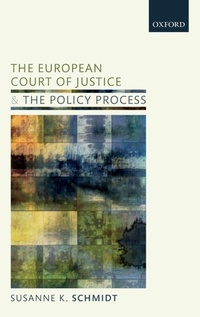
The European Court of Justice and the Policy Process
The Shadow of Case Law
Published on 25. January 2018
Book
Hardback
320 pages
978-0-19-871777-5 (ISBN)
Description
This is an open access title available under the terms of a CC BY-NC-ND 4.0 International licence. It is free to read at Oxford Scholarship Online and offered as a free PDF download from OUP and selected open access locations.
The European Court of Justice is one of the most important actors in the process of European integration. Political science still struggles to understand its significance, with recent scholarship emphasizing how closely rulings reflect member states' preferences. This book argues that the implications of the supremacy and direct effect of the EU Treaty have still been overlooked. As it constitutionalizes an intergovernmental treaty, the European Union has a detailed set of policies inscribed into its constitution that are extensively shaped by the Court's case law. If rulings have constitutional status, their impact will be considerable, even if the Court only occasionally diverts from member states' preferences.
By focusing on the four freedoms of goods, services, persons, and capital, as well as citizenship rights, the book analyses how the Court's development of case law has ascribed a broad meaning to these freedoms. The constitutional status of this case law constrains policymaking at the European and member-state levels. Different case studies show how major pieces of EU legislation partly codify case law. Judicialization is important in the EU. It also directly constrains member-state policies. Court rulings oriented towards individual disputes are difficult to translate into general policies-but if they have constitutional status they have to go through this process. Policy options are thereby withdrawn from majoritarian decision-making. As the Court cannot be overruled, short of a Treaty change, its case law casts a long shadow over policymaking in the European Union, undermining the legitimacy of this political order.
The European Court of Justice is one of the most important actors in the process of European integration. Political science still struggles to understand its significance, with recent scholarship emphasizing how closely rulings reflect member states' preferences. This book argues that the implications of the supremacy and direct effect of the EU Treaty have still been overlooked. As it constitutionalizes an intergovernmental treaty, the European Union has a detailed set of policies inscribed into its constitution that are extensively shaped by the Court's case law. If rulings have constitutional status, their impact will be considerable, even if the Court only occasionally diverts from member states' preferences.
By focusing on the four freedoms of goods, services, persons, and capital, as well as citizenship rights, the book analyses how the Court's development of case law has ascribed a broad meaning to these freedoms. The constitutional status of this case law constrains policymaking at the European and member-state levels. Different case studies show how major pieces of EU legislation partly codify case law. Judicialization is important in the EU. It also directly constrains member-state policies. Court rulings oriented towards individual disputes are difficult to translate into general policies-but if they have constitutional status they have to go through this process. Policy options are thereby withdrawn from majoritarian decision-making. As the Court cannot be overruled, short of a Treaty change, its case law casts a long shadow over policymaking in the European Union, undermining the legitimacy of this political order.
Reviews / Votes
Professor Schmidt uses several case studies to provide a detailed analysis of a number of major ECJ decisions bearing upon the rights of individuals and the binding constraints placed on national courts which, she suggests, must have been one of the factors that drove the British exit from the Union. She is not wrong. When the inevitable obituary of the EU comes to be written, this volume will be an important source in determining the cause of death! * JOURNAL OF CONTEMPORARY EUROPEAN STUDIES * ...hers is a timely text which merits close reading and reflection and is recommended to scholars of EU law and political science. * JCMS: Journal of Common Market Studies * ....Schmidt's book presents a welcome addition to the existing corpus of literature devoted to the ECJ and will undoubtedly become mandatory reading for those seeking to understand, challenge or endorse the vision of this institution as the motor of European integration. * Common Market Law Review * Considered in its entirety, Schmidt's book is an ambitious effort to redirect the debate on European legal integration, whose title ideally would have broadcast the perils of over-constitutionalization. It is an outstanding contribution that demands the attention of scholars and practitioners alike. * Public Adminstration * Finally, Susanne Schmidt's opus magnum! Representing the sum of more than two decades of widely recognized research and publications, it combines a definitive account of the judicial shaping of a European economic constitution and its impact on diverse fields of national economic and social policy with sophisticated analyses of the methodological foundations and political limits of its legitimacy. Essential reading. * Fritz W. Scharpf, Emeritus Director, Max Planck Institute for the Study of Societies. * This is a brilliant and original analysis of a much neglected aspect of the interaction between politics and law. Susanne Schmidt compellingly demonstrates how ECJ case law sets limits to how political actors can shape European policies. It is a 'mustread' for all studying and practicing politics. * Adrienne Heritier, Emeritus Professor, European University Institute. *More details
Language
English
Place of publication
Oxford
United Kingdom
Target group
Professional and scholarly
Dimensions
Height: 240 mm
Width: 161 mm
Thickness: 21 mm
Weight
634 gr
ISBN-13
978-0-19-871777-5 (9780198717775)
Copyright in bibliographic data and cover images is held by Nielsen Book Services Limited or by the publishers or by their respective licensors: all rights reserved.
Schweitzer Classification
Other editions
Additional editions

E-Book
01/2018
1st Edition
OUP eBook
€56.49
Available for download

E-Book
01/2018
1st Edition
OUP eBook
€0.00
Available for download
Person
Susanne K. Schmidt is Professor of Political Science at the University of Bremen. She has published widely on questions of European integration, including the role of the Commission, competition and liberalization policies in the EU, and mutual recognition as a new mode of governance. The policy implications of the European Court of Justice's case law at the European and national levels are the current focus of her research. Her work has appeared in journals such as the Journal of Public Policy, the Journal of European Public Policy, West European Politics, European Union Politics, the Journal of Comparative Policy Analysis, Public Administration, and German Politics. Her publications include The Power of the European Court of Justice (co-authored with R. Daniel Kelemen, Routledge, 2013) and Mutual Recognition as a New Mode of Governance (Routledge, 2008).
Content
1: Introduction
2: The European Court of Justice as a Political Actor
3: Case-Law Development between Path Dependence and Legal Uncertainty
4: The Interaction of Judicial and Legislative Policymaking
5: Reaching Beyond the Market into State Responsibilities
6: Europeanization With and Against the Odds: The Cases of Meilicke and Zambrano
7: The Europeanization Effects of Case Law
8: Conclusion
2: The European Court of Justice as a Political Actor
3: Case-Law Development between Path Dependence and Legal Uncertainty
4: The Interaction of Judicial and Legislative Policymaking
5: Reaching Beyond the Market into State Responsibilities
6: Europeanization With and Against the Odds: The Cases of Meilicke and Zambrano
7: The Europeanization Effects of Case Law
8: Conclusion