

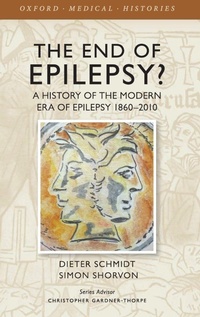
The End of Epilepsy?
A history of the modern era of epilepsy research 1860-2010
Published on 8. September 2016
Book
Hardback
200 pages
978-0-19-872590-9 (ISBN)
Description
Epilepsy is more than just a physical condition, the fact of simply having epileptic seizures, it has cultural, geographic and historical meaning and significance which go beyond that of a neurological disorder, and which defy a single perspective. The End of Epilepsy? is a beautifully illustrated, authoritative, and engaging history of medical developments during the modern era of epilepsy, which began with the introduction of Bromides and Hughlings-Jacksons definition of epilepsy in 1860.
This thought-provoking book comprehensively covers the definitions of and the attitudes to epilepsy over the past 150 years, and describes the bureaucracies surrounding the condition. It explores the technological advances, and the different management techniques, with antiepileptic drugs and surgery, which have been applied to epilepsy up to the present day.
After presenting an overview both of the advances and improvements made, and also of the dark side which has cast shadows over medical and social progress, the authors then critically examine on-going research into new treatments for epilepsy, and provide an insight into the complex underpinnings of scientific and medical practice. They look forward to a time when the condition will no longer be, as Temkin put it, a paradigm of the suffering of both body and soul in disease.
This thought-provoking book comprehensively covers the definitions of and the attitudes to epilepsy over the past 150 years, and describes the bureaucracies surrounding the condition. It explores the technological advances, and the different management techniques, with antiepileptic drugs and surgery, which have been applied to epilepsy up to the present day.
After presenting an overview both of the advances and improvements made, and also of the dark side which has cast shadows over medical and social progress, the authors then critically examine on-going research into new treatments for epilepsy, and provide an insight into the complex underpinnings of scientific and medical practice. They look forward to a time when the condition will no longer be, as Temkin put it, a paradigm of the suffering of both body and soul in disease.
More details
Series
Language
English
Place of publication
Oxford
United Kingdom
Target group
Professional and scholarly
Dimensions
Height: 240 mm
Width: 161 mm
Thickness: 16 mm
Weight
476 gr
ISBN-13
978-0-19-872590-9 (9780198725909)
Copyright in bibliographic data and cover images is held by Nielsen Book Services Limited or by the publishers or by their respective licensors: all rights reserved.
Schweitzer Classification
Other editions
Additional editions
Dieter Schmidt | Simon Shorvon
The End of Epilepsy?
A history of the modern era of epilepsy research 1860-2010
E-Book
09/2016
1st Edition
OUP eBook
€48.49
Available for download
Dieter Schmidt | Simon Shorvon
The End of Epilepsy?
A history of the modern era of epilepsy research 1860-2010
E-Book
08/2016
1st Edition
OUP eBook
€48.49
Available for download
Persons
Dieter Schmidt is a medical academic who specialised in the field of epilepsy, has run a university hospital with a special large clinical epilepsy service and has carried out extensive clinical research. He has held the position of Chair of the Department of Clinical Neurology at Charite Clinic, Humboldt University, Berlin, previously Free University of Berlin. He currently is founding Co-Editor-in-Chief of Epilepsia Open, an official journal of the International League Against Epilepsy (ILAE). He has received several awards, including the 1983 Ambassador award of the ILAE, the Hauptmann Award of the German League of ILAE, and is honorary member of the Mexican League of ILAE. He has published extensively in the field of epilepsy.
Simon Shorvon is a medical academic who specialised in the field of epilepsy, has run a large clinical epilepsy service and has carried out extensive clinical research. He has held the position of Chair of the Department of Clinical Neurology at UC, and Medical Directorship of the National Society for Epilepsy. He served on the international executive committee of the International League Against Epilepsy (ILAE) for 20 years, and held the positions of ILAE Vice-President, co-Editor-in-Chief of EPILEPSIA and President of ILAE British Branch. He has received a number of awards, including 2008 European Epileptology Award and 2010 Lennox Prize of the American Epilepsy Society, and 2016 Lifetime Achievement Award of the ILAE British Branch. He has published extensively in the field of epilepsy.
Simon Shorvon is a medical academic who specialised in the field of epilepsy, has run a large clinical epilepsy service and has carried out extensive clinical research. He has held the position of Chair of the Department of Clinical Neurology at UC, and Medical Directorship of the National Society for Epilepsy. He served on the international executive committee of the International League Against Epilepsy (ILAE) for 20 years, and held the positions of ILAE Vice-President, co-Editor-in-Chief of EPILEPSIA and President of ILAE British Branch. He has received a number of awards, including 2008 European Epileptology Award and 2010 Lennox Prize of the American Epilepsy Society, and 2016 Lifetime Achievement Award of the ILAE British Branch. He has published extensively in the field of epilepsy.
Author
Emeritus Profess of Neurology; and Head of Epilepsy Research Group BerlinEmeritus Profess of Neurology; and Head of Epilepsy Research Group Berlin, Humboldt University Berlin; and Epilepsy Research Group Berlin
Emeritus Profess of Neurology and Consultant NeurologistEmeritus Profess of Neurology and Consultant Neurologist, Institute of Neurology, University College London; and National Hospital for Neurology and Neurosurgery, London
Content
APPENDIX 1: DATING EPILEPSY; INDEX